Definition
When the heart contracts it squeezes its own vessels, so the left ventricle is fed mainly in diastole, while right coronary flow, though smaller, continues in systole. Skin blood flow serves body temperature, not the skin's own needs. In exercise hairy skin widens through sympathetic nerves releasing acetylcholine, and in the heat wide skin vessels can cause fainting or heat exhaustion.
1. Coronary supply
Two coronary arteries leave the base of the aorta. The right coronary artery supplies the right ventricle, part of the septum (the wall between the ventricles) and the back wall of the left ventricle. The left coronary artery supplies the rest; its main branch, the left anterior descending (LAD) artery, supplies part of the septum. Cardiac veins drain via the coronary sinus into the right atrium.
Heart muscle removes 70 to 80% of the O2 from its blood, while most tissues remove about a quarter. So the heart can get more O2 only by increasing its blood flow, which rises up to fourfold in hard exercise.
2. Coronary flow through the cardiac cycle
The heart’s own vessels run through a wall that squeezes them with every beat (The Cardiac Cycle – Phases, Pressures, Volumes and Heart Sounds). Two forces therefore set coronary flow. The first is aortic pressure, the blood pressure inside the aorta, which pushes blood into the coronary arteries because they branch off its base. It peaks at about 120 mmHg in systole and falls to about 80 mmHg by the end of diastole, never to zero, because the stretched aorta recoils. The second is the contracting wall, which presses the vessels shut. This squeeze, called intramural myocardial pressure, is the stronger force.
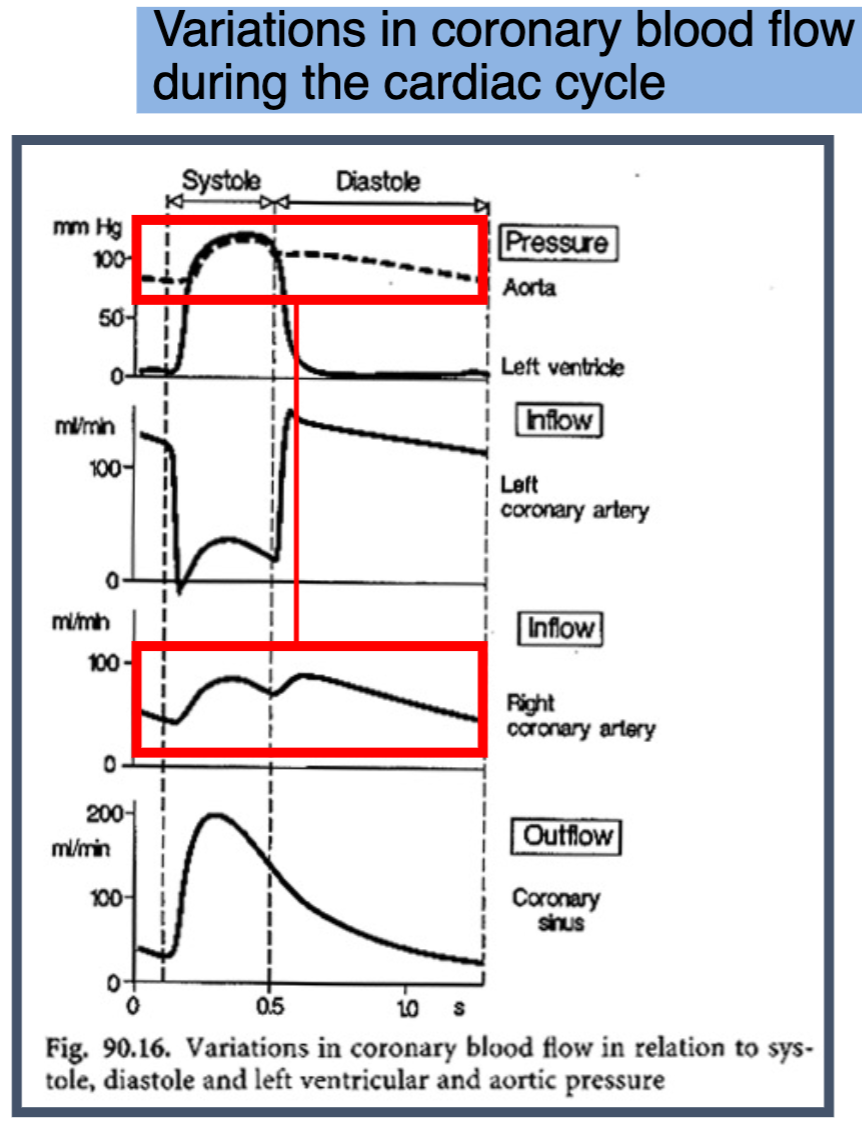
The figure follows one heartbeat, left to right: aortic (dashed) and left ventricular (solid) pressure on top, then left and right coronary inflow. In the left ventricle, three things happen:
- As contraction starts (early systole), the wall squeezes hardest, especially its inner layer (sub-endocardium), while aortic pressure is at its lowest. Inflow stops completely.
- Through the rest of systole, aortic pressure rises and a little blood gets in, but flow stays low.
- When the muscle relaxes (diastole), the vessels reopen and blood rushes in, so the left ventricle is fed mainly in diastole.
The right ventricle squeezes far less, so its flow never stops; it just follows aortic pressure (red line) and is smaller than left flow, having less muscle to feed.
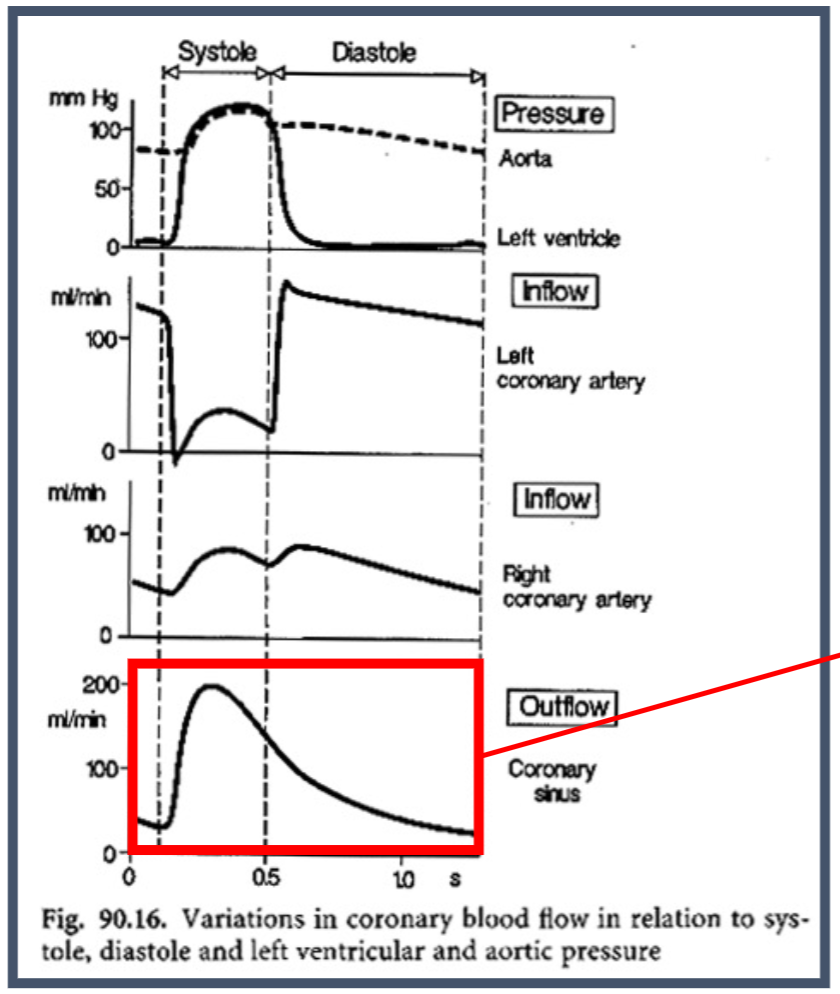
The veins show the mirror image (boxed bottom trace): the squeeze wrings blood out of them, so coronary sinus outflow surges in systole and falls in diastole.
Flow keeps up with demand in three steps:
- The heart beats faster and harder, using more O2.
- The working muscle releases chemicals, especially adenosine, and runs short of O2 (hypoxia).
- Both widen the coronary arterioles and let more blood in. This is metabolic vasodilation (Vascular Resistance – Pressure Profile, Radius and Control of Arterioles).
Sympathetic nerves do not dilate the coronary arteries directly; they only trigger step 1.
Because the left ventricle is fed in diastole, a fast heart rate (less time in diastole) or a low diastolic pressure (a weaker push, common in old age) cuts its supply. The resulting ischaemia, too little blood for the muscle’s needs, can trigger arrhythmias (Arrhythmias – Sinus Arrhythmia, AV Block, Ectopic Beats and Fibrillation).
3. Skin blood flow is for temperature, not metabolism
Skin is different: its blood flow serves mainly temperature control. Its outer layer, the epidermis, has no blood vessels; the dermis below has many.
In muscle, gut, liver and brain, blood flow follows O2 use, but not in skin, which needs little O2. Instead, temperature sets skin flow, which can vary more than 100-fold: from 1 at minimum, through 10 to 20 normally, to 150 to 200 mL/min per 100 g at maximum. So a rise in skin flow as the body warms is temperature control, not autoregulation (an organ holding its own flow steady when blood pressure changes).
The goal is to keep the core (brain, chest and abdominal organs) at 37.0 to 37.5 °C, with the skin losing heat as fast as the core makes it. Unclothed, a person needs no extra effort to stay warm or cool in air at 27 to 28 °C, with skin at about 33 °C. Blood carries heat to the skin, which loses it in three ways:
- In radiation, skin gives off heat in proportion to how much warmer it is than its surroundings.
- In conduction-convection, skin warms the air touching it, and air currents carry that air away.
- In evaporation of sweat, water absorbs heat as it becomes vapour (latent heat of evaporation), cooling the skin; blood brings both the water and the heat.
4. Two routes through the skin
Blood can cross the skin by two routes.
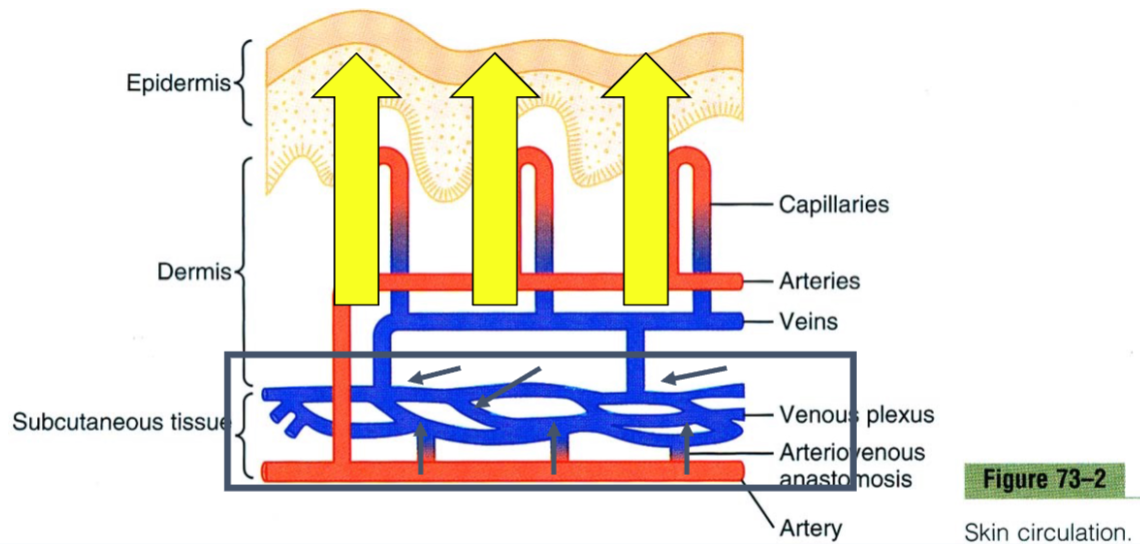
The figure is a slice of skin, with arterial blood red and venous blood blue. In the nutritive (feeding) route, blood flows from an artery in the dermis through arterioles, which control resistance, into capillaries, which exchange gases, nutrients and wastes (the loops under the epidermis), and out through venules and a vein. In the thermoregulatory route (boxed), short-cuts called arteriovenous anastomoses (AVAs) send blood from arterioles straight into the venous plexus, skipping the capillaries. This network of veins holds a large volume of blood and passes its heat up to the surface (yellow arrows).
Skin comes in two kinds:
| Glabrous skin (smooth, hairless) | Non-glabrous skin (hairy) | |
|---|---|---|
| Where | Fingers, toes, palms, soles, lips, nose, outer ear: exposed parts with a large surface for their size | Trunk, limbs, scalp |
| AVAs | Many; coiled and muscular-walled, so they can open and close | Some, but far fewer |
| Heat handling | Loses or keeps heat by radiation and conduction-convection | Many sweat glands: sweats to lose heat by evaporation and conduction-convection |
Sweat glands deliver up to 30 g/min, and the maximum sweat rate is about 2 to 4 L/h.
5. Heat, cold and exercise
Outside heat and cold act directly on skin vessels, especially the AVAs of glabrous skin. Heat widens arterioles, venules and small veins, filling the skin with oxygen-rich blood, so more heat is lost and the face flushes. Cold narrows them, leaving the skin pale and painful.
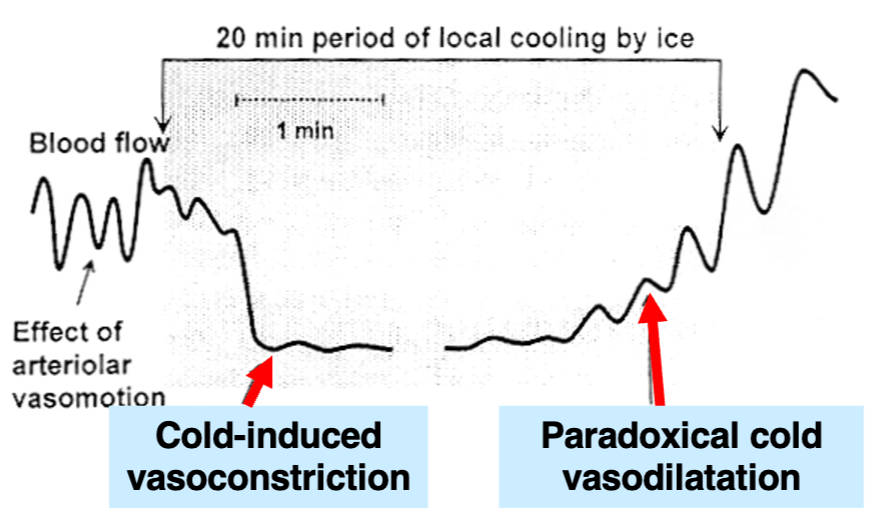
The trace shows glabrous skin flow during 20 minutes of ice cooling, between the two arrows. Flow first drops: cold-induced vasoconstriction. Later it rises again in waves: paradoxical cold vasodilation, which flushes the skin, eases pain and prevents cold injury. If the cold persists, narrowing returns.
Cold has two further effects. In extreme cold, skin flow can fall to 1 mL/min per 100 g, leaving the fat under the skin to insulate the core. Cold on the face also narrows skin and limb vessels, straining the heart, so heart attacks are commoner in cold weather.
In exercise, nerves adjust skin flow. The sympathetic nervous system (SNS) first narrows skin vessels. As core temperature rises, warmth receptors in the hypothalamus, which is linked to the cardiovascular centre in the brainstem, switch this to widening. Hairy skin widens actively, by sympathetic cholinergic vasodilation: its sympathetic nerves release acetylcholine (ACh), helped by nitric oxide (NO), and sweating rises too. Glabrous skin widens passively: its sympathetic nerves fire less, so its AVAs relax. This is unusual: elsewhere sympathetic nerves narrow vessels with noradrenaline, but here they widen them with ACh.
6. When skin vasodilation lowers blood pressure
Wide skin vessels lower blood pressure, because MAP = CO x TPR: mean arterial pressure equals cardiac output times total peripheral resistance (Circulation Overview – Circuits, Vessels and the MAP Equation). In a soldier standing at attention in the heat, skin vasodilation causes a large fall in TPR. Blood also pools in the skin and legs, so central venous pressure, the pressure of blood returning to the heart, falls. The heart fills less and, by the Frank-Starling mechanism (Pressure–Volume Loop, Starling’s Law and Contractility), pumps less. With CO and TPR both down, MAP drops and the soldier faints, despite the baroreflex trying to restore it (Arterial Blood Pressure – Measurement, Normal Values and the Baroreflex).
Heavy exercise in the heat causes heat exhaustion the same way. Skin and muscle vasodilation both lower TPR, while sweating shrinks plasma volume, so venous return and CO fall. With TPR and CO both low, MAP falls and the person collapses. Skin and muscle are supplied side by side (in parallel), so they compete for a cardiac output that cannot rise without enough venous return.
Summary
Summary
The right coronary artery supplies the right ventricle and the back wall of the left ventricle, the left coronary artery supplies the rest, and the veins drain through the coronary sinus into the right atrium. Contraction squeezes the coronary vessels, so left inflow stops in early systole and happens mainly in diastole, right flow continues in systole but is smaller, and venous outflow surges in systole. Coronary flow follows the heart’s O2 needs through adenosine and hypoxia, not through direct sympathetic action. Because the left ventricle is fed in diastole, a fast heart rate or a low diastolic pressure endangers it. Skin flow, from 1 to 200 mL/min per 100 g, serves temperature: glabrous skin uses its many AVAs, hairy skin sweats, and prolonged cold brings paradoxical vasodilation. In exercise, hairy skin widens through sympathetic nerves releasing acetylcholine, while glabrous skin widens because sympathetic firing drops. In the heat, falling TPR and venous return lower blood pressure (MAP = CO x TPR) and can cause fainting or heat exhaustion.