Definition
Hard exercise floods the blood with acid, yet the body works properly only when its acidity stays within a narrow band. This note explains how the body holds that band, and what happens to it in an all-out effort.
1. What pH is and why exercise threatens it
Acid–base balance is the control of how acidic the body’s fluids are. Acidity comes from hydrogen ions, the tiny charged particles that acids release. It is measured on the pH scale, where a lower number means more hydrogen ions and each unit is a tenfold change. Body fluids range from about pH 1.0 in the stomach to 7.35 to 7.45 in the blood. Blood is therefore slightly alkaline, meaning a little less acidic than pure water, which sits at pH 7.0.
A rise in hydrogen ions, which lowers the pH, is called acidosis. A fall, which raises it, is called alkalosis. Any chemical or physiological mechanism that minimises changes in hydrogen ion concentration is called buffering. Three mechanisms do this: chemical buffers, breathing (pulmonary ventilation) and the kidneys.
Hard exercise strains this system, because working muscle relies increasingly on breaking down glucose without oxygen (anaerobic glycolysis). This releases lactate together with hydrogen ions, so pH gets harder to control as intensity rises.
2. How a chemical buffer works
A chemical buffer is a pair of molecules that keeps acidity steady. One partner is a weak acid, an acid that lets go of only a few of its hydrogen ions and keeps most of them. The other partner is what the weak acid becomes after it has let go of a hydrogen ion, and it is called the conjugate base. The two keep turning into each other: the acid releases hydrogen ions and the base takes them back. This two-way balance is written HA ⇌ H⁺ + A⁻, where HA is the weak acid, H⁺ a hydrogen ion and A⁻ the conjugate base, and the double arrow shows that the reaction runs both ways.
When there are too many hydrogen ions, the reaction runs to the left. The base takes them up and becomes the weak acid again, which removes them from the solution. When there are too few, it runs to the right, and the weak acid releases them.
A buffer therefore works like a sponge, soaking up hydrogen ions or squeezing them out as needed. Buffers are already present in the body fluids, so they act at once, which makes them the rapid first line of defence. But a sponge only hides the acid and does not remove it from the body. The blood uses three chemical buffers: bicarbonate, phosphate and proteins such as haemoglobin, the oxygen carrier in red blood cells.
3. The bicarbonate buffer and how breathing removes acid
The bicarbonate buffer is special because one of its products is a gas, which the lungs can get rid of. Its weak acid is carbonic acid, and its base is bicarbonate, supplied by sodium bicarbonate. In acidosis, when the blood holds too much acid, the extra hydrogen ions join bicarbonate to make carbonic acid. Carbonic acid then splits into carbon dioxide and water. The whole chain is written H⁺ + HCO₃⁻ → H₂CO₃ → CO₂ + H₂O, where H⁺ is a hydrogen ion, HCO₃⁻ bicarbonate, H₂CO₃ carbonic acid, CO₂ carbon dioxide and H₂O water. The hydrogen ion is now locked inside a water molecule, and the lungs breathe out the carbon dioxide, so the acid leaves the body.
Breathing harder pulls this reaction along, an effect called the ventilatory buffer. A rise in hydrogen ions or carbon dioxide in the blood excites chemoreceptors, the chemical sensors that drive breathing, explained in Control of Breathing – Brainstem Centres, Chemoreceptors and the Three Phases of Exercise Ventilation. The respiratory centre in the brainstem then raises alveolar ventilation, the fresh air reaching the air sacs (alveoli) each minute. This lowers the carbon dioxide in the air sacs and then in the blood. With less carbon dioxide at the end of the reaction, more hydrogen ions recombine with bicarbonate, and the hydrogen ion concentration falls.
The ventilatory buffer is the second line of defence. It is slower than a chemical buffer, because breathing must change first, but it removes acid instead of hiding it. It relies on the same reaction that red blood cells use to carry carbon dioxide, described in Unloading Oxygen and Carrying Carbon Dioxide – Bohr Effect, 2,3-DPG, Myoglobin and Bicarbonate. The same chemistry explains the ventilatory threshold, the point where breathing starts to rise faster than oxygen uptake. Buffering lactate’s hydrogen ions with bicarbonate releases extra carbon dioxide, which breathing must clear.
In alkalosis, the fall in hydrogen ions weakens the drive to breathe, so carbon dioxide is retained. The bicarbonate reaction then runs the other way. Carbon dioxide combines with water to form carbonic acid, which releases hydrogen ions and lowers the pH again.
4. Phosphate and protein buffers, and why haemoglobin leads
Phosphate and proteins are the other two chemical buffers. The phosphate buffer, phosphoric acid with sodium phosphate, works like the bicarbonate buffer but has no gas end.
Proteins are chains of building blocks called amino acids, and many of these carry charged groups. Negatively charged carboxyl groups attract positive hydrogen ions. Positively charged amino groups attract negative hydroxyl ions, the particles that make a solution alkaline. Together, proteins provide two-thirds of the buffering power of the blood and most of the buffering inside cells.
Haemoglobin is a major acceptor of hydrogen ions. It is about six times more potent as a buffer than the proteins of the plasma, the liquid part of the blood. Two things make it so effective. There is far more haemoglobin in blood than any other protein. It also binds hydrogen ions more readily once it has released its oxygen in working muscle, exactly where acid is made.
5. The kidney, the slow final defence
The kidneys are the body’s last and slowest defence against acid. They are needed because the buffers run down: every hydrogen ion that bicarbonate catches uses up one bicarbonate. The work is done in the renal tubules, tiny tubes that turn fluid filtered from the blood into urine. The tubules secrete hydrogen ions into the urine, and they release ammonia, which picks up more hydrogen ions and carries them out as well. At the same time they reabsorb chloride and alkaline substances such as bicarbonate, returning them to the blood, which restores its buffering power.
So, unlike a chemical buffer, this renal buffer removes acid from the body and restores the bicarbonate that was used up. Together, chemical buffers, breathing and the kidneys defend pH over seconds, minutes and hours to days, in that order.
6. Blood pH and lactate in all-out exercise
As exercise gets harder, hydrogen ions pour in from both carbon dioxide and lactate. The turning point is the lactate threshold, the intensity at which lactate starts to build up in the blood, explained in Oxygen Uptake – VO2, VO2max and the Lactate Threshold. Above it, hydrogen ions are produced faster than they can be cleared, so blood pH starts to fall.
Repeated, brief all-out efforts can raise blood lactate to 30 mM or more, where mM means millimoles per litre. That is about thirty times the resting level of about 1 mM, and acid–base regulation becomes difficult. The body can tolerate such a pronounced disturbance for a short time during maximal exercise. But a plasma pH of 7.0 or below can cause nausea, headache and dizziness.
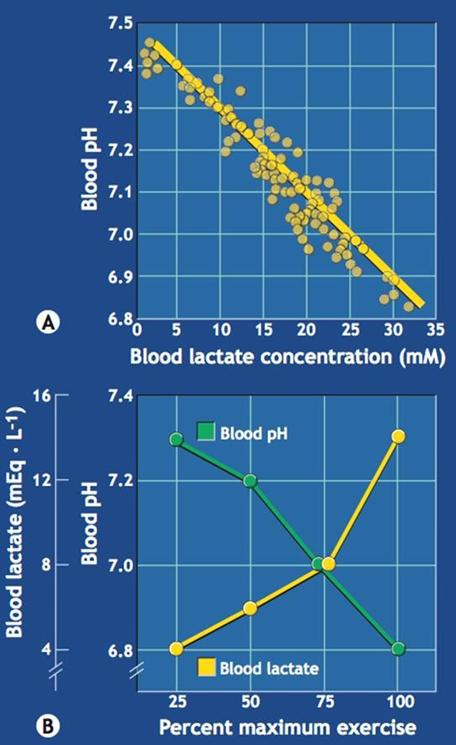
Panel A plots blood pH against blood lactate concentration in mM. Each dot is one blood sample, taken at rest or during short bouts of exercise up to maximum. The dots lie along a straight line that falls from about pH 7.4 at rest to about 6.8 at just over 30 mM.
Panel B plots blood pH and blood lactate against percent of maximum exercise, each on its own vertical scale. Lactate rises slowly up to 75 per cent and then steeply, while pH falls steadily to about 6.8. The two move like the ends of a seesaw, because the hydrogen ions released with lactate pull the pH down.
Buffering is harder still at altitude, where the blood carries less bicarbonate, as Altitude – Less Oxygen, Acclimatisation, Performance and Altitude Training explains.
Summary
Summary
Blood pH is held at 7.35 to 7.45, and a rise in hydrogen ions is acidosis while a fall is alkalosis. A chemical buffer, a weak acid paired with its conjugate base, soaks up or releases hydrogen ions within seconds but only hides the acid. Bicarbonate, phosphate and proteins are the blood’s chemical buffers, with proteins, led by haemoglobin, providing two-thirds of its buffering power. In the ventilatory buffer, hydrogen ions join bicarbonate to make water and carbon dioxide, which the lungs breathe out within minutes. Over hours to days, the kidneys secrete hydrogen ions and reabsorb bicarbonate, removing acid and restoring the bicarbonate used up. Repeated all-out bouts can push blood lactate to 30 mM or more, and a plasma pH of 7.0 or below can cause nausea, headache and dizziness.