Definition
Language is a lateralised cortical function, dominated by the left hemisphere, while the other hemisphere is concerned with spatial and temporal relations. A small connected network of areas in the dominant hemisphere implements the comprehension and production of language.
Hemisphere dominance
The left hemisphere is dominant for language in the great majority of people, and the other hemisphere is concerned with spatial and temporal relations. This dominance is not absolute: a small percentage of people, typically left handed, have right hemisphere language dominance instead.
Evidence for dominance
Four lines of evidence establish the dominance. The first comes from aphasias, language disorders that arise from damage to the language areas of the left hemisphere; these disorders are covered in Aphasias and Speaking Pathways. The second is imaging and direct recording, in which PET, fMRI and the direct recording of electrical activity during surgery show language tasks activating left hemisphere areas. The third is the Wada procedure, in which one hemisphere is anaesthetised, revealing whether the awake hemisphere alone can sustain language. The fourth comes from split brain patients, in whom the corpus callosum has been severed, so the two hemispheres can no longer communicate and each can be studied independently.
The language implementation system
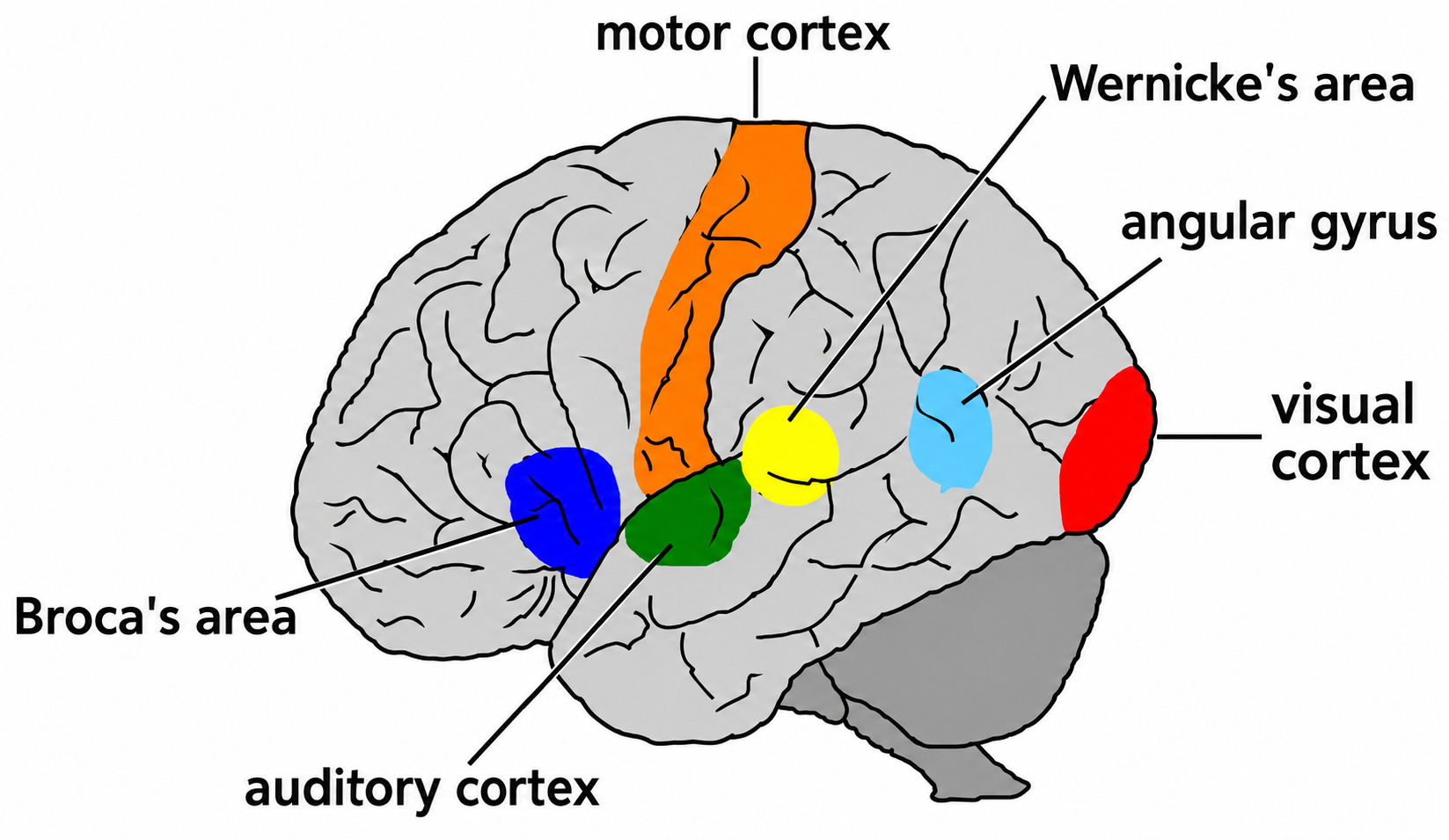
Four areas form a connected map, each anchored to a nearby sensory or motor region. Wernicke’s area lies in the posterior part of the superior temporal lobe, just behind the auditory cortex, and handles the comprehension of auditory and visual information. The arcuate fasciculus, the fibre tract that connects Wernicke's area with Broca's area, carries this understood information forwards into the frontal lobe. Broca’s area lies in the frontal lobe, in front of the lower part of the motor cortex, and plans and coordinates vocalisation. The angular gyrus lies in the parietal lobe, above and behind Wernicke’s area and just in front of the visual cortex, functionally, it converts written words into their verbal form by matching visual symbols from reading to their auditory language representation, which is why damage to it produces some dyslexias.
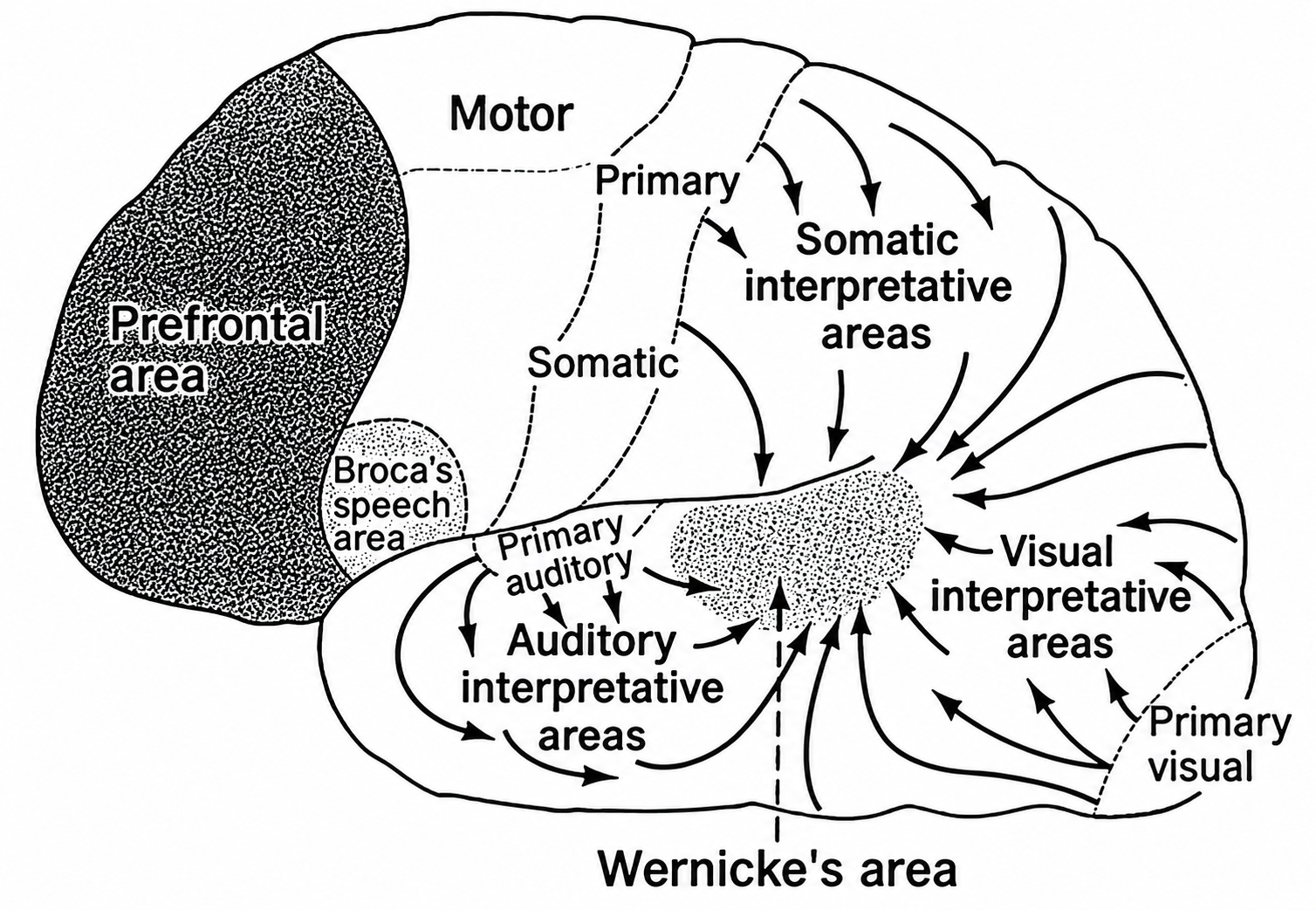
The second figure shows why Wernicke’s area sits where it does: the somatic, auditory and visual interpretative areas all converge on it in the posterosuperior temporal lobe, making it the meeting point at which the senses are interpreted, while Broca’s speech area lies forward in the frontal lobe, beside the prefrontal area that plans the intended message and in front of the motor area that executes it.
Summary
Summary
Language is dominated by the left hemisphere, with the other hemisphere handling spatial and temporal relations and a small, typically left handed minority showing right dominance, as shown by aphasias, imaging and direct recording, the Wada procedure and split brain patients. The implementation system runs from Wernicke’s area behind the auditory cortex, which comprehends auditory and visual information, through the arcuate fasciculus to Broca’s area in front of the motor cortex, which plans and coordinates vocalisation, with the angular gyrus near the visual cortex implicated in some dyslexias.