Definition
Deafness is a partial or complete loss of hearing. Sound is only perceived once the information gathered by the ear reaches the auditory cortex, so a failure at any stage of that chain, from the outer ear to the auditory nerve, can produce it. These failures fall into two main types, conductive and sensorineural, and the hearing tests below exist to tell them apart.
Noise damage and high frequency deafness
Prolonged or frequent exposure to excessive noise degenerates the hair cells, which is exactly the danger of loud music, and because hair cells do not regenerate the damage is permanent. The hair cells at the base of the cochlea are the most vulnerable, and since the base encodes high frequencies (see The Place Principle and Loudness Coding), their degeneration produces high frequency deafness: thresholds rise first and worst for high pitched sounds.
The two types of deafness
Conductive deafness is a failure of transmission through the outer or middle ear: the cochlea and the auditory nerve are intact, but vibrations never reach them efficiently. Typical causes include wax blocking the ear canal, a ruptured eardrum or fixation of the middle ear bones. Because the sensorineural machinery still works, conductive loss is the usually treatable one: a hearing aid amplifies sound to compensate for the inefficient conductive apparatus, and standard procedures such as clearing the blockage or surgery on the ossicles can restore transmission directly.
Sensorineural deafness is a failure of the inner ear or the auditory nerve: most often the cochlear hair cells die, as in the noise damage above, or the nerve itself is damaged, so even a vibration delivered perfectly to the cochlea cannot be transduced or conveyed onwards. Amplification cannot restore a neural signal that was never generated, so hearing aids are of limited help here.
Hearing tests
Two routes deliver sound to the cochlea during testing. Air conduction presents the sound through the air, as in normal listening, so before the tone can be perceived it must pass through the outer, middle and inner ear together with the whole auditory pathway, and a fault at any point along that chain raises the measured threshold. Bone conduction uses a vibrator pressed against the skull to shake the cochlea directly through the bones of the head, so it bypasses the outer and middle ear and tests only the inner ear and beyond. Comparing the two tells whether the fault lies before the cochlea or within it.
The same comparison can be made at two levels of precision. The quick version is the bedside tuning fork test, which distinguishes conductive from sensorineural loss with no equipment beyond a vibrating fork. In the Weber test the fork is pressed against the midline of the skull, so both cochleas receive the vibration equally through bone; a patient with conductive loss hears it louder in the affected ear, because the blockage stops the vibration escaping back out of the skull through the ear canal on that side, while a patient with sensorineural loss hears it louder in the intact ear, because the damaged cochlea or nerve cannot turn the vibration into a neural signal.
The precise version is audiometry. It measures the hearing threshold, the quietest pure tone the patient can detect, at each frequency, separately for air and for bone conduction, and plots the results as a pure tone audiogram; the next section shows how to read one.
Reading the pure tone audiogram
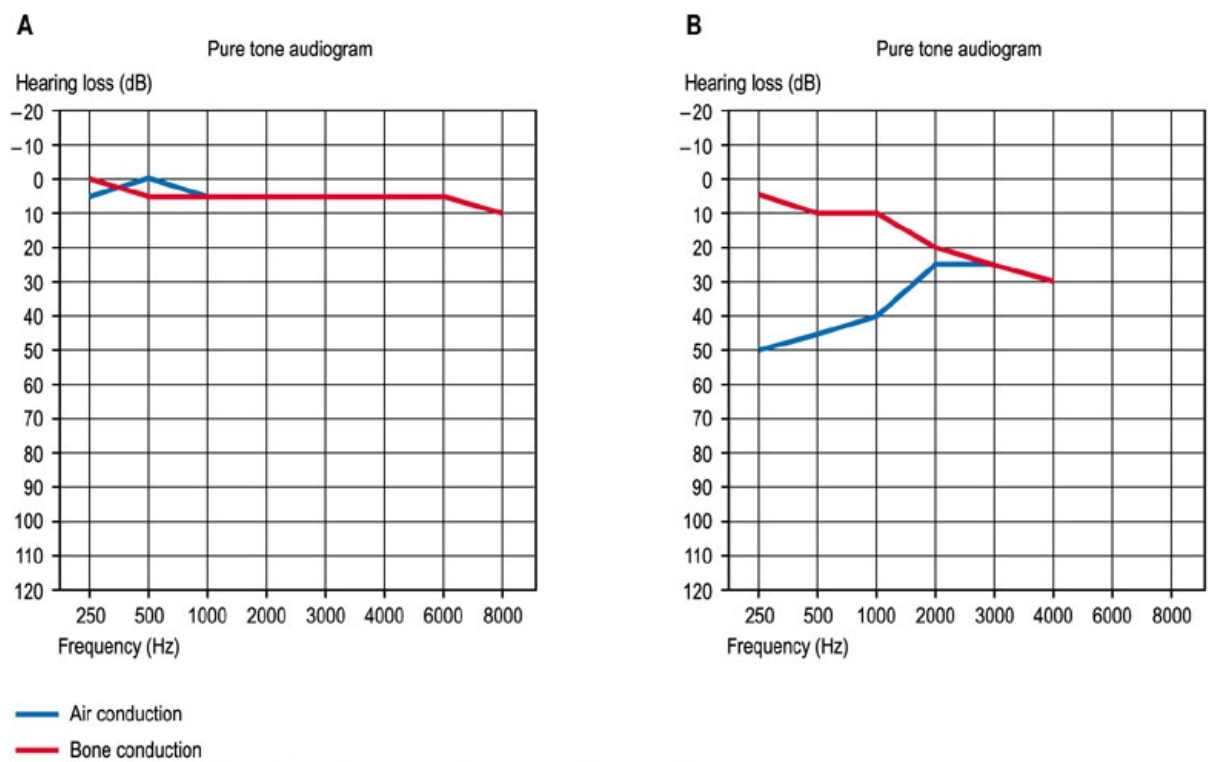
An audiogram is a chart of hearing thresholds, plotting hearing level in decibels against frequency in hertz. Frequency runs along the chart from low pitch on the left to high pitch on the right, while the decibel scale is drawn the unusual way round, with 0 dB at the top meaning normal hearing and the numbers increasing downwards. Each plotted point is the threshold at one frequency, so the further down the chart a point sits, the louder the tone had to be before the patient heard it, and a curve that sinks lower on the chart means a raised threshold, not a better one. Every chart carries two curves: air conduction, drawn in blue or marked with X symbols, and bone conduction, drawn in red or marked with arrows.
In figure A, both curves run along the top of the chart, within a few decibels of 0 at every frequency: normal hearing. In B, the two curves part company. Bone conduction stays close to normal, but the air conduction thresholds are raised across the range, worst at low frequencies where the curve sinks to about 50 dB at 250 Hz and recovering towards high frequencies, so the gap between the air and bone conduction curves is widest at low pitch and narrows as the two curves rejoin. Sound is therefore reaching the cochlea normally through bone but not through the air route, the hallmark of a conductive problem.
Severity of deafness
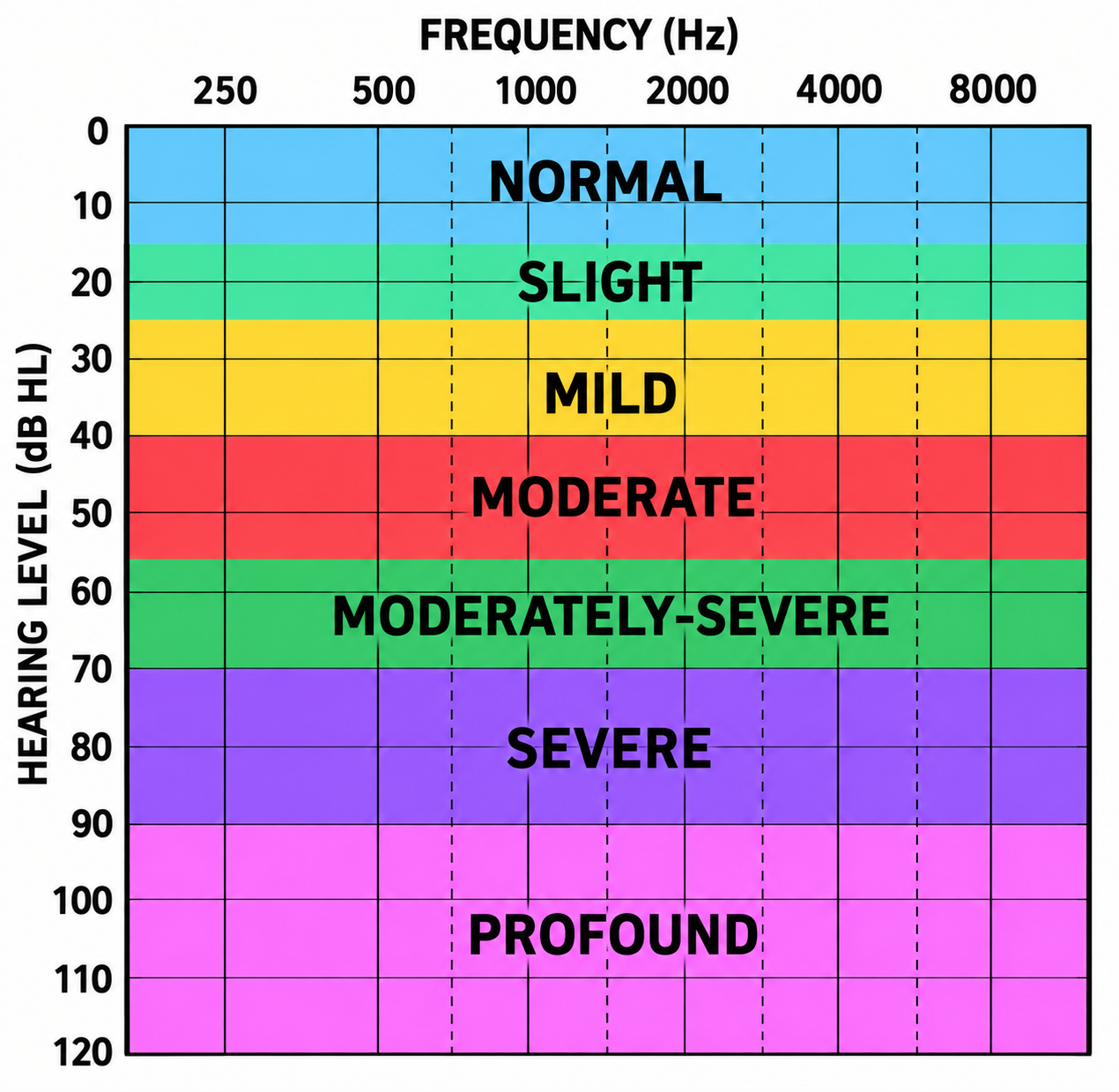
Severity is graded by how far the threshold has fallen, and the bands run straight across all frequencies because severity depends on the threshold level alone. The figure paints them in colour from top to bottom: normal spans 0 to 15 dB, slight 15 to 25 dB, mild 25 to 40 dB, moderate 40 to 55 dB, moderately severe 55 to 70 dB, severe 70 to 90 dB, and profound anything over 90 dB.
The three audiogram patterns
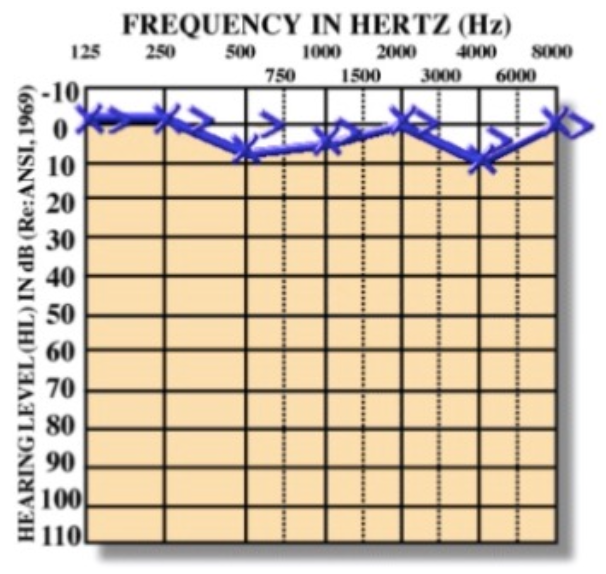
In normal hearing both curves overlap within about 10 dB of the top across the whole range from 125 to 8000 Hz, since the air and bone routes both work.
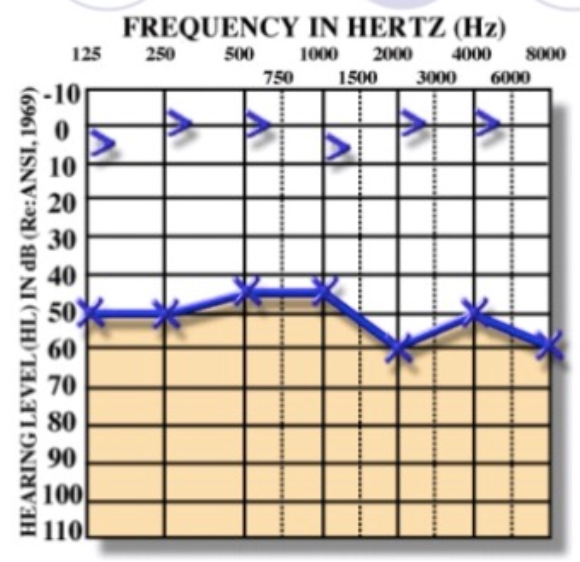
In conductive deafness air conduction thresholds are raised while bone conduction is preserved: the bone curve stays near 0 dB at every frequency while the air curve sits around 45 to 60 dB, so the gap between the curves extends across the whole range. The loss is roughly flat because the blockage attenuates all sound rather than selectively destroying frequency tuned hair cells.
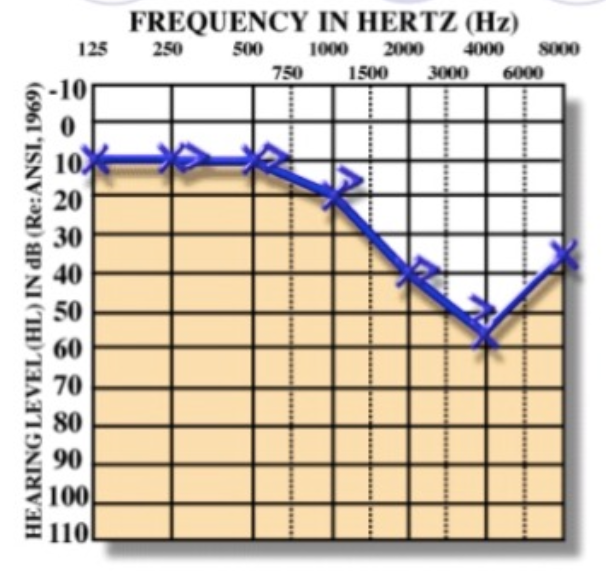
In sensorineural deafness both curves are raised together, with no gap between them, and they slope downwards towards the high frequencies, falling from near normal at low pitch to about 55 dB at 4000 Hz. This is precisely the curve predicted by the loss of basal hair cells, the classic picture of noise induced and age related deafness.
Summary
Summary
Deafness comes in two forms: conductive, a failure of transmission through the outer or middle ear that hearing aids and standard procedures can usually correct because the cochlea is intact, and sensorineural, a death of hair cells or damage to the nerve that amplification cannot undo, most famously the high frequency loss produced by loud noise. Air conduction tests the whole chain from ear canal to cortex while bone conduction bypasses the outer and middle ear, so comparing the two curves on an audiogram both separates the types and grades the severity from normal to profound.