Definition
The hair cells of the Organ of Corti are the receptor cells of hearing: they sit upon the basilar membrane with their hairs coupled to the tectorial membrane above. Cochlear transduction is the conversion of sound driven vibration into an electrical signal: bending of the stereocilia opens or closes K⁺ channels, so the hair cell depolarises or hyperpolarises in step with the sound.
From stapes to basilar membrane
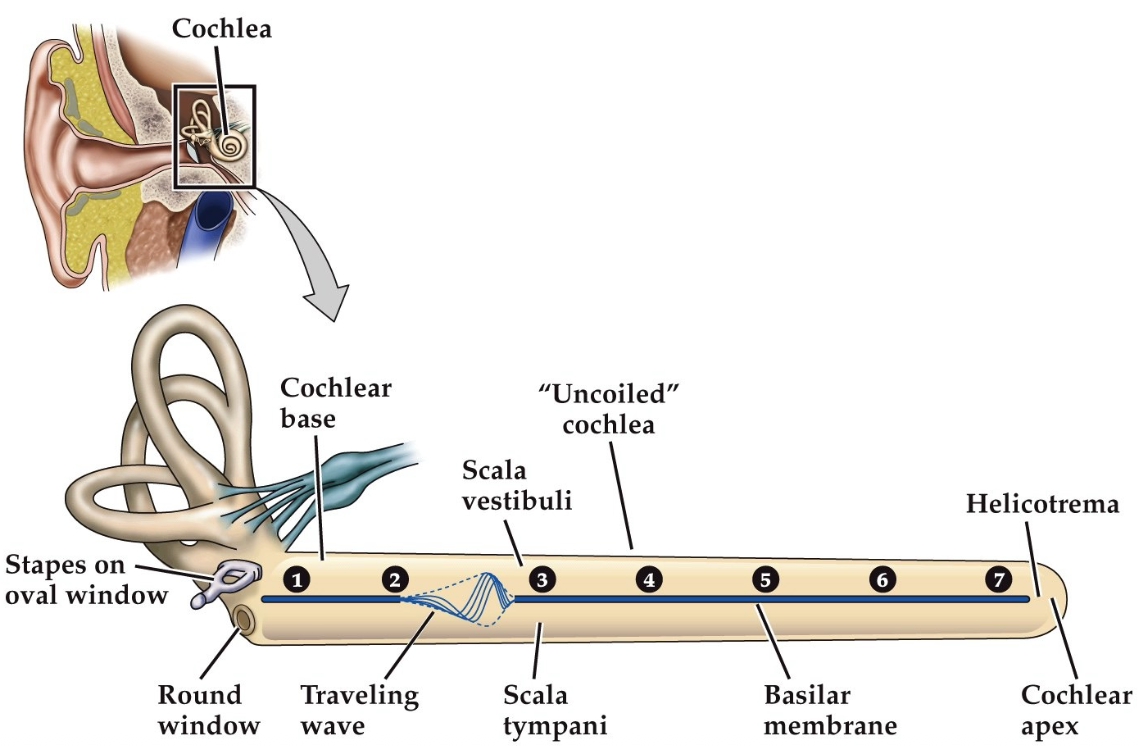
Sound reaches the cochlea as a mechanical chain: vibration of the stapes causes vibration of the perilymph, and the moving fluid in turn vibrates the elastic basilar membrane. To make what happens next visible, the figure shows the cochlea fictionally uncoiled: the living cochlea is always wound into its spiral, but drawn straight the two scalae and the basilar membrane lie in a line and the path of the wave is easy to follow.
The disturbance does not spread everywhere at once: it propagates as a travelling wave along the basilar membrane. The wave begins at the cochlear base, driven by the stapes at the oval window, and travels toward the apex, where the scala vestibuli and scala tympani meet at the helicotrema.
Inner and outer hair cells
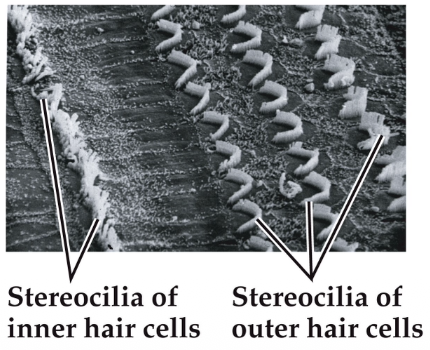
The hair cells sit in the Organ of Corti, where they stand on the basilar membrane with their hairs connected to the tectorial membrane, so any relative movement of the two membranes bends the hairs. They number 16,000 in all, with some counts putting the figure nearer 20,000, and they divide into two populations with distinct jobs. One row of inner hair cells forms the true sensory receptors and sends the signal toward the cerebral cortex, while three to four rows of outer hair cells (five rows in some people) serve signal amplification: they shorten when depolarised and lengthen when hyperpolarised, feeding energy back into the basilar membrane so its vibration grows larger. In the electron micrograph the two are easy to tell apart, the single inner row carrying straight bundles of hairs while the outer rows carry bundles in a V arrangement, and the arrangement is not fixed but varies with position along the cochlea, the rows and bundles being organised differently at the base and at the apex.
Shearing force bends the stereocilia
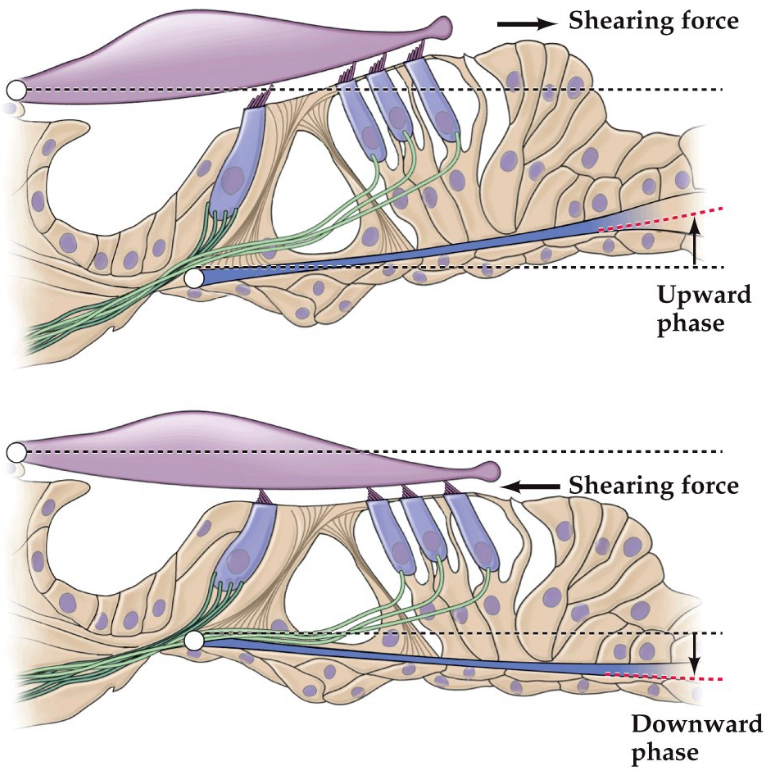
The basilar and tectorial membranes are anchored at different points, so when the basilar membrane vibrates the two membranes slide past each other and the bundle is caught between them. In the upward phase the shear bends the stereocilia toward their tall edge and the hair cell depolarises; in the downward phase the shearing force reverses, the stereocilia bend away from their tall edge and the cell hyperpolarises. Each vibration of the basilar membrane therefore produces one depolarising swing and one hyperpolarising swing, so the electrical signal rises and falls in step with the sound wave. Here the outer hair cells earn their amplifying role: they shorten when depolarised and lengthen when hyperpolarised, feeding energy back into the basilar membrane so its vibration grows larger.
Transduction at the hair bundle
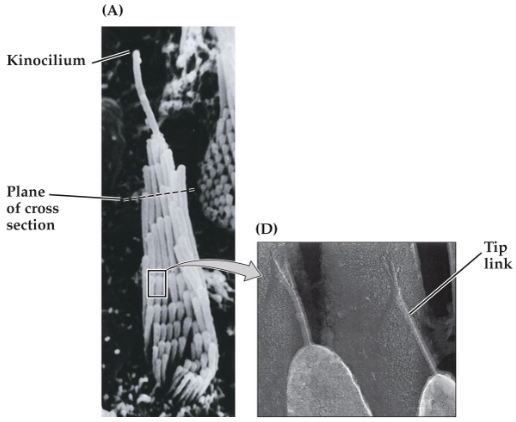
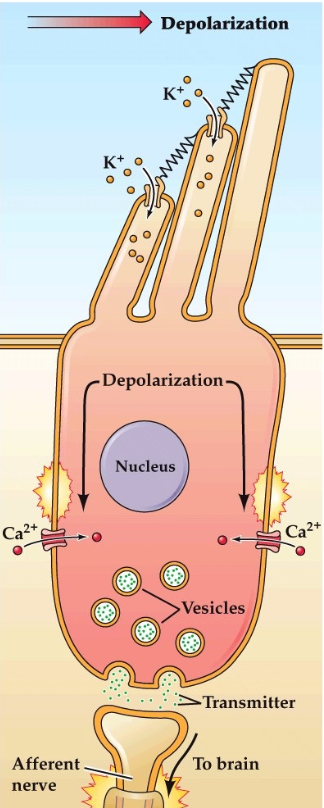
The hairs of one cell pack together into a hair bundle. Inside the bundle the stereocilia stand in rows of increasing height, like a staircase, and each shorter one is tied to the taller one beside it by a fine thread called a tip link. At the tall edge of the staircase stands the kinocilium, the tallest hair of all. Movement of the stereocilia opens or closes K⁺ channels: bending toward the tall edge pulls the tip links tight and the channels open, bending back lets them close. When the channels open, K⁺ enters the cell and depolarises it, possible because the endolymph bathing the bundle is unusually rich in K⁺ (see The Inner Ear and the Cochlea). Depolarisation then admits Ca²⁺ at the base of the cell, synaptic vesicles release transmitter onto the afferent nerve fibre, and the signal leaves for the brain.
This is a graded receptor potential: its size follows how far the bundle bends, and the action potentials arise only in the afferent nerve fibre.
Summary
Summary
Sound is transduced by mechanics: stapes, perilymph, basilar membrane, shear. The bending of the stereocilia gates the K⁺ channels, so the hair cell swings between depolarisation and hyperpolarisation with each vibration, and the inner hair cells pass the resulting signal on toward the cortex.