Definition
The ear is the organ of hearing and balance, divided into outer, middle and inner regions. The outer and middle ear handle only the mechanical side of hearing: they collect sound, protect the delicate parts and deliver an amplified vibration to the inner ear, where transduction begins.
Overview of the Ear
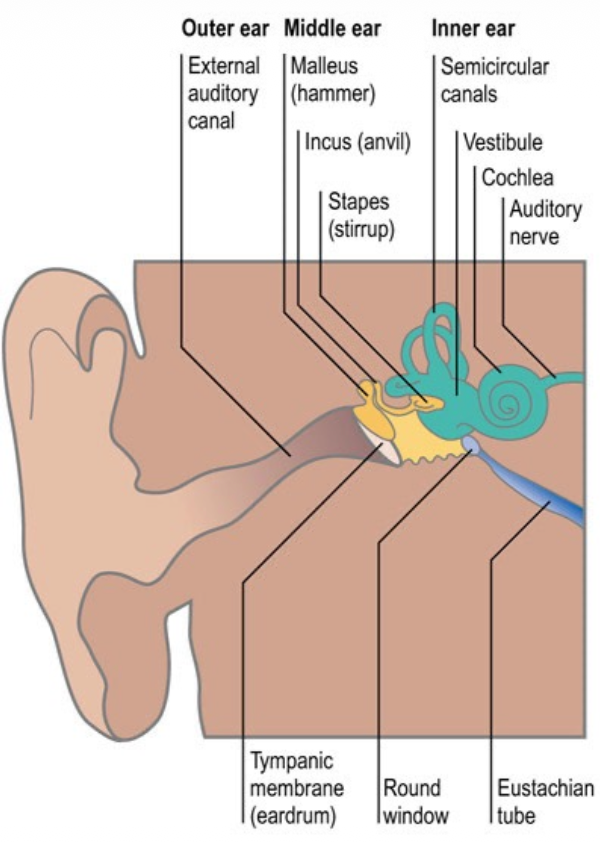
The overview diagram shows the whole ear in section, grouped into its three regions. The outer ear consists of the visible pinna and the external auditory canal, which funnels sound inwards to the tympanic membrane (eardrum), the thin sheet that marks the boundary with the middle ear. The middle ear holds the three ossicles, and the inner ear, shown in blue, contains the semicircular canals, vestibule, cochlea and auditory nerve, with the round window at the base of the cochlea and the Eustachian tube running down from the middle ear cavity towards the throat.
The external auditory canal is lined with hairs and wax secreting glands, a protective arrangement that traps dust and debris before they can reach the tympanic membrane.
The Middle Ear and the Eustachian Tube
The middle ear is an air filled cavity sitting between the tympanic membrane and the inner ear. Because it is filled with air, its pressure has to match the pressure outside, and this is the job of the Eustachian tube, which connects the cavity to the back of the nasal cavity and equalises pressure across the tympanic membrane.
The tube is normally closed, but chewing gum or changing the shape of the oral cavity pulls it open, letting air pass in or out so the pressure difference across the eardrum is relieved. Children are more prone to middle ear infection because their shorter face leaves the tube at a flatter angle: a flatter tube gets little help from gravity, so mucus drains poorly and pools in the cavity, ventilation on swallowing is less effective, and that trapped fluid becomes a ready site for infection. As the face lengthens with growth the tube steepens, which is why the tendency largely resolves with age.
The Auditory Ossicles
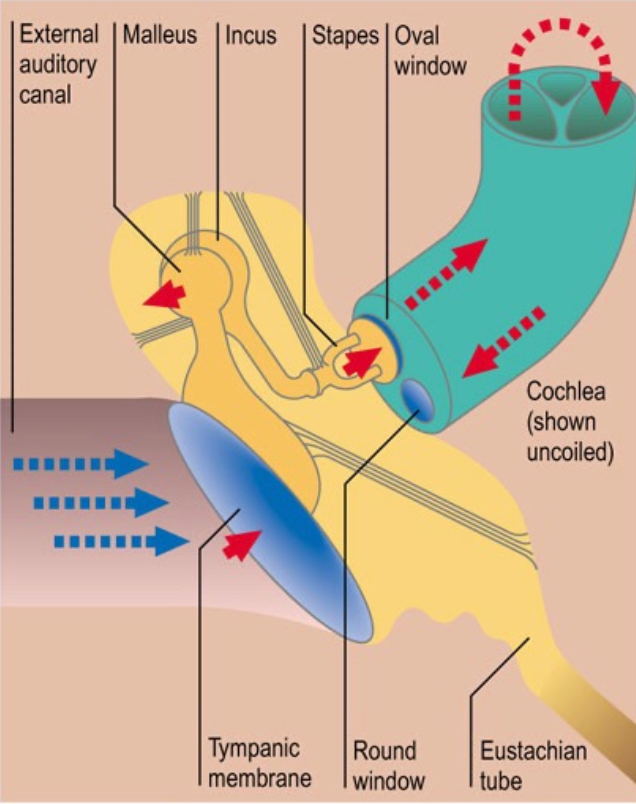
The middle ear contains 3 auditory ossicles: the malleus (hammer), the incus (anvil) and the stapes (stirrup), joined to one another by tiny synovial joints. Their job is to amplify vibrations and transmit them from the tympanic membrane to the oval window, the point where the stapes meets the inner ear.
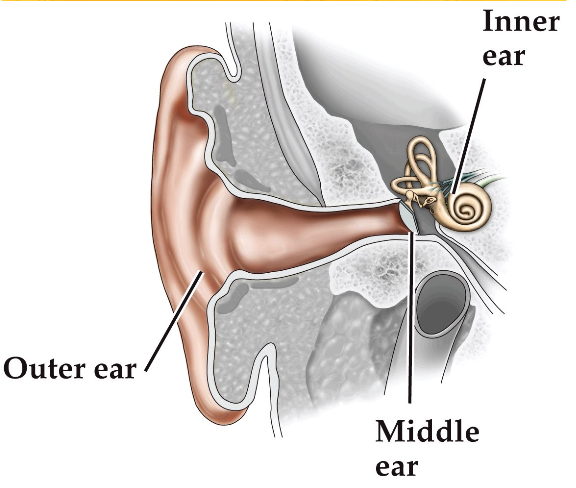
The following figure traces this chain: sound waves travel down the external auditory canal and set the tympanic membrane vibrating, the malleus attached to its inner surface moves the incus and then the stapes, and the stapes pushes on the oval window, sending pressure waves through the cochlea, which is shown uncoiled so the wave path and the round window at its base can be seen. The next figure, a cross section through the skull, shows the same layout in situ: the pinna and canal of the outer ear, the air filled middle ear cavity with the ossicle chain suspended in it, and the coiled cochlea of the inner ear embedded in bone.
Summary
Summary
The outer and middle ear solve a purely mechanical problem: the canal gathers and protects, the Eustachian tube keeps pressure balanced across the eardrum, and the ossicle chain boosts the vibration before handing it to the oval window. Converting that vibration into a neural signal is the work of the inner ear, covered in the next note.