Definition
Glia (Greek for “glue”, from the old idea that these cells hold the nervous system together) are the non neuronal cells of the nervous system: the protectors and support cells of neurons. Unlike neurons they are not electrically excitable; instead they heighten the functional capacity of neurons by insulating them, controlling their surroundings, building the brain and defending it. They are also far more numerous: there are 10 to 50 times more glia than neurons.
1. The six types of glia
The simplest way to place them is by where they act and what they look after:
-
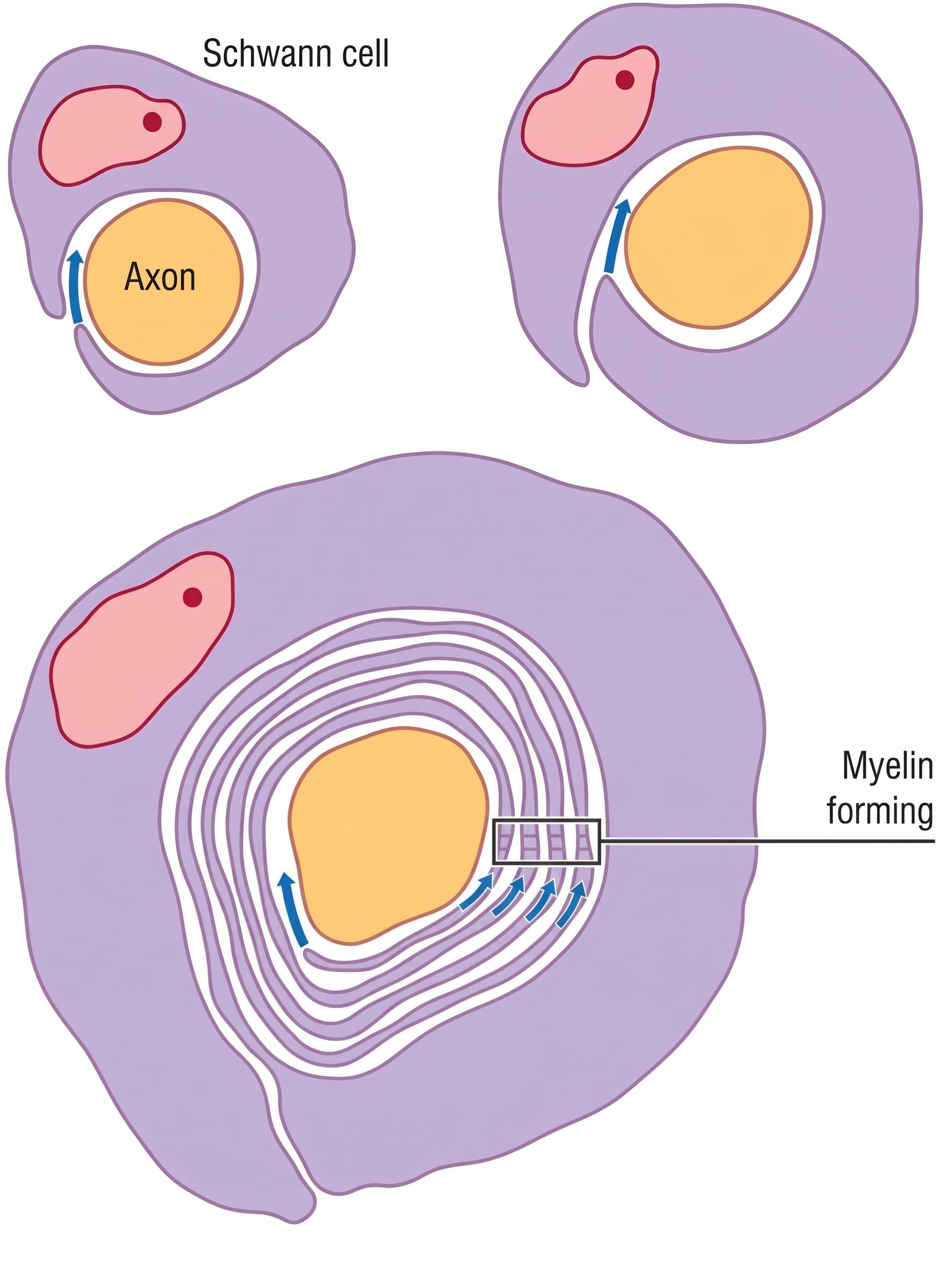
Schwann cells: the myelin forming glia of the peripheral nervous system (PNS). One Schwann cell wraps itself around a segment of axon, laying down the insulating sheath.
-
Oligodendrocytes: the myelin forming glia of the central nervous system (CNS), the Schwann cell equivalent inside brain and spinal cord.
-
Astrocytes: star shaped CNS glia that look after the extracellular environment around neurons.
-
Ependymal cells: the glia lining the ventricles, working with astrocytes in controlling that environment.
-
Radial glia: developmental glia, active while the brain is being built.
-
Microglia: the immune cells of the CNS.
2. Glial functions
-
Myelin is made by Schwann cells in the PNS and oligodendrocytes in the CNS. Wrapping axons in insulating membrane is what allows fast saltatory conduction, so these cells quite literally heighten the functional capacity of neurons.
-
Control of the extracellular environment around neurons belongs to astrocytes and ependymal cells: they keep the fluid bathing the neurons chemically stable, which neurons need in order to signal reliably.
-
Brain development is the job of radial glia.
-
Immune function belongs to microglia.
3. Origins: microglia vs macroglia
Not all glia are born the same way:
Microglia are the outsiders. They are derived from macrophages outside the CNS, so they belong to the immune lineage rather than the neural one. Their job matches their origin: they are phagocytes, activated by infection and injury, clearing debris and dead cells from damaged tissue.
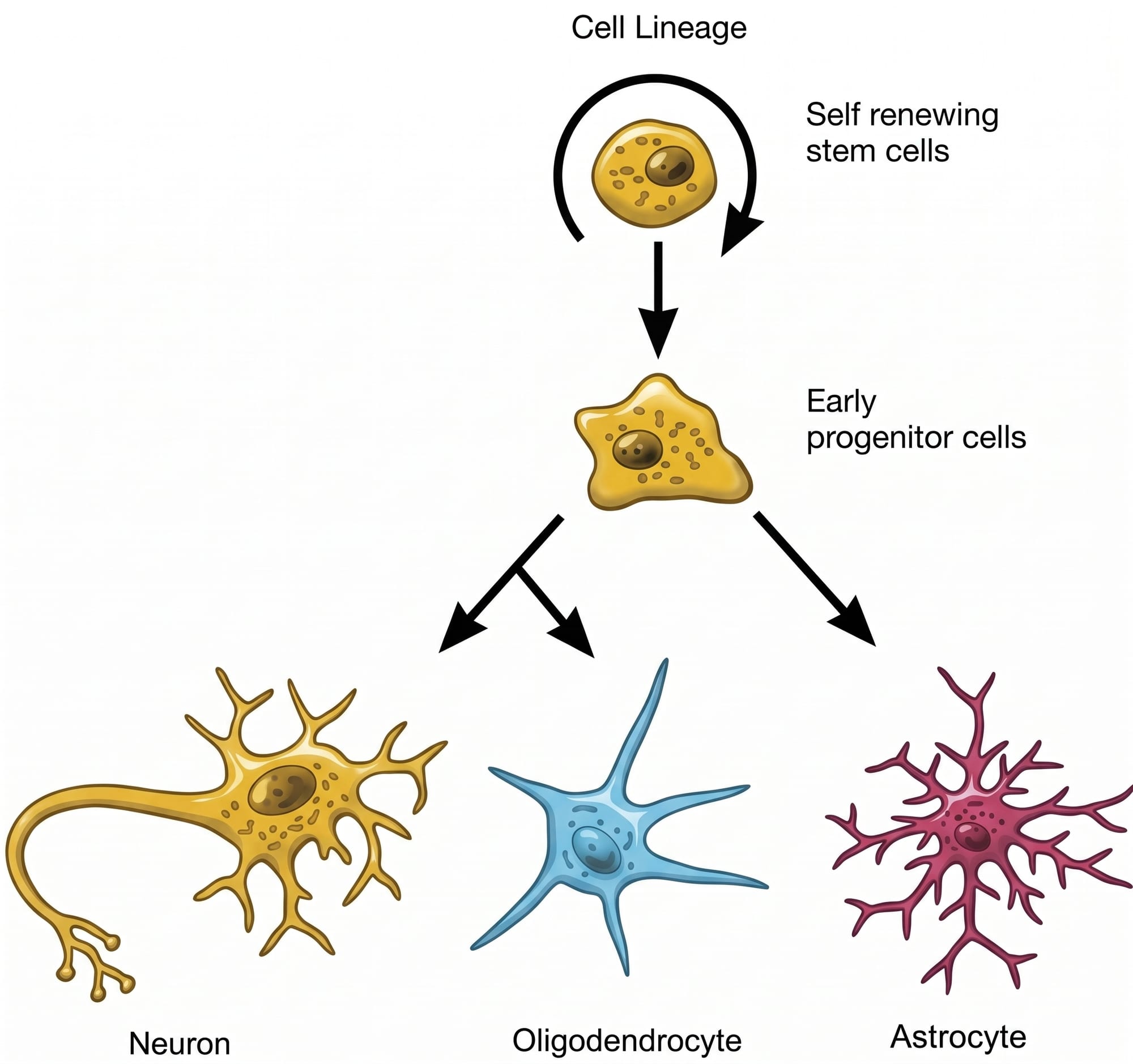
Macroglia are all the other glial groups (astrocytes, oligodendrocytes, Schwann cells, ependymal cells and radial glia). They are derived from neural stem cells, which means they share their lineage with neurons themselves: self renewing stem cells give rise to early progenitor cells, which then produce neurons, oligodendrocytes and astrocytes, as the lineage diagram on the slide shows:
Summary
Summary
Glia (“glue”) are the non neuronal support and protector cells of the nervous system, 10 to 50 times more numerous than neurons. The six types map onto four core functions: Schwann cells (PNS) and oligodendrocytes (CNS) make myelin, astrocytes and ependymal cells control the extracellular environment, radial glia act in brain development, and microglia provide immune defence. By origin, microglia are macrophage derived phagocytes from outside the CNS, while all other glia are macroglia, born from neural stem cells just like neurons.