Definition
The membrane potential is the voltage difference across the cell membrane, expressed as the charge inside the cell relative to the outside. It is measured directly with a recording microelectrode inserted into the cytosol and a reference electrode in the extracellular fluid, connected to a voltmeter; a typical resting nerve or muscle cell reads about −70 mV, meaning the inside is negative relative to the outside. The potential exists because ions are distributed unequally across the membrane and the membrane’s permeability to each ion is selective.
Nerve and muscle cells are electrically excitable, and their electrical current results from the movement of ions across the membrane. When channels open and ions flow, this voltage changes in a controlled way, and that voltage change is the signal with which neurons communicate and muscles are triggered to contract.
Resting membrane potential
The voltage difference across a cell membrane when the cell is at rest. It arises from three factors working together: an unequal distribution of ions (Na⁺, K⁺, Cl⁻) across the membrane, a membrane that is more permeable to K⁺ than to Na⁺, and the activity of the Na⁺/K⁺ pump. The result is that the inside of the cell is electrically negative relative to the outside. Typical values range between negative 60 and negative 80 mV.
| Ion | Extracellular (mmol/L) | Intracellular (mmol/L) |
|---|---|---|
| Na⁺ | 150 | 15 |
| Cl⁻ | 110 | 10 |
| K⁺ | 5 | 150 |
Sodium and chloride are concentrated outside the cell; potassium is concentrated inside. These differences create two forces on every ion: a concentration gradient (the ion diffuses from where it is abundant to where it is scarce) and an electrical gradient (the ion is attracted or repelled by the charge on the other side of the membrane). Net movement of an ion depends on the balance of these two gradients.
Greater permeability to K⁺ than Na⁺
At rest the membrane allows K⁺ to cross far more easily than Na⁺ (K⁺ permeability is roughly 60 times that of Na⁺, 6.0 × 10⁻¹¹ versus 1.0 × 10⁻¹² cm/s; water and Cl⁻ are also far more permeant). Because K⁺ leaks out of the cell down its concentration gradient while Na⁺ barely leaks in, positive charge steadily leaves the cell and the interior becomes negative.
Large anions inside the cell
The intracellular fluid contains large negatively charged proteins (Pr⁻) that cannot cross the membrane at all. These trapped anions add to the negative charge inside the cell and help hold K⁺ within, reinforcing the negative resting potential.
The Na⁺/K⁺ electrogenic pump
An ATP consuming transporter that moves 3 Na⁺ out of the cell and 2 K⁺ into the cell per cycle. It has two roles: it maintains the concentration gradients by continuously restoring the Na⁺ and K⁺ that leak across the membrane, and because it exports three positive charges for every two it imports, it is electrogenic, meaning it contributes a small net negative charge to the cell interior directly.
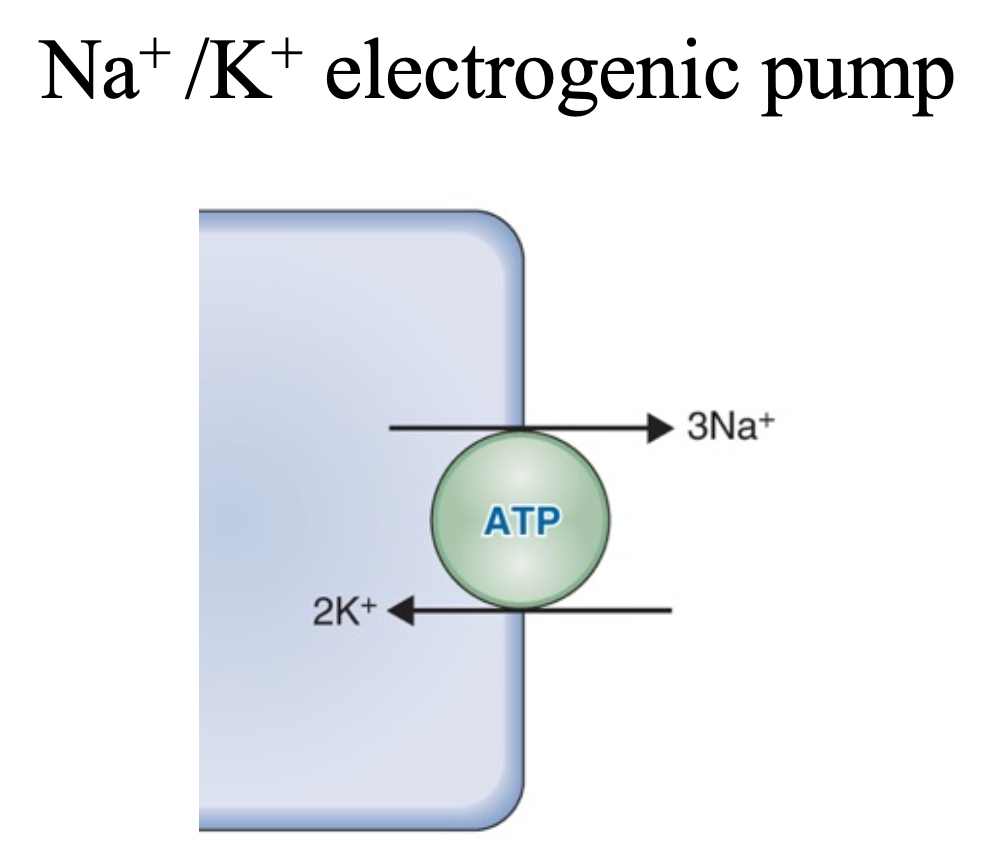
Inside negative relative to outside
The combined effects (K⁺ leaving down its gradient, impermeant intracellular anions, and the electrogenic pump) leave more positive charge outside than inside. The interior of the resting cell is therefore negative relative to the exterior, which is exactly what the resting membrane potential measures.
Equilibrium potential
For any single ion, there is one membrane voltage at which the electrical gradient pulling the ion in exactly balances the concentration gradient pushing it out, so net movement of that ion stops. That voltage is the ion’s equilibrium potential. Equilibrium potentials are calculated with the Nernst equation, which takes the ion’s charge and its concentrations inside and outside the cell and returns the voltage at which the two gradients cancel.
| Ion | Permeability (cm/s) | Equilibrium potential |
|---|---|---|
| Water | 1.2 × 10⁻² | — |
| Cl⁻ | 1.1 × 10⁻¹⁰ | negative 70 mV |
| K⁺ | 6.0 × 10⁻¹¹ | negative 80 mV |
| Na⁺ | 1.0 × 10⁻¹² | positive 50 mV |
The resting potential (around negative 60 to negative 80 mV) sits close to E_K because the membrane is most permeable to K⁺ at rest. When Na⁺ permeability suddenly rises during an action potential, the membrane potential shifts toward E_Na (positive 50 mV), which largely explains the value of the action potential voltage. Key exam principle: the resting membrane potential is always closest to the equilibrium potential of the ion to which the membrane is most permeable, which at rest is K⁺.
Summary
Summary
The resting membrane potential (about negative 60 to negative 80 mV, inside negative) exists because Na⁺, K⁺ and Cl⁻ are unevenly distributed, the membrane leaks K⁺ far more readily than Na⁺, impermeant anions are trapped inside, and the electrogenic Na⁺/K⁺ pump (3 Na⁺ out, 2 K⁺ in) maintains the gradients while adding a small negative charge itself.