Types of Movements across the Membrane
-
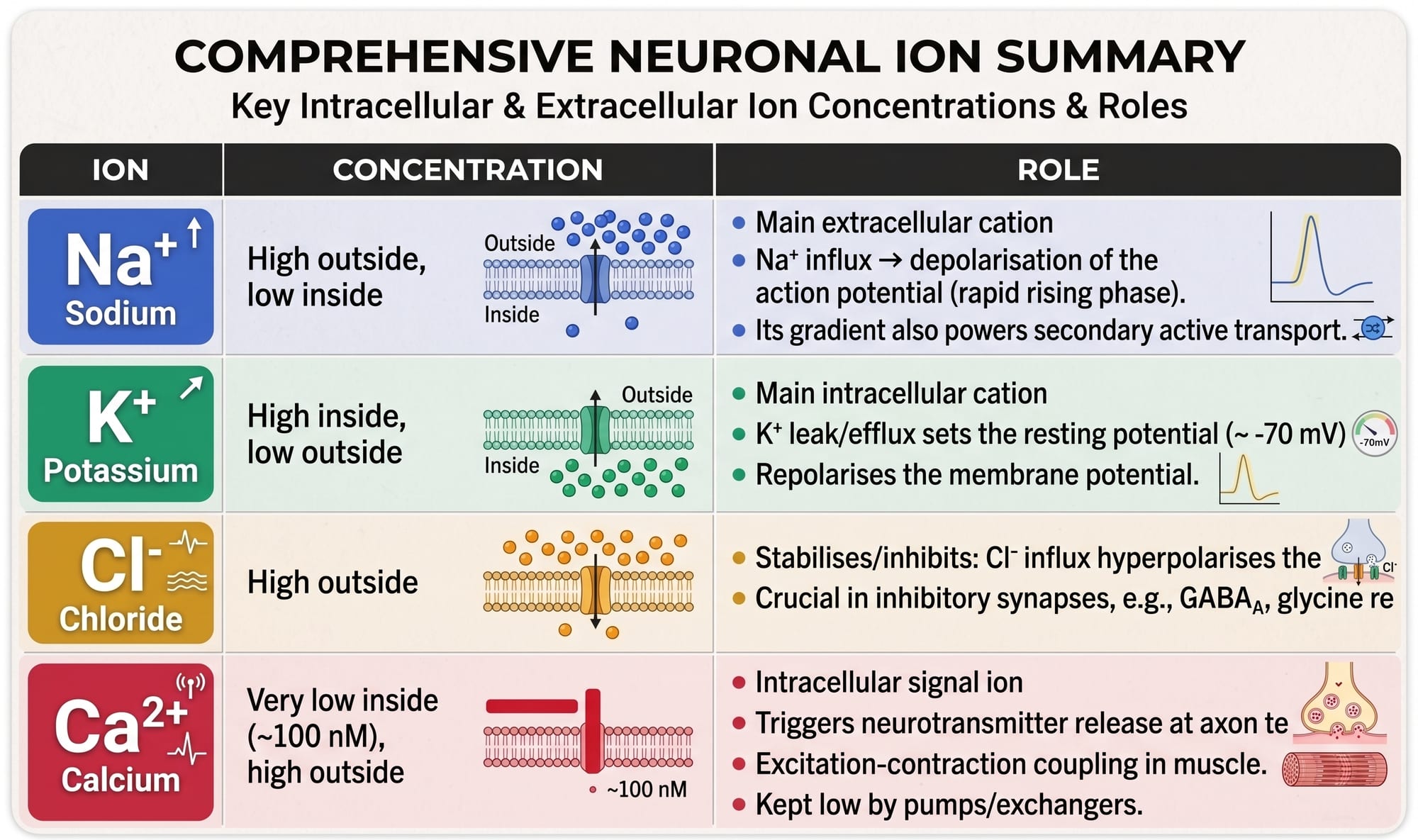
Passive diffusion through ion channels. Ions flow through an open channel pore strictly down their electrochemical gradient, meaning the combined pull of the concentration gradient and the electrical gradient. No energy is consumed at any point. The channel’s gate simply opens (in response to voltage, a ligand, or mechanical stretch) and ions flood through at millions per second. Its purpose is rapid signalling: this is what generates the electrical currents underlying action potentials and synaptic potentials, and the resting K⁺ leak that sets the resting membrane potential.
-
Facilitated diffusion. Also passive and also down the gradient, with no ATP involved, but the ion or solute crosses via a carrier protein rather than an open pore. The carrier binds the molecule on one side, changes shape, and releases it on the other. Because of that shape change every cycle, it is far slower than a channel and can be saturated when all carriers are occupied. Its purpose is to let charged or polar substances cross the membrane down their gradient in a controlled, selective way when a simple pore is not the route used.
-
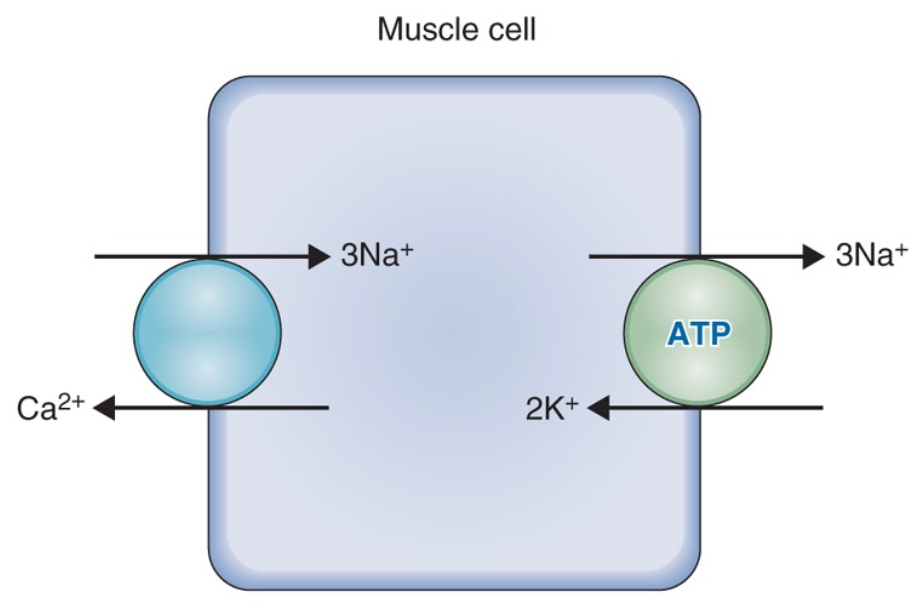
Active transport. The only mechanism that moves ions against their electrochemical gradient, and the only one that costs energy. In primary active transport a pump burns ATP directly, as the Na⁺/K⁺ ATPase does by ejecting 3 Na⁺ and importing 2 K⁺ per cycle. In secondary active transport the downhill flow of one ion is harnessed to drag another uphill, as in the Na⁺/Ca²⁺ exchanger, where 3 Na⁺ entering the cell drive 1 Ca²⁺ out. Per protein it is the slowest of the three, but it runs continuously. Its purpose is to build and maintain the ion gradients (Na⁺ and Ca²⁺ low inside, K⁺ high inside) and to restore them after activity, making all passive signalling possible in the first place.
Main differences
channels and facilitated diffusion both dissipate gradients passively and differ only in the protein used (open pore versus shape-changing carrier, hence fast versus slower), while active transport is the slow, energy-dependent builder of those same gradients.
Roles of the key ions