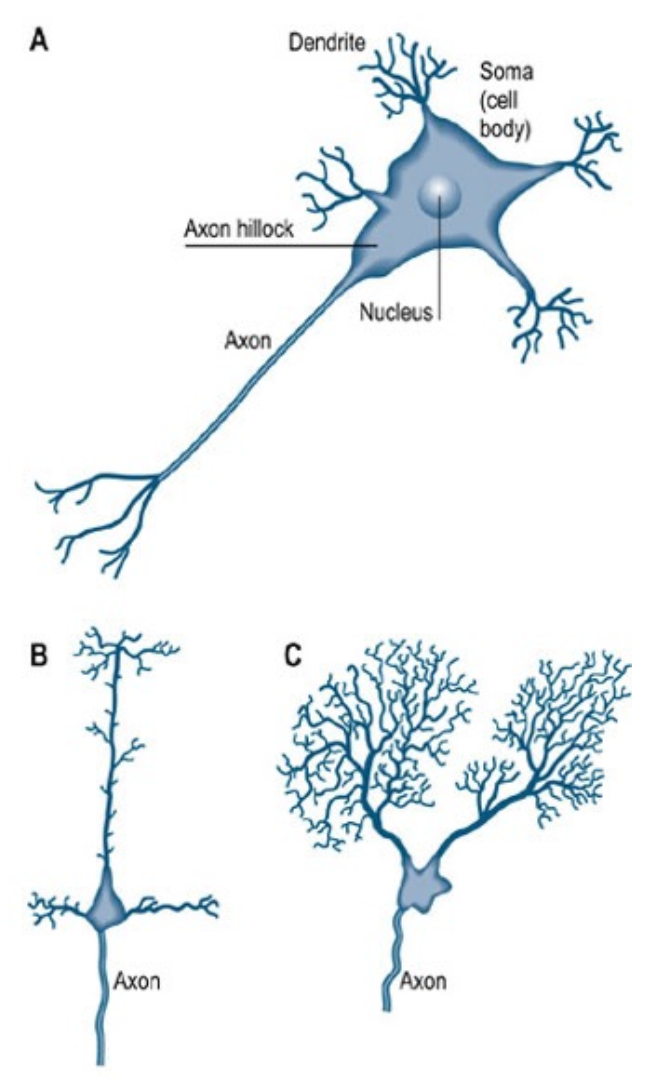
Definition
It is the structural and functional unit of the nervous system; an electrically excitable cell specialised for receiving, integrating, and transmitting information via electrical (action potential) and chemical (synaptic) signals. Its main components are:
Cell Body (Soma)
The metabolic and synthetic centre of the neuron. Contains the organelles (ribosomes, mitochondria, endoplasmic reticulum) responsible for protein synthesis and energy production. Integrates incoming signals and maintains the neuron’s survival.
- Subcomponent: Nucleus, located within the soma; contains the genetic material (DNA) and controls all cellular activity, including gene expression for neurotransmitter synthesis.
Dendrites
Branched, tree-like processes extending from the soma. They are the main receptive structures, receiving incoming signals from other neurons at synapses and conducting them toward the cell body. Their extensive branching (as in cells B and C) vastly increases the surface area for synaptic input.
Axon
A single, elongated projection that conducts signals away from the soma to other neurons, muscles, or glands. Carries action potentials over distances ranging from millimetres to over a metre.
- Subcomponent: Axon Hillock, the cone-shaped junction between the soma and the axon. It acts as the neuron’s “spike-initiation zone”: it sums (integrates) all incoming excitatory and inhibitory postsynaptic potentials, and if the threshold is reached here, an action potential is generated.
Dendrites receive → Soma integrates → Axon hillock triggers → Axon transmits.