1. The neuron and the direction of the signal
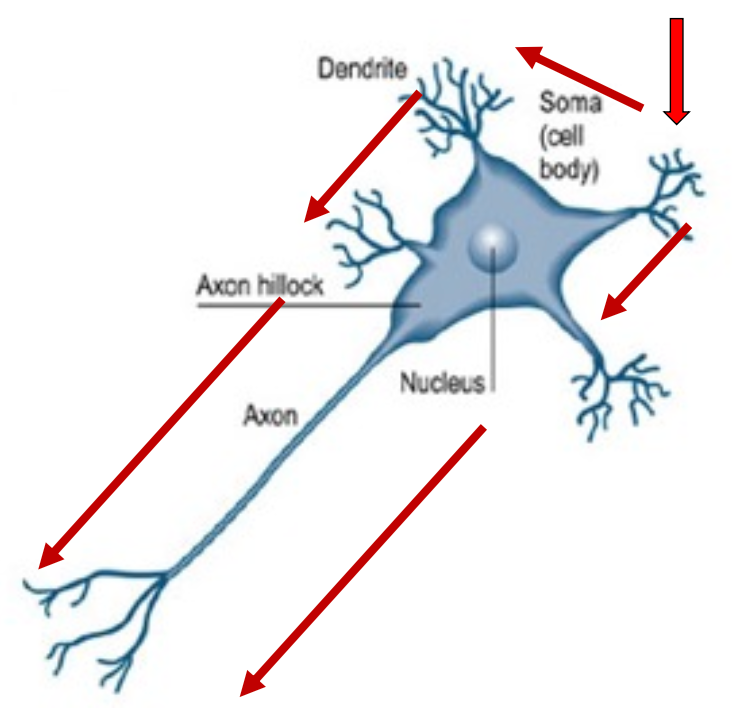
The neuron consists of dendrites, a soma (cell body) containing the nucleus, the axon hillock, and the axon, which ends in terminals. Dendrites receive incoming signals and carry them toward the soma. The soma integrates all incoming signals. If the summed depolarisation reaches threshold at the axon hillock, which acts as the trigger zone, an action potential is initiated there. The action potential then travels along the axon to the terminals, which pass the signal to the next cell. In the living neuron, information therefore flows in one direction only: dendrite, soma, axon hillock, axon, terminal.
2. Local circuits and propagation of the action potential
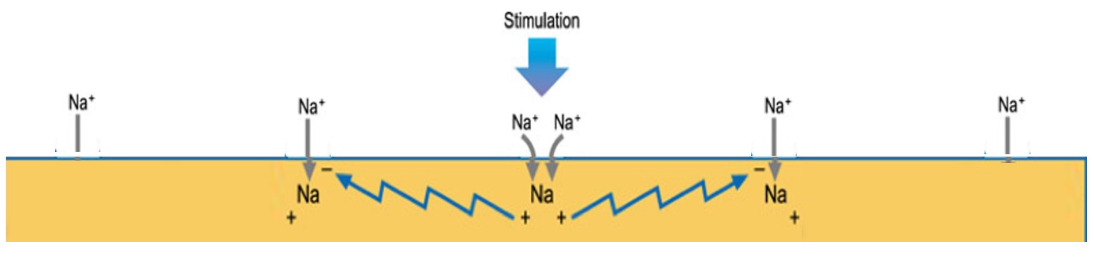
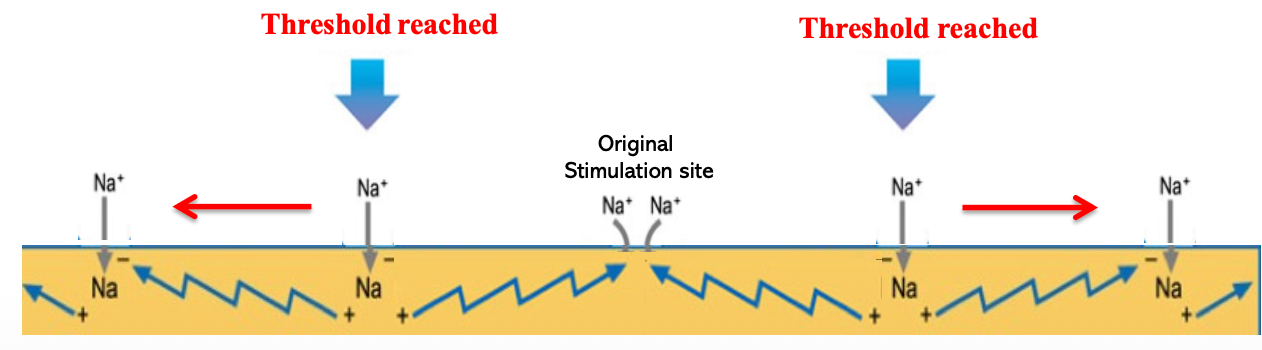
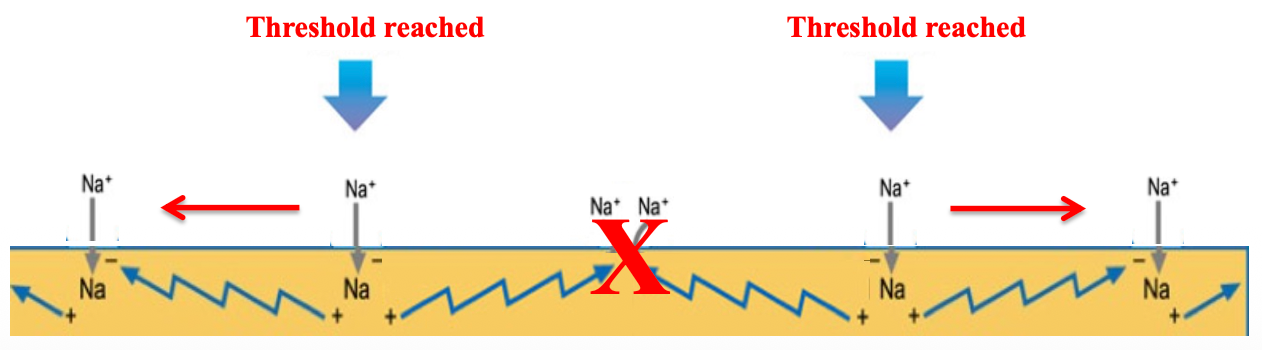
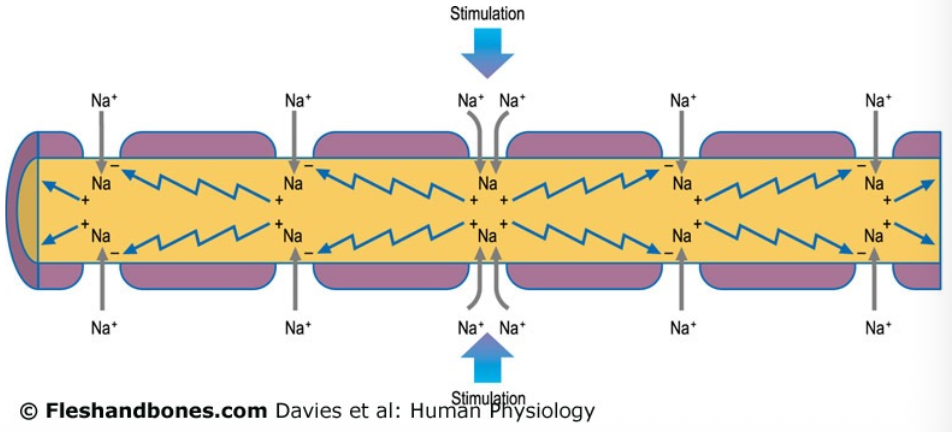
When an action potential is generated at one point of the membrane, Na+ rushes in and the inside of that region becomes positive. These positive charges spread passively along the inside of the fibre, forming local circuit currents. The local current depolarises the neighbouring regions of membrane, and when a neighbouring region reaches threshold, its voltage gated Na+ channels open and a complete new action potential is generated there. This repeats from segment to segment, so the action potential propagates along the whole axon. Because the action potential is regenerated at every new site and is all or none, it does not weaken with distance. If a fibre is stimulated at its midpoint, the local current spreads to both sides and two action potentials travel away from the stimulation site in opposite directions, exactly as shown in the slide diagrams.
3. The refractory period makes propagation one way only
Although local currents can in principle spread in both directions, in the body the action potential normally starts at the axon hillock and travels toward the terminals, and this is guaranteed by the refractory period. Immediately after firing, the stretch of membrane just behind the advancing action potential is refractory: its Na+ channels are inactivated and cannot reopen for a short time. A refractory region cannot be brought to threshold again, so the impulse can never turn back on itself. The refractory period therefore ensures propagation in one direction only and keeps successive action potentials separate events. It also sets the maximum firing frequency of the neuron.
4. Saltatory conduction
In myelinated axons, the myelin sheath insulates the membrane, and voltage gated Na+ channels are concentrated at the nodes of Ranvier, the gaps between myelin segments, spaced about 1 to 3 mm apart. Action potentials are therefore generated only at the nodes. The Na+ influx at one active node depolarises the inside of the cell for up to 3 mm along the axon, which is enough to bring the next node to threshold. The action potential appears to jump from node to node, and this is called saltatory conduction. It is much faster than the continuous conduction seen in unmyelinated fibres, and it is cheaper in energy terms, because ion exchange is confined to the nodes and less Na+ must be pumped back out of the cell afterwards.
5. Myelin: production, structure and function
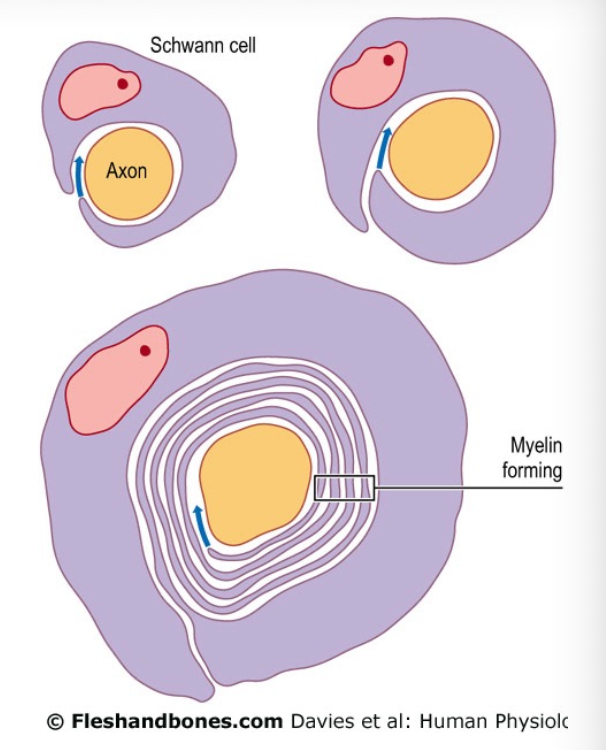
Myelin is produced by glial cells: Schwann cells in the peripheral nervous system and oligodendrocytes in the central nervous system. It consists of many layers of glial membrane wrapped around the axon, and these layers contain sphingomyelin, a lipid that acts as an electrical insulator. This insulation is precisely what makes saltatory conduction possible.