Definition
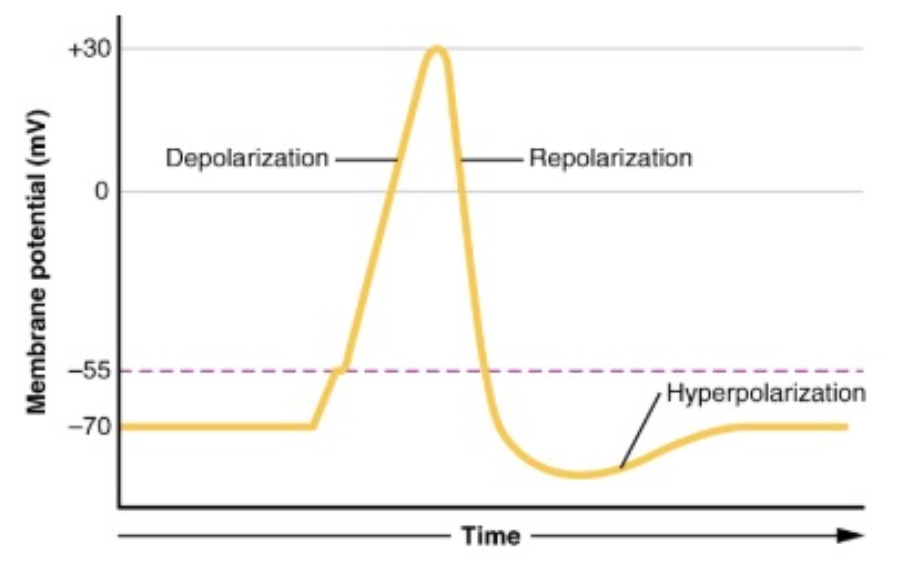
A rapid, transient reversal of the membrane potential in an excitable cell (neuron or muscle fibre): the interior flips from about −70 mV (resting membrane potential, RMP) to about +30 mV and back, in roughly 1 ms. It is the unit of long distance electrical signalling along axons. It requires voltage gated ion channels, which are proteins built from subunits; channels can also be ligand gated or mechanosensitive.
Threshold
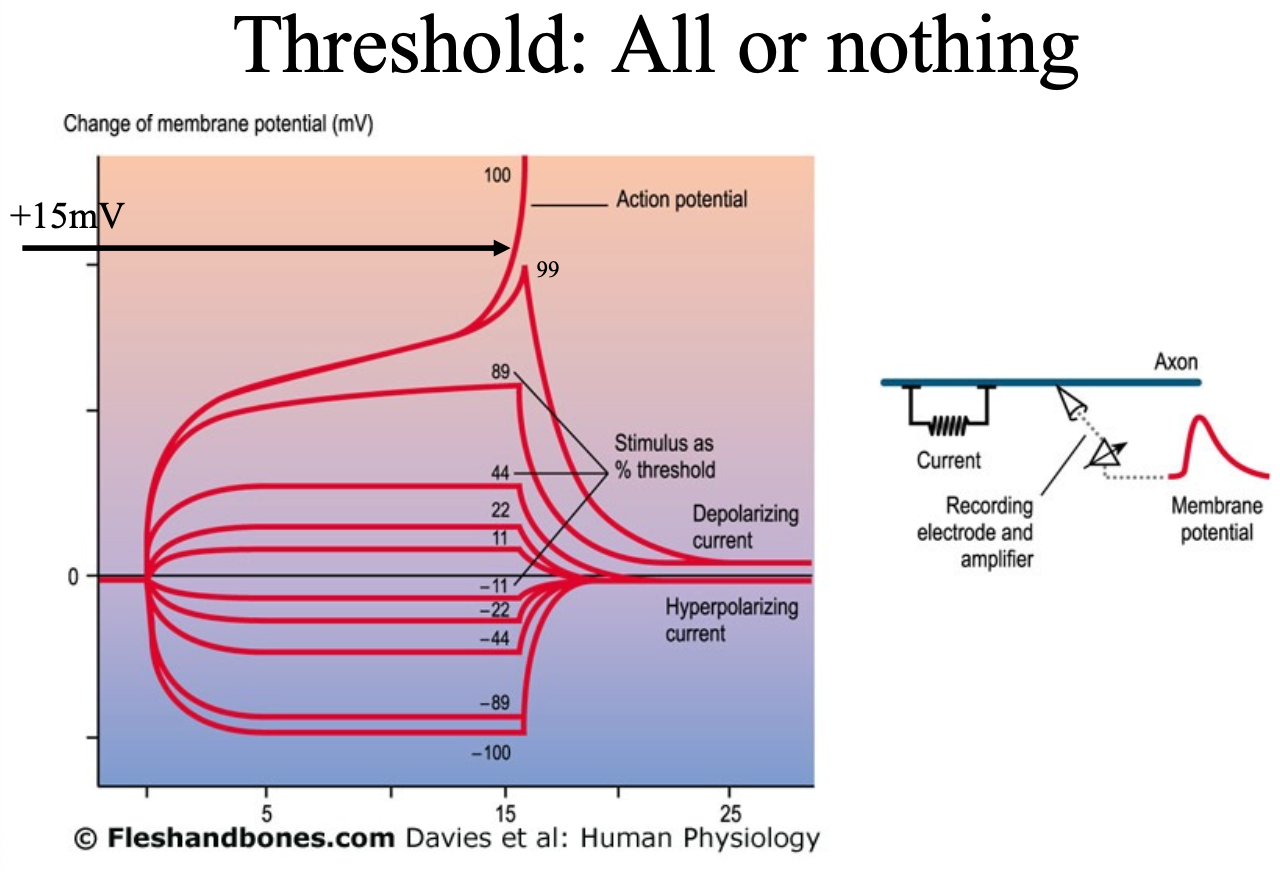
The critical depolarisation needed to fire an AP, about +15 mV above RMP (from −70 mV to ≈ −55 mV). Depolarisations that stay below threshold produce only small graded potentials that fade out; crossing threshold opens voltage gated Na⁺ channels in a regenerative, self reinforcing way and the full AP follows.
Only depolarising stimuli can fire an AP; hyperpolarising currents never do, however strong. Subthreshold responses are graded: the closer the stimulus gets to threshold (e.g. 11% → 89% of threshold), the larger the local potential, but all fade out. At 100% of threshold the response jumps abruptly to a full AP, which is the experimental proof of the all or nothing law.
All or nothing
If threshold is reached, the AP fires always at the same full amplitude (peak ≈ +30 mV); if threshold is not reached, nothing happens. Stimulus strength does not change AP size; stronger stimuli are coded as higher firing frequency, not bigger APs.
Self propagating
The AP is regenerated at full size at every point along the axon: local current from the active region depolarises the neighbouring membrane to threshold, opening its Na⁺ channels. The signal therefore travels without decaying, and it travels in one direction only because the region just behind is refractory.
The three phases (the curve)
-
Depolarisation (rising phase): threshold reached → activation gates of Na⁺ channels open → Na⁺ rushes in (conductance rises up to ×5000) → positive feedback drives the membrane toward +30 mV, close to the Na⁺ equilibrium potential.
-
Repolarisation (falling phase): Na⁺ inactivation gates close and voltage gated K⁺ channels (slower to open) finally open → K⁺ leaves the cell → the interior becomes negative again.
-
Hyperpolarisation (undershoot): K⁺ channels are slow to close, so K⁺ keeps leaving and the membrane dips below RMP, toward the K⁺ equilibrium potential (≈ −80 mV), before returning to rest. This phase matches the relative refractory period.
Voltage gated Na⁺ channel gates
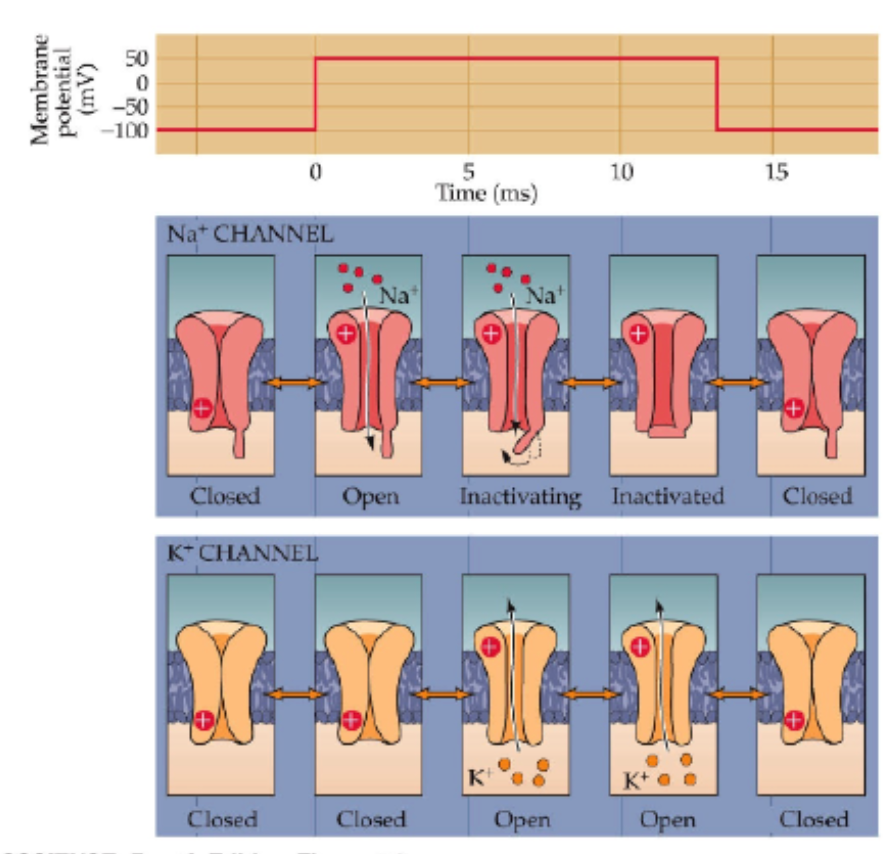
Each channel has two gates. The activation gate opens fast when the membrane depolarises to threshold. The inactivation gate closes shortly afterwards, automatically, even while depolarisation persists. States: closed but available at rest (activation shut, inactivation open) → open at threshold (both open, Na⁺ influx, conductance ×5000) → inactivated at the peak (inactivation shut, no Na⁺ flow) → back to closed and available once repolarisation resets both gates. The inactivated state is the molecular basis of the absolute refractory period.
Voltage gated K⁺ channels and repolarisation
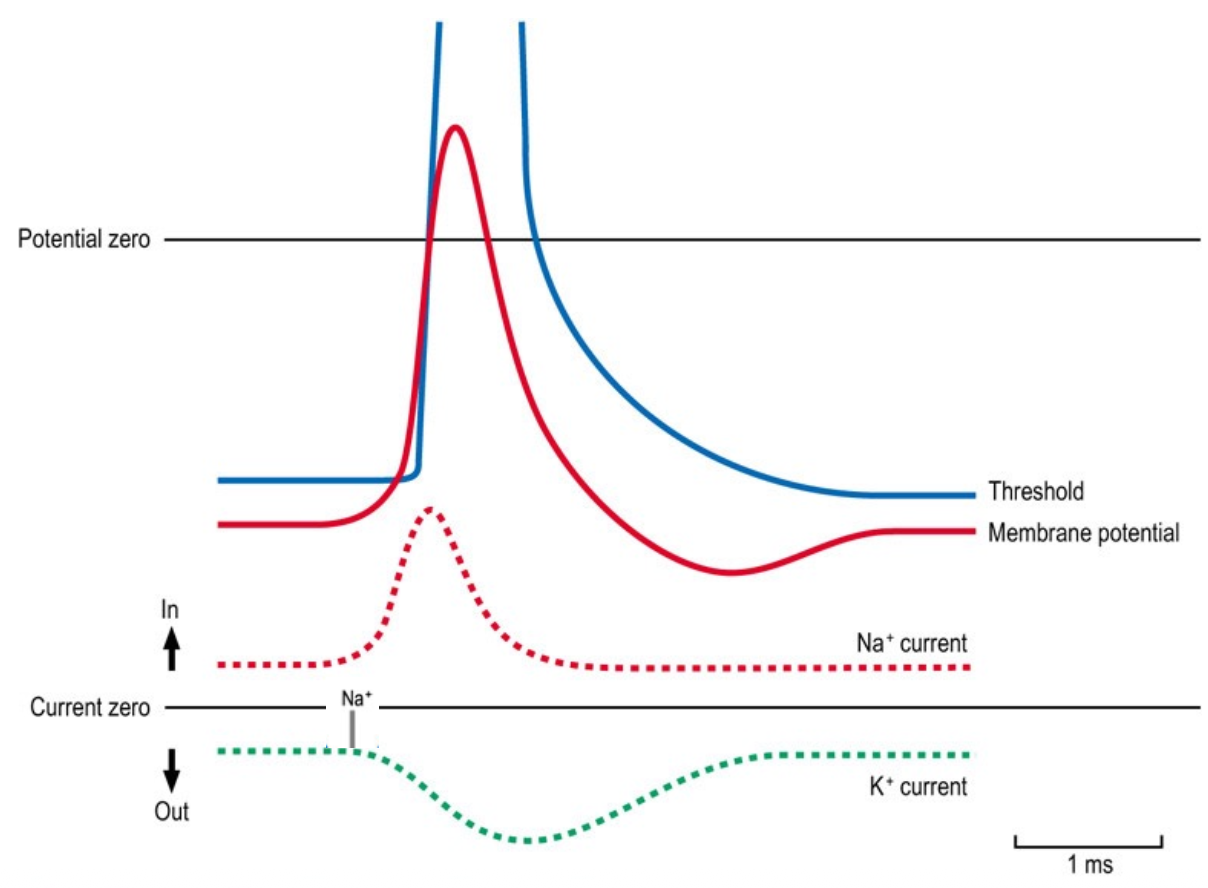
One slow activation gate, opened by the same depolarisation but with a delay. Their late opening, combined with Na⁺ channel inactivation, ends the upstroke: outward K⁺ current repolarises the membrane, and because they close slowly the membrane transiently hyperpolarises. On the current trace: the Na⁺ current is brief and inward (fast activation, fast inactivation), while the K⁺ current is delayed, outward and longer lasting, matching repolarisation and the undershoot.
Channel state sequences to memorise: Na⁺ channel goes closed → open → inactivating → inactivated → closed; the K⁺ channel goes closed → closed → open → open → closed. The key point is timing: the K⁺ channel opens with a clear delay relative to the Na⁺ channel, and that delay is what allows depolarisation to develop before repolarisation begins.
Refractory periods
-
Absolute: from the upstroke through most of repolarisation. No stimulus, however strong, can trigger a second AP, because Na⁺ inactivation gates are shut and cannot reopen until the membrane repolarises. Function: enforces one way propagation and caps maximum firing rate.
-
Relative: during hyperpolarisation. A second AP is possible but only with a stronger than normal stimulus, because the membrane sits further from threshold and K⁺ is still leaving; some Na⁺ channels have recovered. Duration is more variable than the absolute period.
Graphically, threshold is not fixed: during the spike it rises off scale, so no stimulus can reach it (absolute refractory period), and during hyperpolarisation it gradually settles back toward normal, so only a stronger than normal stimulus can reach it (relative refractory period). The refractory periods can therefore be read directly from the threshold curve, not just from the membrane potential curve.
Key numbers to memorise
RMP −70 mV, threshold −55 mV (+15 mV above RMP), peak +30 mV, Na⁺ conductance up to ×5000, duration ≈ 1 ms.