Definition
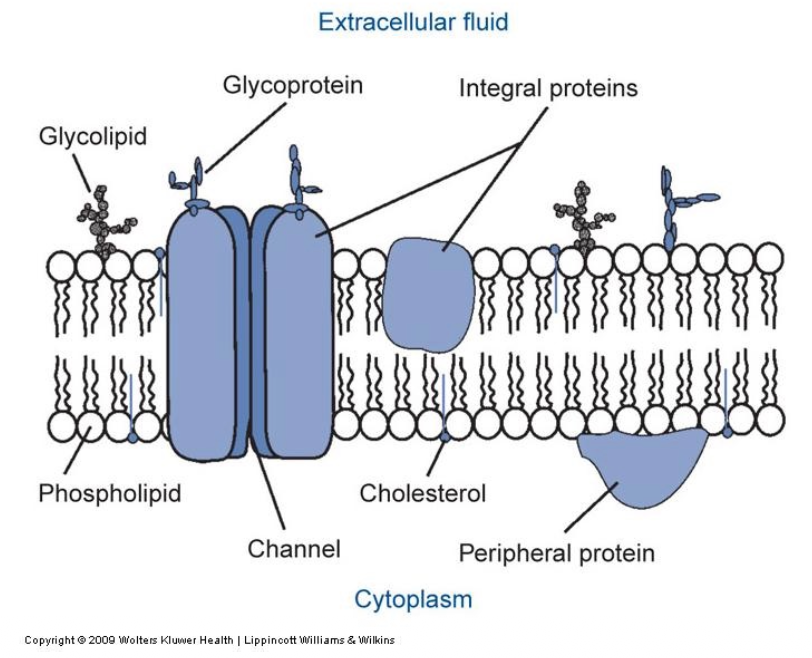
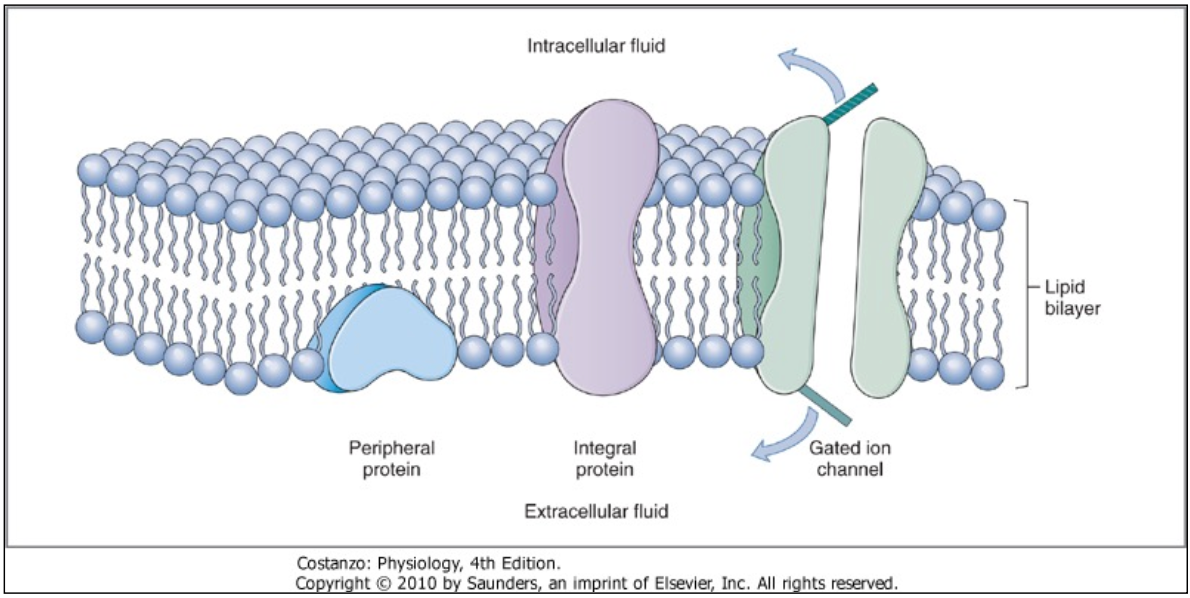
A thin (~7.5 nm), selectively permeable barrier that encloses every cell, separating the intracellular fluid (cytoplasm) from the extracellular fluid. It is structured as a phospholipid bilayer with embedded proteins (the fluid mosaic model): lipids form the matrix, proteins carry out most specific functions. Its key physiological role is controlling what enters and leaves the cell, this is the basis of the membrane potential that underlies all nerve signalling. Its main components are:
-
Phospholipid bilayer: The structural matrix. Amphipathic molecules: hydrophilic heads face the intra/extracellular fluid, hydrophobic tails face inward. Impermeable to ions and polar molecules. This is what allows charge separation (membrane potential).
-
Cholesterol: Interspersed between phospholipids; modulates membrane fluidity and stability (prevents it becoming too rigid or too fluid).
-
Integral (transmembrane) proteins: Span the entire bilayer. Serve as channels, carriers/pumps, receptors, and enzymes, meaning, they mediate in selective transport and signal transduction.
-
Channel proteins: Form water-filled pores allowing passive ion diffusion (down electrochemical gradients), e.g., Na⁺, K⁺, Cl⁻, Ca²⁺ channels.
-
Gated ion channel: A channel that opens/closes in response to a stimulus (voltage, ligand, or mechanical). Fundamental to action potential generation in neurons.
-
Peripheral proteins: Loosely attached to one membrane surface (usually intracellular); act as enzymes or structural anchors (cytoskeleton attachment), support signalling cascades.
-
Glycoprotein: Protein with an attached carbohydrate chain on the extracellular surface; functions in cell recognition, receptors, and cell–cell adhesion.
-
Glycolipid: Lipid with an extracellular carbohydrate chain; contributes to the glycocalyx (cell surface coating) — cell identity and recognition.
Neurophysiology relevance in one line
the lipid bilayer provides the insulating barrier; the ion channels and pumps (integral proteins) create and exploit the ionic gradients that produce resting and action potentials.