Definition
Ascending tracts are the pathways that carry somatosensory information from the receptors of the body up through the spinal cord and brainstem to the thalamus and, from there, to the somatosensory cortex. Each system is organised as a chain of three neurons: a first order neuron running from the receptor, a second order neuron that crosses the midline and reaches the thalamus, and a third order neuron projecting from the thalamus to the cortex. Two systems carry the exam weight: the dorsal column medial lemniscal system and the anterolateral (spinothalamic) system.
Dorsal Column Medial Lemniscal System
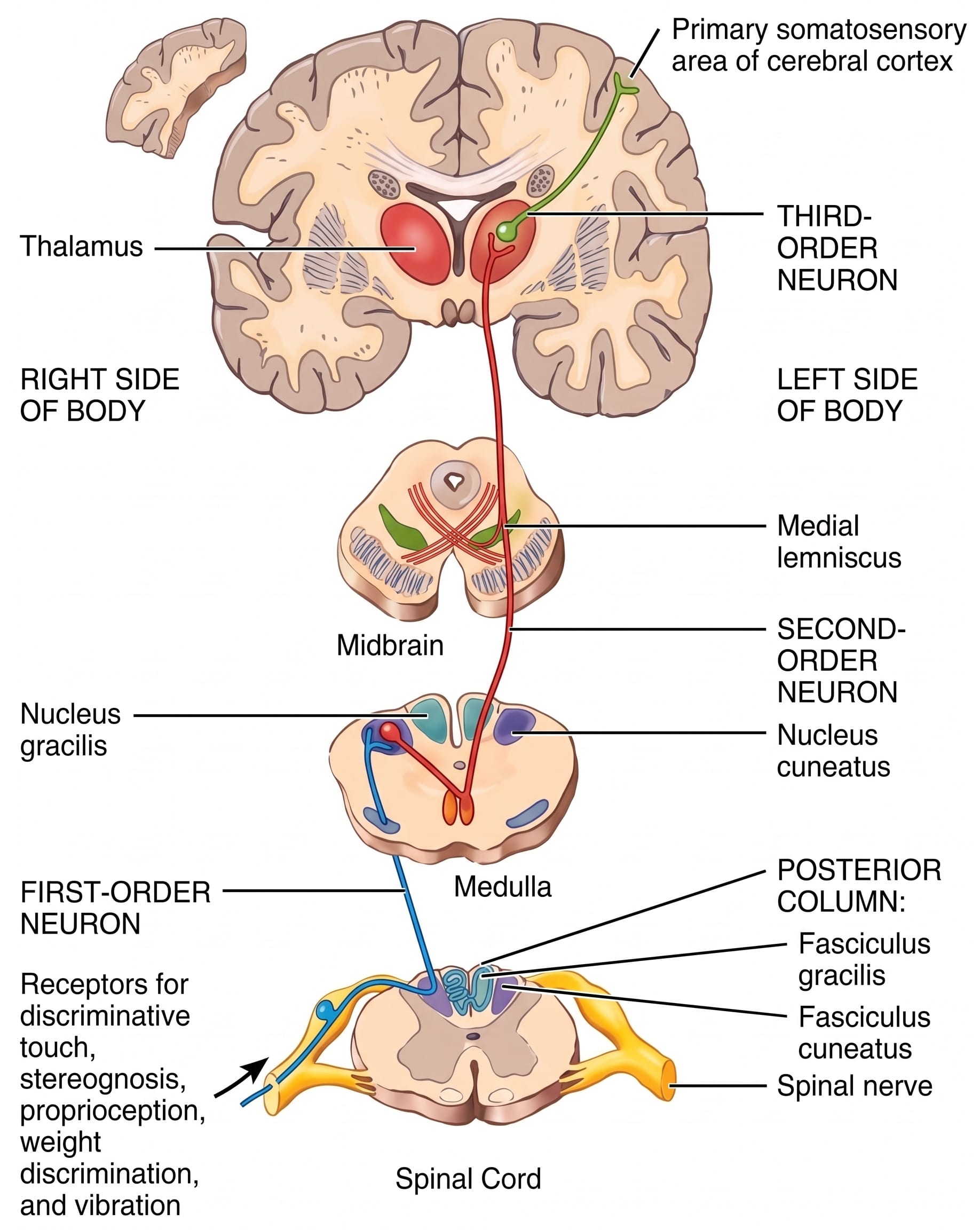
Carries tactile sensation and proprioception, the discriminative side of somatic sensation.
The first order neurons are mainly Aβ fibres, the large, fast, myelinated afferents for touch and pressure. Their central processes ascend the spinal cord without crossing and terminate in the dorsal column nuclei in the medulla, which is the first synapse of the pathway.
The second order neurons have their cell bodies in these nuclei. Their axons cross the midline in the medulla and then project to the thalamus. This crossing is the reason each cerebral hemisphere receives touch and proprioceptive information from the opposite side of the body.
The third order neurons project from the thalamus to the somatosensory cortex, where the conscious perception of touch and body position is generated.
Anterolateral System (Spinothalamic)
Carries temperature and pain, the protective side of somatic sensation.
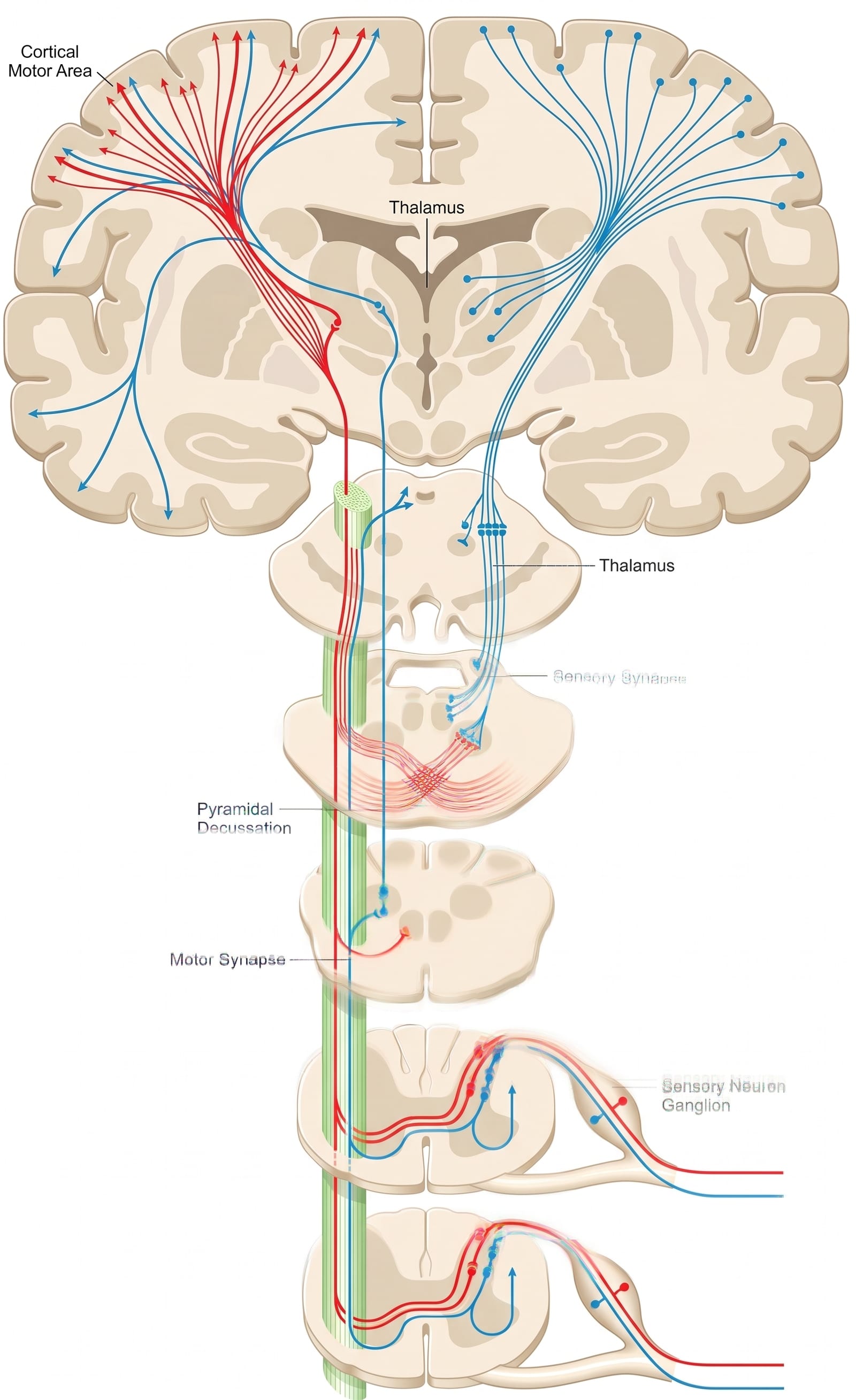
The first order neurons are Aδ and C fibres, thin and slow compared with Aβ: Aδ carries fast, sharp pain and cold, C carries slow, dull pain and warmth. Unlike the dorsal column system, these fibres terminate in the spinal cord itself, synapsing shortly after entering.
The second order neurons cross the midline within the spinal cord and ascend to terminate in the thalamus, specifically in its ventral posterior complex (VP).
The third order neurons project from the thalamus to the somatosensory cortex, as in the dorsal column system.
Key contrast: the dorsal column system crosses in the medulla; the anterolateral system crosses in the spinal cord. Same three neuron plan, different crossing point, different fibre type, different modality.
Side by Side Comparison
| Feature | Dorsal column medial lemniscal | Anterolateral (spinothalamic) |
|---|---|---|
| Modalities | Tactile sensation and proprioception | Temperature and pain |
| First order fibres | Mainly Aβ | Aδ and C |
| First order termination | Dorsal column nuclei in the medulla | Spinal cord |
| Second order crossing | Crosses in the medulla, then projects to the thalamus | Crosses in the spinal cord, terminates in the ventral posterior complex (VP) |
| Third order | Thalamus to somatosensory cortex | Thalamus to somatosensory cortex |
Other Ascending Tracts
Beyond the two conscious pathways, the spinal cord gives rise to smaller tracts named after their targets, each serving adjustment and coordination rather than perception.
-
Spinoreticular tract: ascends together with the anterolateral system to the reticular formation of the brainstem. It carries the arousal and affective side of pain, the unpleasantness and autonomic activation that accompany a noxious stimulus, rather than its location or quality.
-
Spinocerebellar tracts: carry proprioceptive information from muscle spindle and related afferents directly to the cerebellum (lower body afferents relay in Clarke’s nucleus). This is the input the cerebellum uses to coordinate movement; it never reaches consciousness.
-
Spino olivary tract: projects from the cord to the inferior olive, whose climbing fibres supply the cerebellum with a training signal that adjusts movement circuits.
The Thalamus as the Sensory Relay
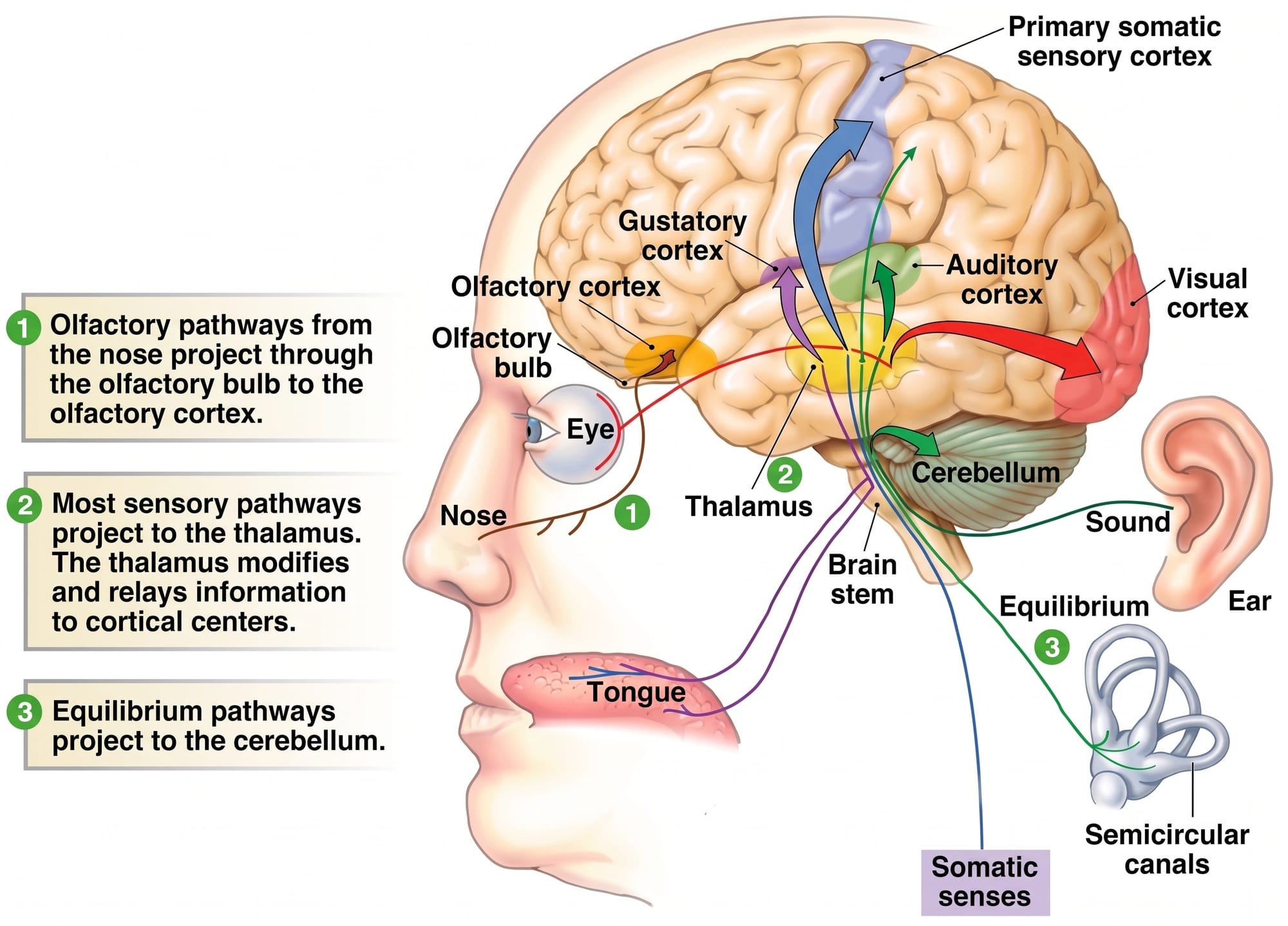
The figure places both systems in the wider plan of sensory projection: most sensory pathways project to the thalamus, which modifies and relays the information to the cortical centres. The exceptions are olfaction, which projects from the nose through the olfactory bulb directly to the olfactory cortex, and equilibrium pathways, which project to the cerebellum.
Summary
Summary
Ascending tracts are three neuron chains that carry somatosensory information from the body to the cortex, with the thalamus as the relay that modifies and forwards nearly all sensory input; the figure’s exceptions are olfaction, which goes straight to its cortex, and equilibrium, which goes to the cerebellum. The two exam systems split the work by modality, touch and proprioception by the dorsal column medial lemniscal route and pain and temperature by the anterolateral route, and the single sharpest discriminator between them is where they cross: medulla versus spinal cord. The remaining spinoreticular, spinocerebellar and spino olivary tracts serve arousal, cerebellar coordination and motor adjustment rather than conscious perception.