Definition
The primary somatosensory cortex (SI) is the cortical region that brings somatic sensory signals into conscious awareness, registering their intensity and location. It occupies the postcentral gyrus of the parietal lobe and holds an orderly map of the body.
Location and fields
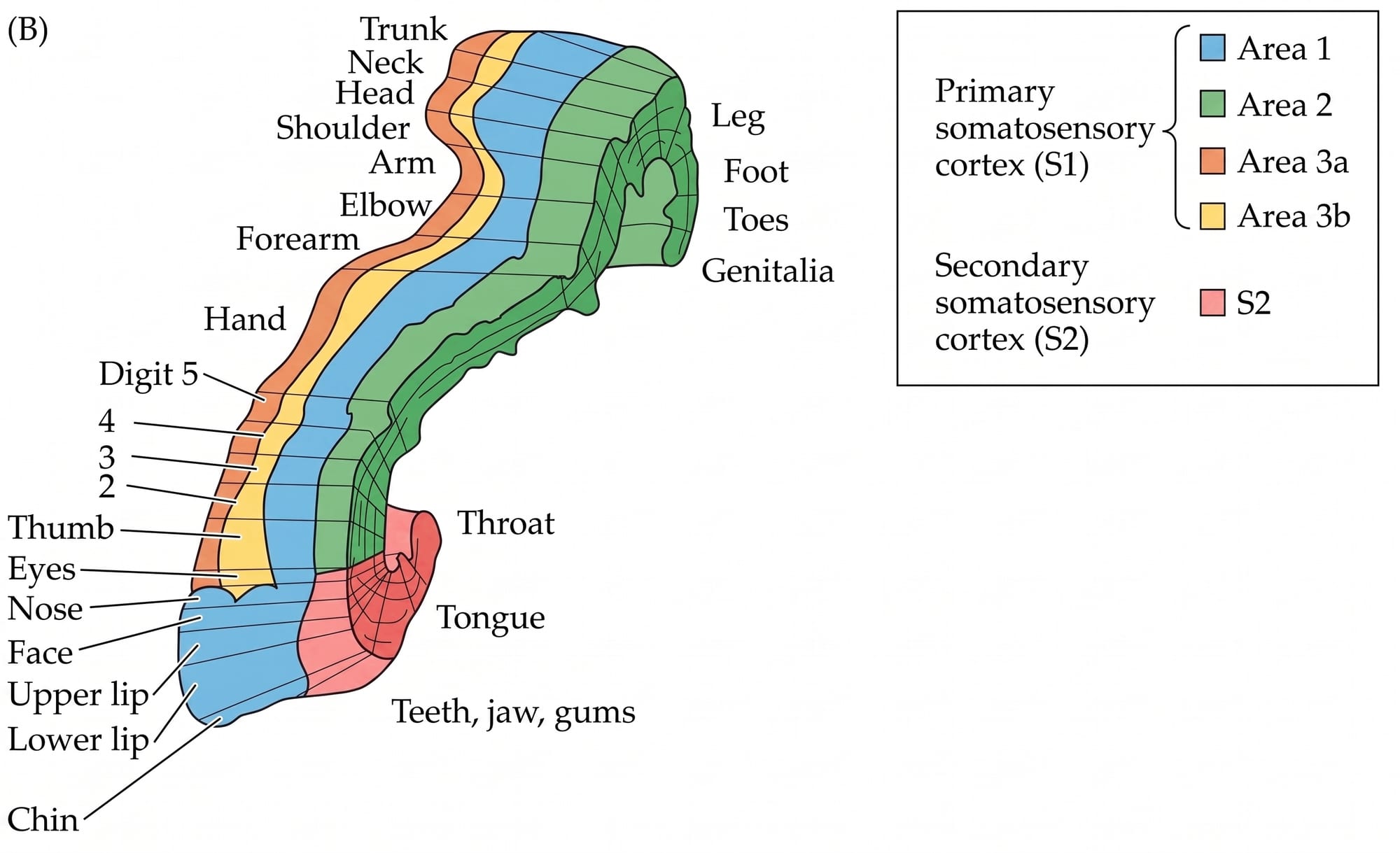
SI sits in the postcentral gyrus of the parietal lobe, directly behind the central sulcus. It is divided into four distinct fields, Brodmann areas 3a, 3b, 1 and 2, each containing its own complete representation of the body.
The somatotopic map: the homunculus
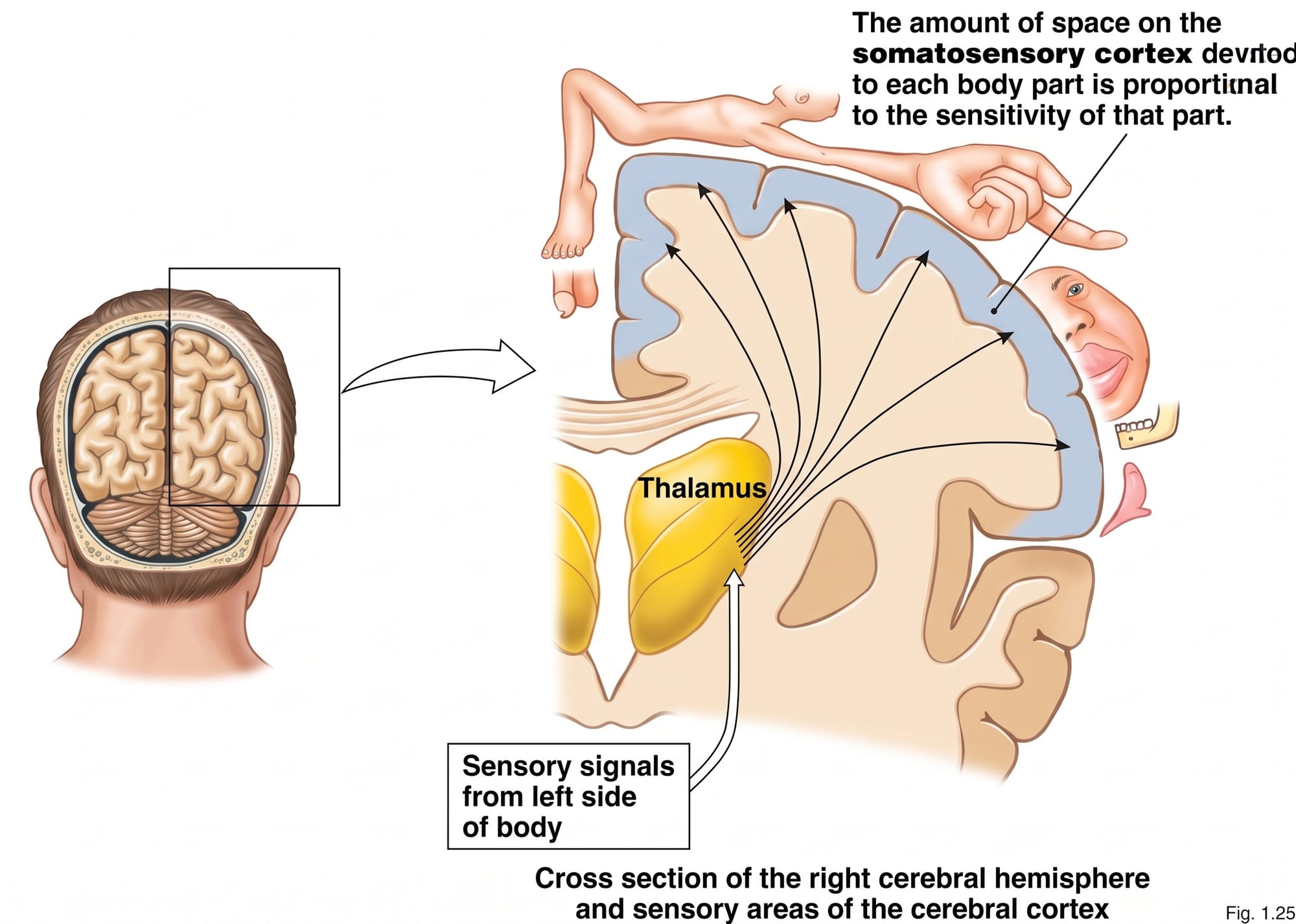
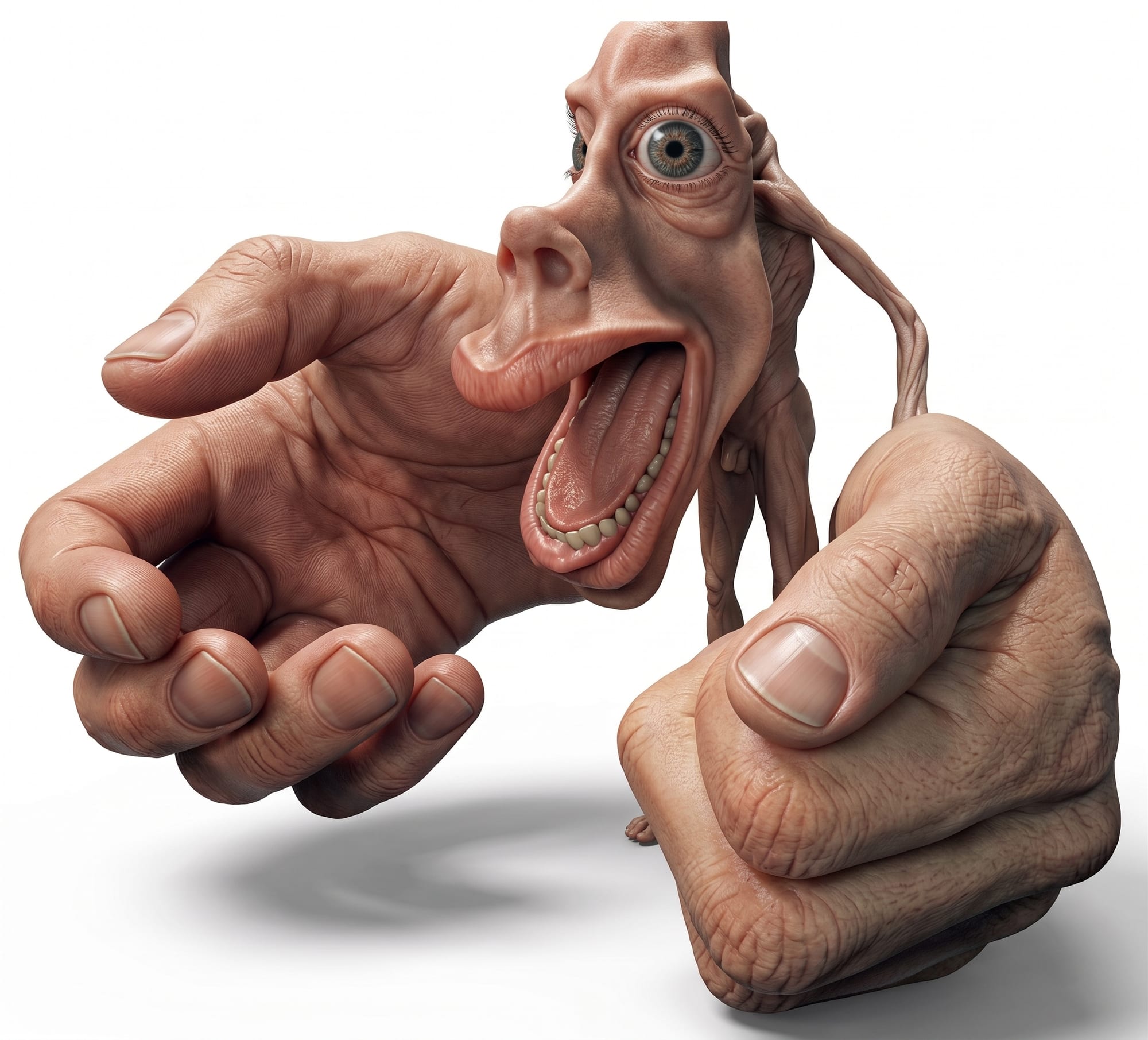
The body is mapped onto SI in a somatotopic arrangement, so neighbouring body parts are processed by neighbouring patches of cortex, and each hemisphere represents the opposite side of the body. Drawn onto the cortex this map produces the homunculus, a distorted figure whose proportions reflect sensitivity rather than physical size: the amount of cortex devoted to each body part is proportional to the sensitivity of that part. Parts serving critical functions receive a greater representation, the classic example being the face and lips, reflecting the importance of facial expression.
Functional columns and modality areas
Neurons in SI are grouped into functionally distinct columns running through the depth of the cortex, so the cells within one column share the same response properties. Fast adapting and slow adapting neurons are found in different areas of the map rather than being intermixed. The four fields also divide the work by modality: 3b and 1 handle cutaneous stimuli (pain and temperature), 3a handles proprioception, and area 2 processes both tactile input from mechanoreceptors and proprioception.
Beyond SI
SI is only the first cortical stage, and from it information travels onwards along several routes. SI sends projections to the secondary somatosensory cortex (SII) in the lateral sulcus, and SII projects in turn to limbic structures, especially the amygdala and hippocampus, giving the stimulus learning and memory significance. SI also projects to other parietal areas, which relay onwards to the motor and premotor areas; this is the route for the integration of sensory and motor information, through which proprioception reaches the circuits that guide movement. Finally, SI sends descending projections back down to the thalamus, brain stem and spinal cord, which fine tune the ascending input, regulating the flow of sensory information on its way up.
Summary
Summary
SI lies in the postcentral gyrus of the parietal lobe and gives conscious awareness of the intensity and location of somatic signals. Its somatotopic map, the homunculus, grants more cortex to sensitive and critical parts, such as the face for facial expression. Its neurons form functional columns with fast and slow adapting cells in different areas, and its fields split the modalities: 3b and 1 cutaneous, 3a proprioception, 2 both. Beyond SI, projections reach SII in the lateral sulcus and onward to the amygdala and hippocampus for learning and memory, pass through parietal areas to motor and premotor cortex for sensorimotor integration, and descend to the thalamus, brain stem and spinal cord to fine tune ascending input.