Definition
Cutaneous Mechanoreceptors are the sensory receptors of the skin that transduce mechanical deformation into electrical signals, providing tactile information. Tactile information is carried mostly by large diameter, myelinated Aβ axons, which conduct rapidly and give the fine spatial and temporal resolution that touch requires.
The four cutaneous mechanoreceptors
Four types of mechanoreceptor mediate touch, and they are classified along two axes: speed of adaptation (slowly adapting versus rapidly adapting) and size of the receptive field (small versus large). Slowly adapting receptors keep firing for as long as the stimulus is applied, so they signal sustained features of the stimulus; rapidly adapting receptors fire only at stimulus onset and offset, so they signal change and motion. Small receptive fields give high spatial acuity; large receptive fields sacrifice detail for sensitivity over a wide area. The four types also differ in depth: Merkel disk receptors and Meissner’s corpuscles sit in the superficial layers of the skin, while Ruffini endings and Pacinian corpuscles lie in the deep layers. The deep receptors have larger receptive fields that can extend across a whole finger or much of the hand.
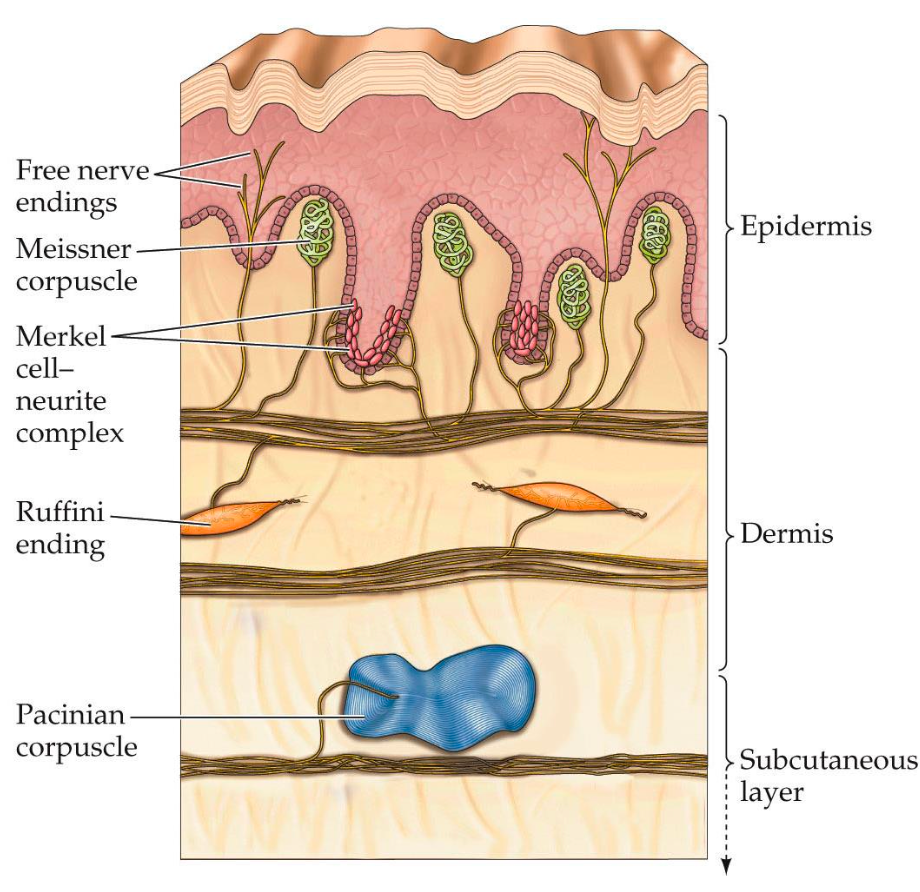
Merkel receptors
Slowly adapting, small receptive field. They respond to form and texture, which is the discrimination that lets you tell cotton from silk. Their effective stimuli are edges, points, corners and curvature, and because they adapt slowly they sustain their response to maintained indentation, giving a continuous readout of fine spatial detail. These are the receptors that let you tell an apple from an orange by form and texture, and that let you feel the corners of a table.
Meissner corpuscles
Rapidly adapting, small receptive field. They mediate fine touch and motion detection, with skin motion as their effective stimulus, and they contribute to grip control: the burst of firing as an object slips across the skin is what allows grip force to be adjusted. Because they adapt rapidly they do not respond to sustained indentation, only to changes. This is why a gentle unchanging touch of the fingertips on the forearm fades after a few seconds: rapidly adapting receptors signal only change, so a constant stimulus quickly stops evoking a response.
Pacinian corpuscles
Rapidly adapting, large receptive field. They respond to pressure, and lying in the dermis and deeper tissues their receptive field can cover an entire finger or hand. Their effective stimulus is vibration, which allows perception of distant events through vibrations transmitted by objects held in the hand, as in tool use.
Ruffini endings
Slowly adapting, large receptive field. They respond to stretch of the skin, giving a sustained signal of tangential force, hand shape and direction of motion across the skin.
| Receptor | Location | Adaptation | Receptive field | Effective stimulus | Sensory function |
|---|---|---|---|---|---|
| Merkel | Tip of epidermal sweat ridges (superficial) | Slowly adapting | Small (9 mm²) | Edges, points, corners, curvature | Form and texture perception |
| Meissner | Dermal papillae, close to skin surface (superficial) | Rapidly adapting | Small (22 mm²) | Skin motion | Motion detection; grip control |
| Pacinian | Dermis and deeper tissues (deep) | Rapidly adapting | Large (entire finger or hand) | Vibration | Perception of distant events through transmitted vibrations; tool use |
| Ruffini | Dermis (deep) | Slowly adapting | Large (60 mm²) | Skin stretch | Tangential force; hand shape; motion direction |
Reading braille
All four mechanoreceptor types respond when reading braille, but they contribute differently. Merkel and Meissner recognise the details of the pattern, combining sustained spatial detail (Merkel) with motion related change (Meissner). Pacinian and Ruffini track the movement and position of the fingers as they scan across the text.
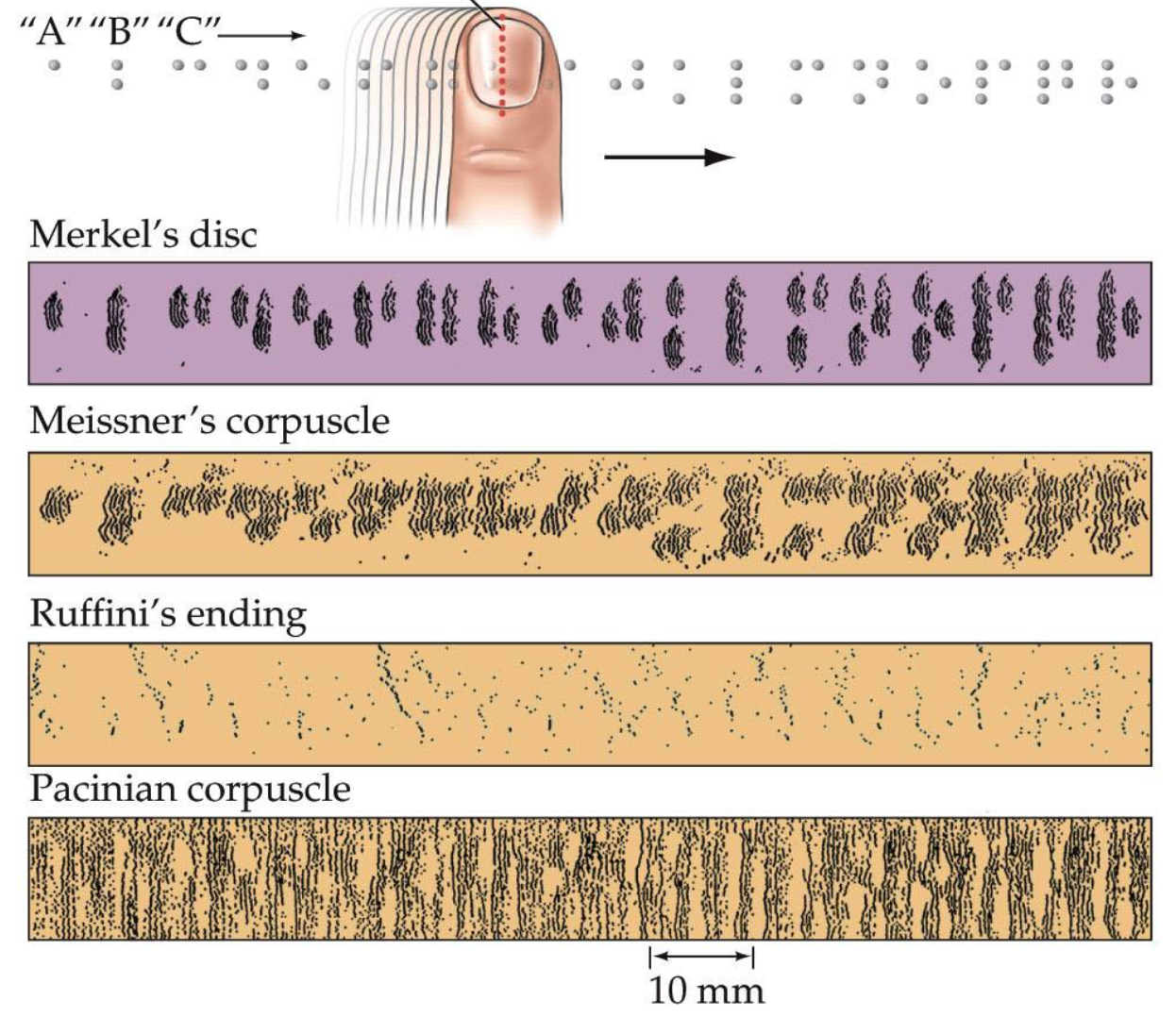
Merkel’s disc is the pattern reader: its contribution is the actual spatial image of the braille characters, since its fine acuity and sustained response to each dot supply the form and texture information that identifies the letter.
Meissner’s corpuscle is the motion detector: its contribution is signalling each dot as a transient event, the skin motion of dot edges crossing the finger, and controlling grip and scanning pressure so the finger keeps gliding steadily over the text.
Ruffini’s ending is the stretch reporter: its contribution is the tangential force and direction of the scanning movement, signalling how the skin deforms and which way the finger is moving across the dots.
Pacinian corpuscle is the vibration reporter: its contribution is the vibration generated by the scanning motion itself (friction between the skin and the paper in this case), helping track the movement of the finger across the surface, which is why it fires almost throughout rather than only at dots.
Together this is the division of labour Purves describes: the small field pair reads what is under the finger, the large field pair reads what the finger is doing.
Summary
Summary
Tactile information travels mainly on large myelinated Aβ axons and is extracted by four mechanoreceptors that divide labour along adaptation speed and receptive field size: Merkel (slowly adapting, small field, form and texture), Meissner (rapidly adapting, small field, fine touch, motion detection and grip control), Pacinian (rapidly adapting, large field, pressure and vibration) and Ruffini (slowly adapting, large field, skin stretch). The small field pair sits superficially and resolves detail; the large field pair lies deep and covers wide areas. In braille reading, Merkel and Meissner read pattern detail while Pacinian and Ruffini track finger movement and position.