Definition
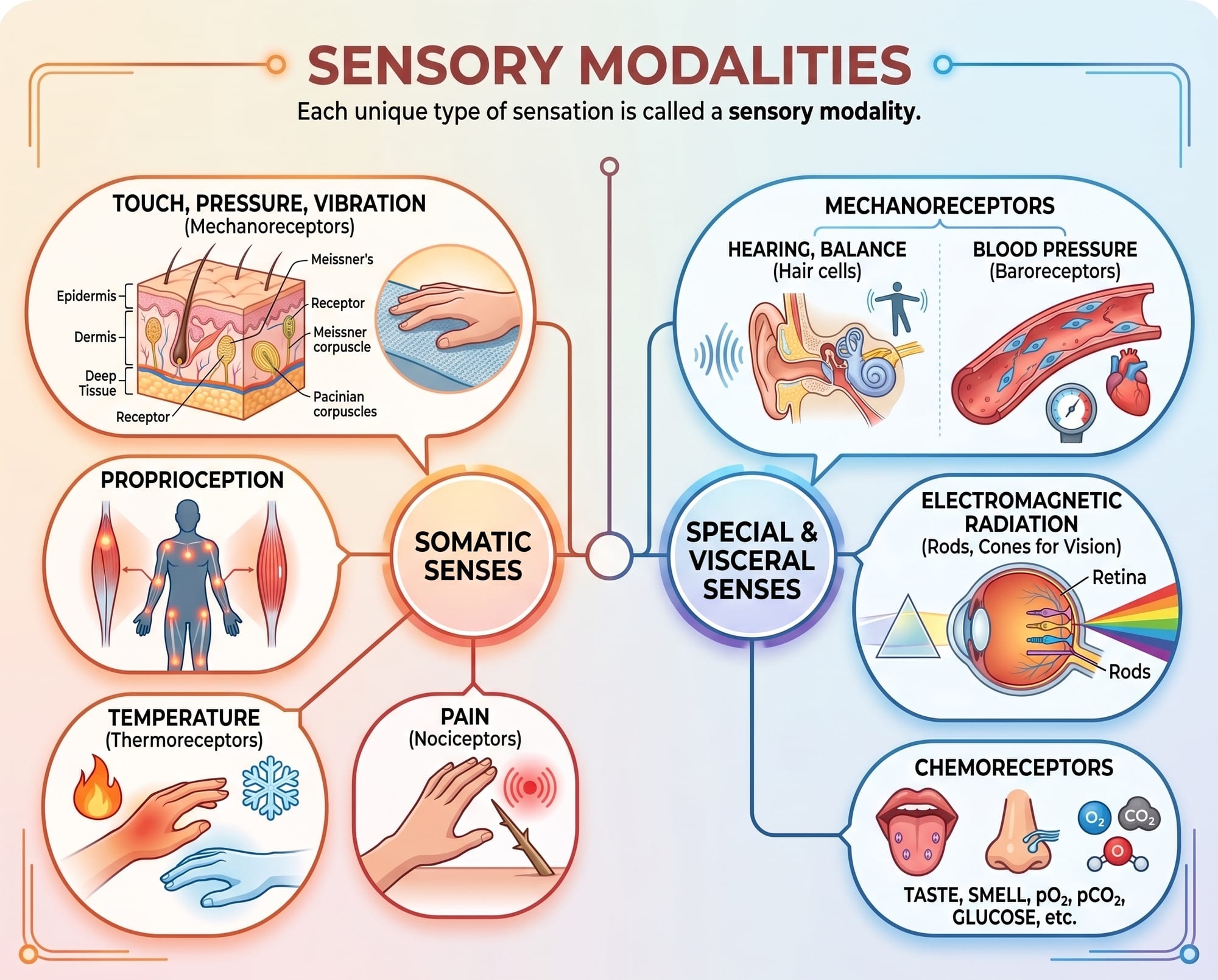
A sensory modality is each unique type of sensation: every distinct quality of experience, such as touch, pain or vision, that the nervous system detects through its own class of receptor.
Somatic modalities
The somatic modalities gather information from the skin and deep tissues. Touch, pressure and vibration are mechanical stimuli detected by mechanoreceptors, which are distributed through the epidermis, the dermis and the deep tissue, so mechanical energy is sampled at different depths. Alongside these sit proprioception, the sense of the position and movement of the body, temperature, detected by thermoreceptors, and pain, detected by nociceptors.
Special senses and visceral modalities
The same receptor logic extends to the special senses and the viscera. Mechanical stimuli are also detected by hair cells, which mediate hearing and balance, and by baroreceptors, which monitor blood pressure. Electromagnetic radiation is detected by rods and cones, while chemoreceptors cover taste and smell together with internal chemical variables such as pO₂, pCO₂ and glucose.