Definition
Thermoreceptors and nociceptors are the free nerve endings of small diameter fibres, either thinly myelinated Aδ or unmyelinated C fibres (see Classification of Nerve Fibres), and they share a common property: they are slowly adapting, so they keep signalling temperature or pain for as long as the stimulus persists.
1. Free nerve endings
Unlike the encapsulated mechanoreceptors of touch, thermoreceptors and nociceptors are free nerve endings without any specialised structure around them. They belong to the slow end of the fibre spectrum: small myelinated Aδ fibres or unmyelinated C fibres, and their slow adaptation means the signal does not fade during a maintained stimulus, which is exactly what you want from a system that warns about tissue danger.
2. Thermoreceptors
Thermoreceptors split into two populations according to fibre type:
- Cold receptors run on Aδ fibres and are more numerous than warm receptors.
- Warm receptors run on C fibres.
So the two innocuous temperature qualities are already separated at the level of the peripheral fibre: cold travels on the faster of the two slow fibre types, warmth on the slowest.
3. Nociceptors
Nociceptors follow the same fibre division, and this explains the classic double sensation of pain after an injury:
- Aδ fibres carry fast pain, the immediate sharp “ouch” you feel the moment you hurt yourself.
- C fibres carry dull, throbbing pain, the delayed, lingering ache that follows.
Same injury, two fibre types, two pain qualities arriving one after the other because of their different conduction velocities.
4. Molecular transducers: TRPV1, TRPM8 and PIEZO2
Transduction is the conversion of a physical stimulus, here temperature or mechanical force, into an electrical signal in the sensory ending. The channels responsible are membrane proteins whose pore opens in response to the stimulus itself, with no intermediary: ions flow through the open pore, the ending depolarises, and the frequency of action potentials fired is roughly proportional to the size of that depolarisation. Since intensity is coded by firing frequency, the rate ranges from a few action potentials per second for weak stimuli up to a few hundred per second at most for intense ones, the ceiling set by the refractory period of the axon, though the exact numbers go beyond the slides.
-
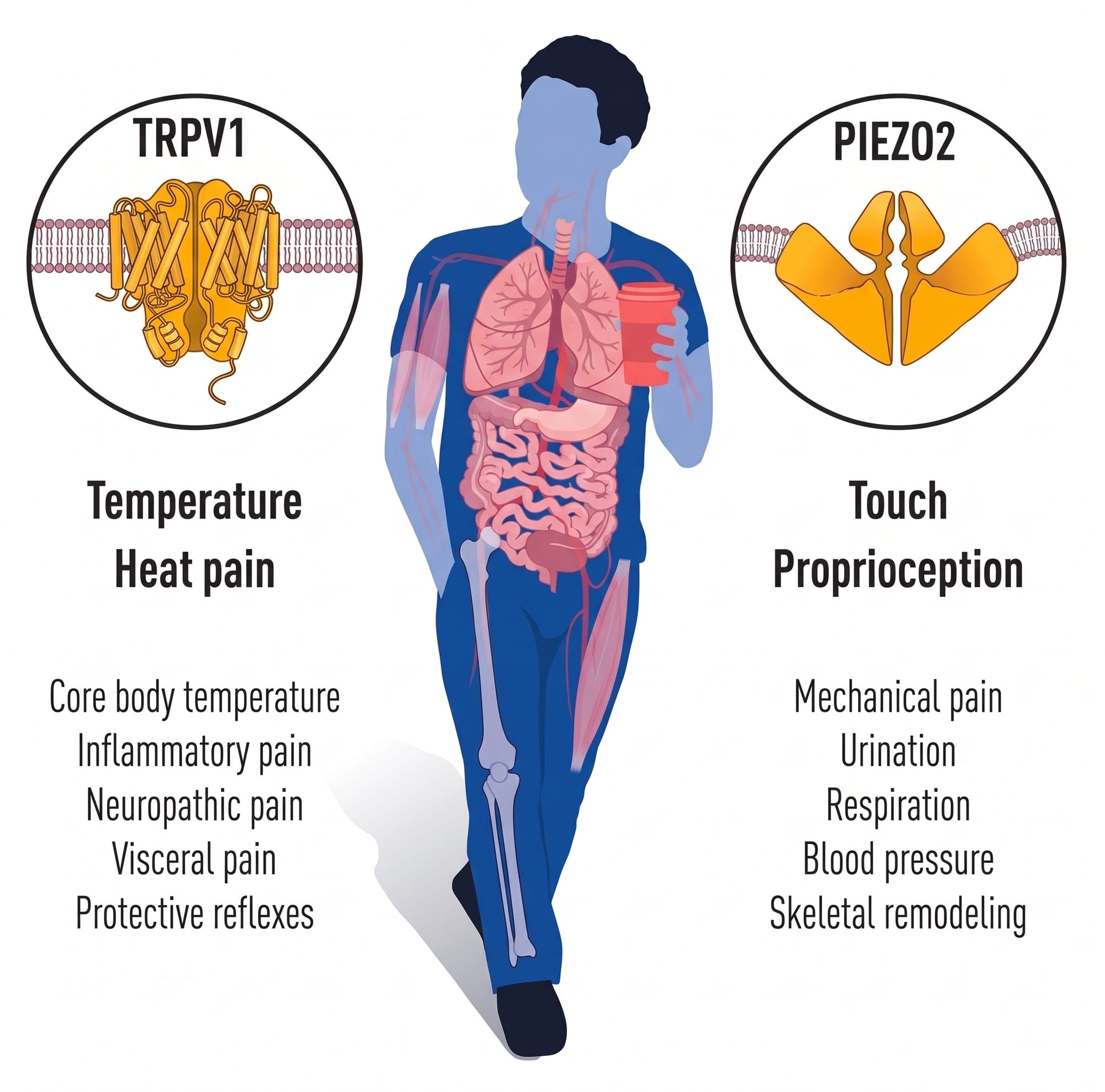
TRPV1: noxious heat. A member of the transient receptor potential (TRP) family, built from four subunits forming a central cation selective pore, and expressed in both Aδ and C nociceptive endings. Heat opens it by displacing membrane lipids associated with the channel, and its activation threshold of around 43 °C matches the threshold at which heat becomes painful. As the slide figure shows, its roles extend to core body temperature, inflammatory, neuropathic and visceral pain, and protective reflexes.
-
TRPM8: cold. Another TRP family channel, this one opened by cold temperatures, giving cold receptors their sensitivity.
-
PIEZO2: touch and proprioception. A mechanosensitive channel with an unusual three subunit structure and large extracellular blades. Tension in the surrounding membrane opens the pore, which is how it converts mechanical deformation into current in touch afferents and proprioceptors. The figure adds its wider roles: mechanical pain, urination, respiration, blood pressure and skeletal remodelling.
The discovery of these receptors for temperature and touch earned David Julius and Ardem Patapoutian the 2021 Nobel Prize in Physiology or Medicine.
Summary
Summary
Thermoreceptors and nociceptors are the receptors themselves: slowly adapting free nerve endings on Aδ or C fibres that detect temperature and pain. The molecular transducers are not separate receptors but the ion channels expressed within those endings, the machinery that opens in response to heat, cold or membrane tension and turns the physical stimulus into an electrical signal. TRPV1, TRPM8 and PIEZO2 are only some of these channels: a wider family divides the whole range between them, each gated at its own threshold, so that innocuous warmth, for example, is transduced by other channels below the 43 °C at which TRPV1 opens and heat becomes painful. In short, the fibre is the detector, the channel is what makes detection possible, and which channel opens determines which quality you perceive.