Definition
Referred pain is pain arising in the internal organs that is perceived instead on the surface of the body.
Convergence theory
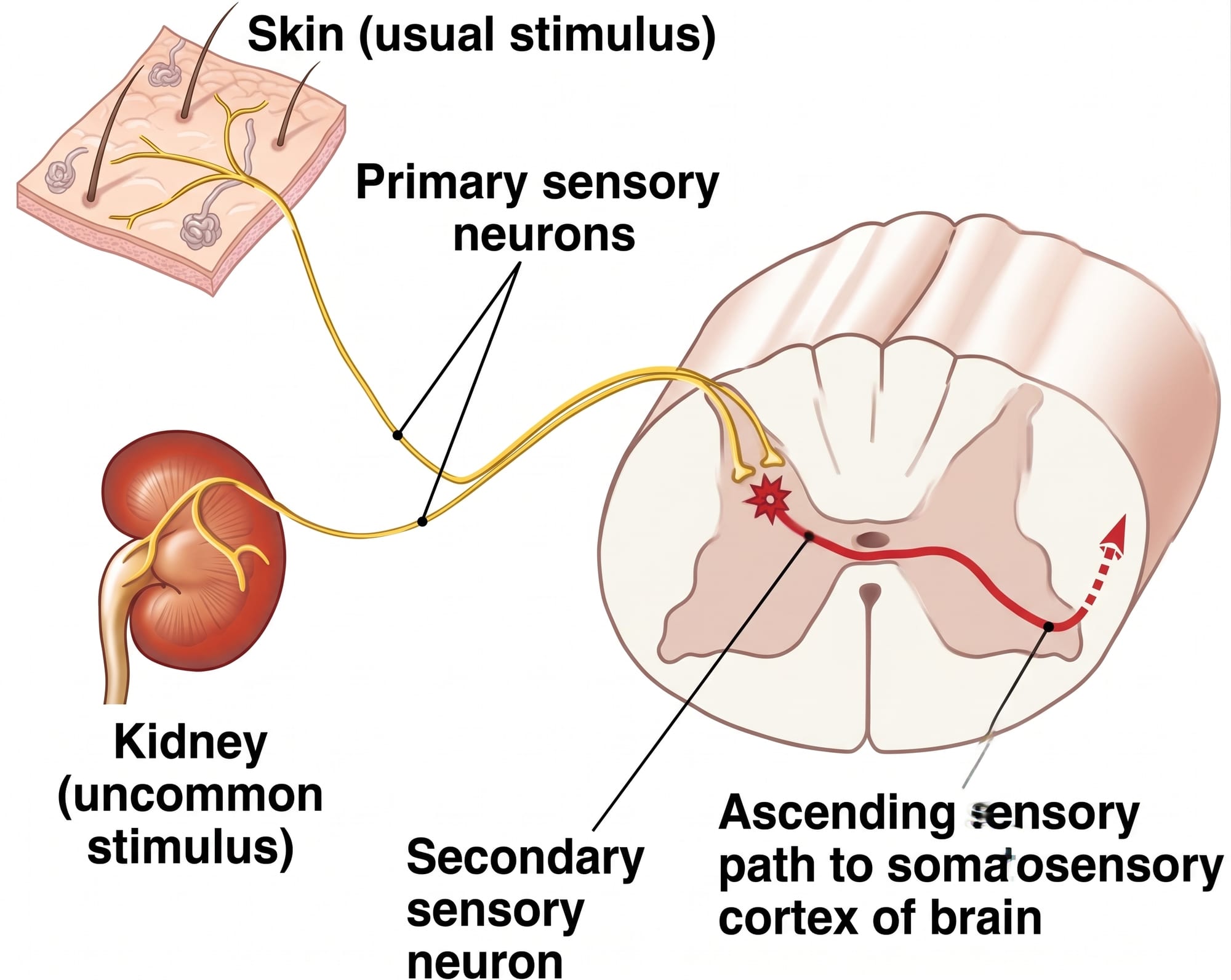
The proposed mechanism is convergence: nociceptors from several locations, visceral and somatic, converge on a single ascending tract in the spinal cord, so a primary sensory neuron from an organ and one from a region of skin synapse on the same secondary sensory neuron, whose ascending path runs to the somatosensory cortex. Because pain signals from the skin are more common than pain from internal organs, the brain associates activation of that pathway with pain in the skin, and the visceral signal is felt on the body surface rather than in the organ itself.
Classic examples
- The heart refers to the chest and left arm.
- The liver and gall bladder refer to the shoulder region.
- The stomach refers to the upper central abdomen.
- The small intestine refers to the umbilical region.
- The colon refers to the lower central abdomen.
- The appendix refers to the periumbilical region.
- The ureters refer to the groin.
In each case the organ and its referral site share the same level of entry into the spinal cord, which is what allows their nociceptors to converge.
As class context beyond the slides, the classic cardiac pattern of chest and left arm pain comes mostly from studies in men, and women having a heart attack more often report less typical distributions, a reminder that much of pain knowledge carries a male bias.
Summary
Summary
Referred pain is visceral pain perceived on the body surface. Visceral and somatic nociceptors converge on the same ascending tract in the spinal cord, and because cutaneous pain is more common the brain attributes the signal to the skin. Classic referrals: heart to chest and left arm, liver and gall bladder to the shoulder region, stomach, small intestine and colon to successive bands of the central abdomen, appendix to the periumbilical region, and ureters to the groin.