Definition
Sensation is the ability of the nervous system to transduce, encode and perceive information from external and internal stimuli: receptors convert the stimulus into electrical signals (transduction), the signals are carried and processed as action potentials (encoding), and the cerebral cortex turns them into conscious experience (perception).
General senses: somatic and visceral
The general sensory system is divided in two. Somatic sensation arises from the body surface and its framework, and responds to mechanical, thermal and chemical stimulation; it is carried by somatic afferent fibres and includes modalities such as touch, temperature and pain. Visceral sensation arises from the internal organs and generally does not reach the level of conscious awareness.
Special senses
Alongside the general senses stand the special senses: vision, hearing, taste, smell and balance. These are handled by dedicated sense organs rather than by the general sensory receptors of skin and viscera.
The three neuron relay to the cortex
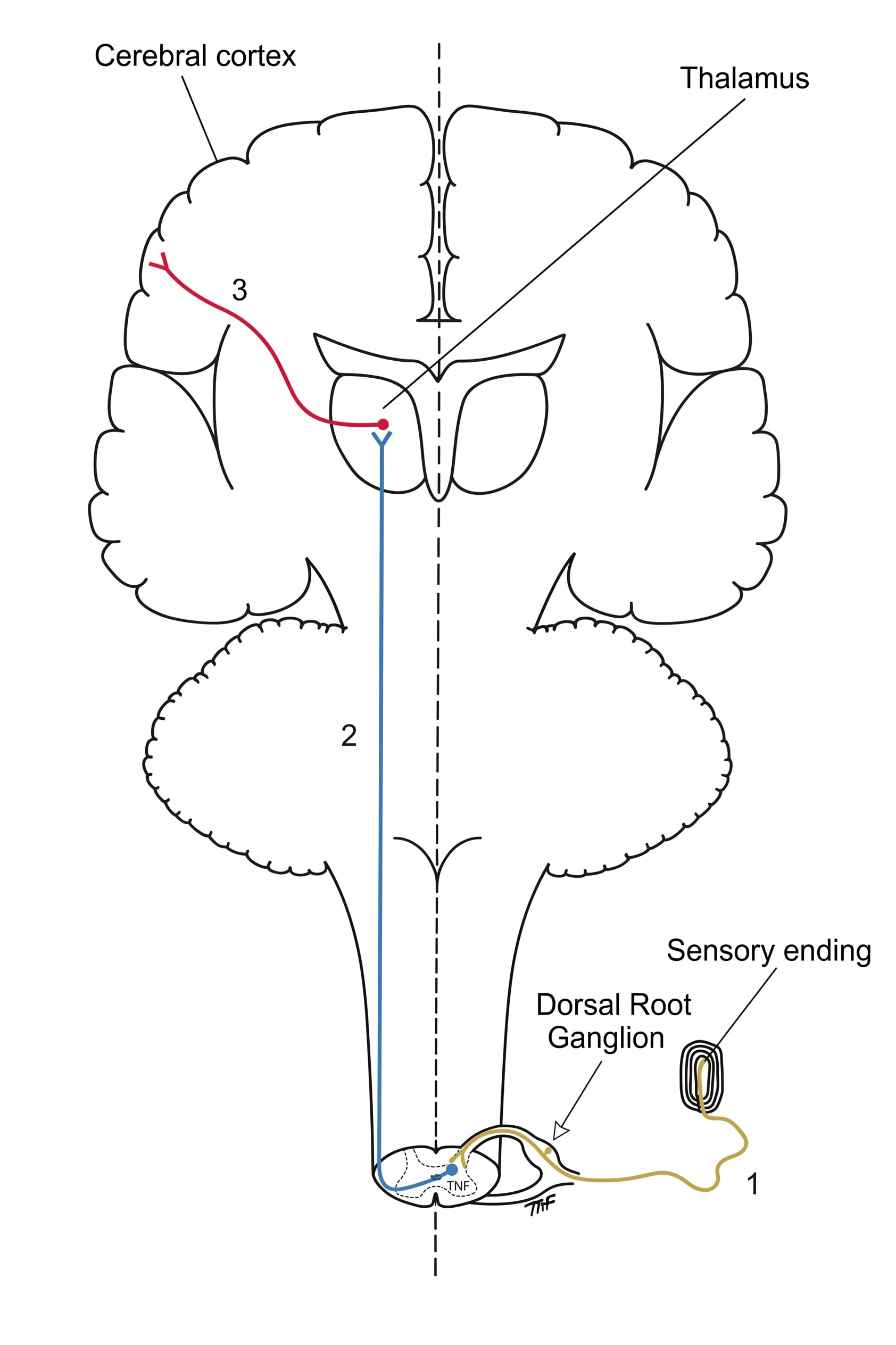
Sensation is perceived in the cerebral cortex, so every sensory pathway must carry information from the site of sensation up to the somatosensory cortex. This is done by a chain of three neurons:
- First order neuron: the peripheral afferent itself, with its cell body in the dorsal root ganglia.
- Second order neuron: located in the spinal cord or the brain stem.
- Third order neuron: located in the thalamus, which relays the signal to the somatosensory cerebral cortex.
Summary
Summary
Sensation transduces, encodes and perceives external and internal stimuli. The general senses split into somatic (mechanical, thermal, chemical) and visceral (internal organs, mostly unconscious), distinct from the special senses. Information reaches the cortex through a three neuron relay: first order from the periphery with cell bodies in the dorsal root ganglia, second order in the spinal cord or brain stem, and third order from the thalamus to the somatosensory cortex.