Definition
Beyond V1, vision is sorted into two largely separate cortical pathways. The magnocellular pathway continues as the dorsal pathway to the posterior parietal cortex and serves spatial vision, while the parvocellular pathway continues as the ventral pathway to the inferior temporal cortex and serves object recognition.
The magnocellular pathway
The magnocellular pathway carries the output of the M ganglion cells (see P, M and K Ganglion Cells) onwards from V1 (see The Primary Visual Cortex), relaying from V1 to V2, then to V3 and finally to MT. From V1 it forms the dorsal pathway, sweeping up into the posterior parietal cortex. Each area adds its own analysis: V3 processes the orientation and position of objects, while MT, the middle temporal area, processes object movement. Taken as a whole, the stream provides spatial vision: the detection of motion and change in the visual scene.
The parvocellular pathway
The parvocellular pathway carries the output of the P ganglion cells onwards from V1, relaying from V1 to V2 and then to V4. It forms the ventral pathway, sweeping down into the inferior temporal cortex. V4 analyses colour, form, shape and texture, and the stream as a whole provides object recognition: the perception of form and detail.
V2 itself has no separate speciality: like every extrastriate area, it contains its own map of visual space and is largely dependent on V1 for its activation, and it serves as the shared relay of both pathways, passing information on to the specialised areas that follow.
The two pathways on the brain
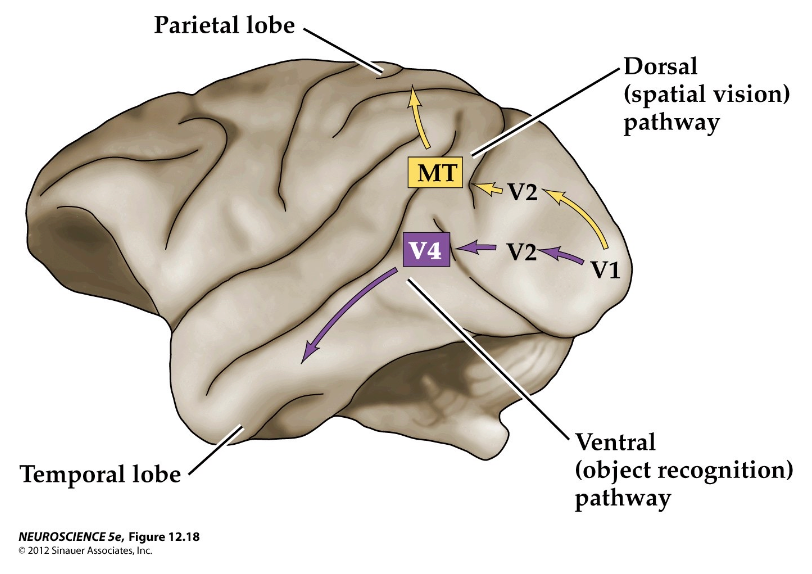
The figure shows a lateral view of the hemisphere with V1 at the occipital pole, where both pathways begin before passing through V2 just anterior to it. The dorsal pathway (yellow arrows) runs from V1 through V2 to MT at the junction of the occipital and temporal lobes and then up into the parietal lobe, and is labelled for spatial vision. The ventral pathway (purple arrows) runs from V1 through V2 to V4 and then curves down and forwards into the temporal lobe, and is labelled for object recognition. The anatomical split therefore mirrors the functional one: dorsal and parietal for where things are and how they move, ventral and temporal for what things are.
Summary
Summary
The magnocellular pathway relays from V1 through V2 and V3 to MT and forms the dorsal pathway to the posterior parietal cortex: V3 encodes orientation and position, MT encodes object movement, and the stream gives spatial vision, motion and change. The parvocellular pathway relays from V1 through V2 to V4 and forms the ventral pathway to the inferior temporal cortex: V4 encodes colour, form, shape and texture, and the stream gives object recognition, form and detail.