Definition
The retina passes visual information through a short chain of neurones, and running across that chain horizontal and amacrine cells mediate lateral inhibition in the retina. This retinal lateral inhibition enhances the quality of sensory information and provides the contrast information on which visual acuity depends.
The retinal cell chain
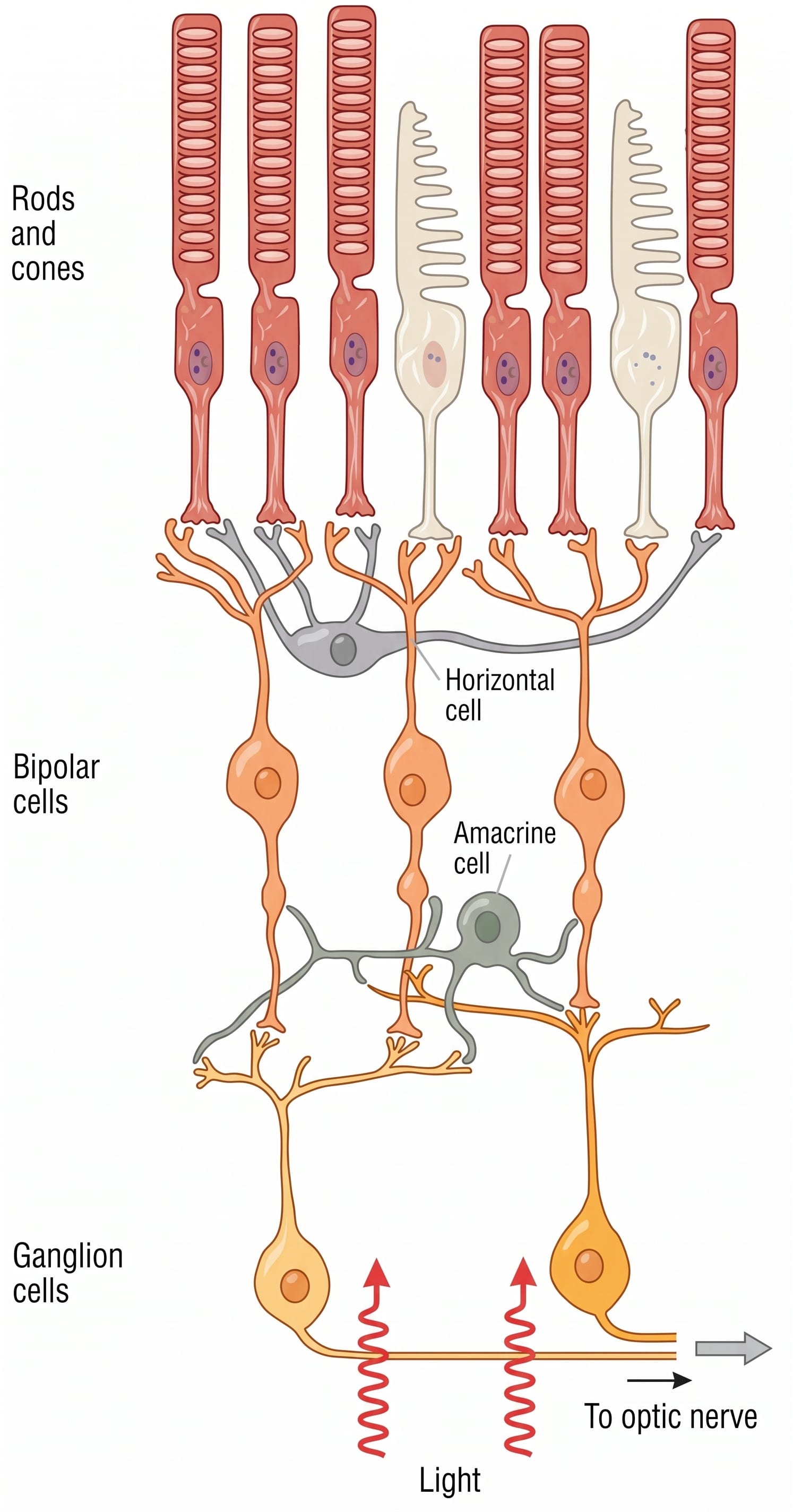
Visual signals flow through the retina in a chain of three neurones: rods and cones signal to bipolar cells, which signal to ganglion cells, whose axons form the optic nerve. The wiring of this chain, and what its convergence pattern means for sensitivity and acuity, is covered in Rods and Cones.
Lateral inhibition in the retina
The general principle of lateral inhibition, in which the most active pathway suppresses its flanking neighbours, is covered in Lateral Inhibition and Adaptation. What matters for vision is what that mechanism achieves in the retina: lateral inhibition enhances the quality of sensory information, and by sharpening the difference between strongly and weakly stimulated pathways it provides contrast information, which in turn enables visual acuity. Seeing a sharp image at all depends on this retinal contrast enhancement, not just on the optics of the eye.
Horizontal and amacrine cells mediate lateral inhibition
Two further retinal neurone types sit across the vertical chain and carry out the lateral interactions. Horizontal cells lie at the level between the photoreceptors and the bipolar cells, and their processes mediate the lateral inhibition that maintains sensitivity to contrast. Amacrine cells lie one level deeper, between the bipolar cells and the ganglion cells: their processes are postsynaptic to bipolar terminals and presynaptic to ganglion cell dendrites, mediating lateral interactions at that level too. Together they allow each point in the retinal image to be compared with its surround before the signal ever leaves the eye.
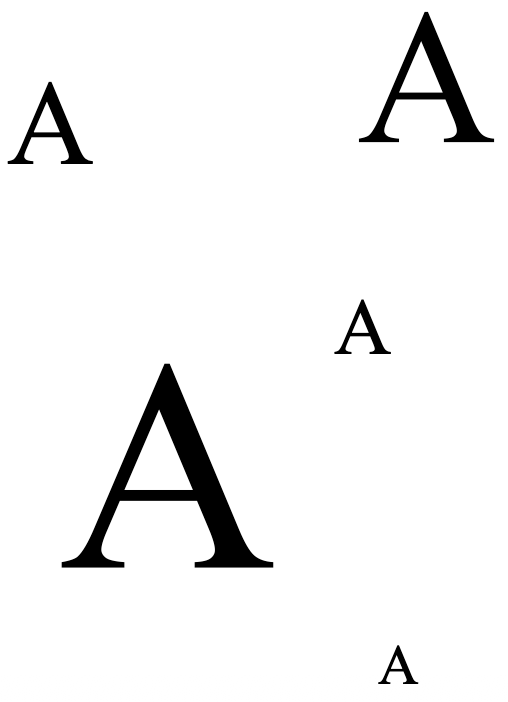
The letter A example on the slide makes the function concrete. A letter is nothing more than dark strokes against a light background, so reading it depends entirely on detecting the contrast at its edges. Because lateral inhibition exaggerates exactly these edges, the strokes of the A stand out crisply from the white around them, and letters can still be resolved as they shrink. The smallest letter that can still be resolved defines visual acuity, and acuity is therefore a direct product of the contrast information that horizontal and amacrine cells create.
Summary
Summary
The retinal signal travels from rods and cones to bipolar cells to ganglion cells, whose axons form the optic nerve. Across this chain, horizontal and amacrine cells mediate lateral inhibition, which enhances the quality of sensory information, supplies contrast information and thereby enables visual acuity, as illustrated by resolving the edges of the letter A.