1. In relation to the electrocardiogram (ECG), which of the following is true:
This is the professor’s key, but it may be wrong. CVS4 gives a normal PR interval of 0.12–0.20 s, so a PR of 0.2–0.3 s would already be first degree AV block. The statement that matches the slides is “repolarisation of the atria is not seen”, because it happens during the much larger QRS complex. The other two are clearly false: aVF is an augmented limb lead, not one of the six chest leads (V1–V6), and the right leg carries only the earth, lead III running from the left arm (negative) to the left leg (positive). See The ECG – Conduction, Leads and the Hexaxial System > 6. Reading the paper calibration, intervals and heart rate and The ECG – Conduction, Leads and the Hexaxial System > 4. The origin of the waves in lead II.
2. In primary hypertension (unknown origin) which factor is NOT believed to be involved in its development:
Cardiac hypertrophy is a consequence of hypertension (the ventricle thickens against the raised afterload), not a cause. Psychological stress and chronic alcohol intake are in the slide’s box of environmental influences, and sympathetic over-reactivity in its box of inherited predispositions. See Hypertension – Causes, Mechanisms, Consequences and Treatment > 6. What causes essential hypertension.
3. In relation to the absolute refractory period in cardiac muscle:
The absolute refractory period is the plateau, when the membrane sits at about 0 to −20 mV. The fast Na+ channels are inactivated (h gates shut), not open; K+ channels are open, their outward current almost balanced by the inward Ca2+ current; and the L-type Ca2+ channels are open, which is what makes the plateau. See Cardiac Action Potential – Resting Potential, Phases and Refractory Period > 5. Refractory periods and the sodium-channel gates and Cardiac Action Potential – Resting Potential, Phases and Refractory Period > 3. The five phases.
4. In relation to coronary blood flow:
The contracting wall squeezes the coronary veins, so blood surges out of the coronary sinus in systole and venous flow subsides in diastole. Right coronary flow is smaller than left (less muscle to feed); sympathetic nerves do not dilate the coronary arteries directly, metabolic vasodilation does; and adenosine is a vasodilator. See Coronary and Cutaneous Blood Flow > 2. Coronary flow through the cardiac cycle.
5. In the coronary circulation (which statement is correct):
The right ventricle has less muscle and a lower intramural pressure, so its flow is smaller but never stops, simply following aortic pressure. Venous outflow is greatest in systole; left coronary inflow is interrupted in early systole and happens mainly in diastole. See Coronary and Cutaneous Blood Flow > 2. Coronary flow through the cardiac cycle.
6. In relation to the cardiac cycle (which statement is correct):
At about 180 beats/min the cycle shortens to 0.33 s with diastole 0.13 s and systole 0.2 s, because most of the time saved comes out of diastole. At 120/min the cycle is 60/120 = 0.5 s; ventricular pressure rises steeply (never falls) during isovolumetric contraction; atrial contraction is the last event of diastole. See The Cardiac Cycle – Phases, Pressures, Volumes and Heart Sounds > 2. What a cardiac cycle is and The Cardiac Cycle – Phases, Pressures, Volumes and Heart Sounds > 3. Diastole in three steps.
7. In relation to the cardiac cycle at rest:
Isovolumetric contraction lasts 0.05 s and ejection 0.3 s. Isovolumetric contraction is early systole (isovolumetric relaxation is early diastole); at rest diastole is 0.66 s and systole 0.34 s (2/3 : 1/3); atrial contraction ends diastole. See The Cardiac Cycle – Phases, Pressures, Volumes and Heart Sounds > 4. Systole in two steps.
8. In relation to cardiac output (and its distribution) in a normal young adult, which statement is INCORRECT:
Cardiac output reaches 30–35 L/min in severe exercise. Renal flow (20% of CO) far exceeds the kidneys’ own O2 needs because its job is filtration, coronary flow rises up to fourfold in exercise, and the splanchnic bed takes about 25% at rest. See Circulation Overview – Circuits, Vessels and the MAP Equation > 7. How the cardiac output is shared out and Circulation Overview – Circuits, Vessels and the MAP Equation > 4. The three features and the one equation.
9. In relation to cardiac output (and its distribution) in a normal young adult, which statement is INCORRECT:
Per the lecturer, brain flow stays essentially unchanged in exercise while muscle takes 80–85% of the output and renal and splanchnic flow fall. “Never above 60 L/min” is true, since the maximum is 30–35 L/min. See Circulation Overview – Circuits, Vessels and the MAP Equation > 7. How the cardiac output is shared out.
10. Which of the following interventions will have a NEGATIVE inotropic effect on the heart:
Hypoxia starves the cell of ATP, and the H+ and phosphate that accumulate blunt the response to Ca2+, so less force comes from the same Ca2+ and the same stretch. Raised extracellular Ca2+ and a faster rate (staircase effect) raise contractility; more venous return raises stroke volume by stretch (Starling’s law), which is not an inotropic effect at all. See Excitation–Contraction Coupling – Calcium Cycle and Sympathetic Stimulation > 5. Inotropic agents and the mechanism of hypoxia.
Questions 11 to 14 refer to the pressure–volume loop of the left ventricle for a single cardiac cycle, with the points lettered A to F:
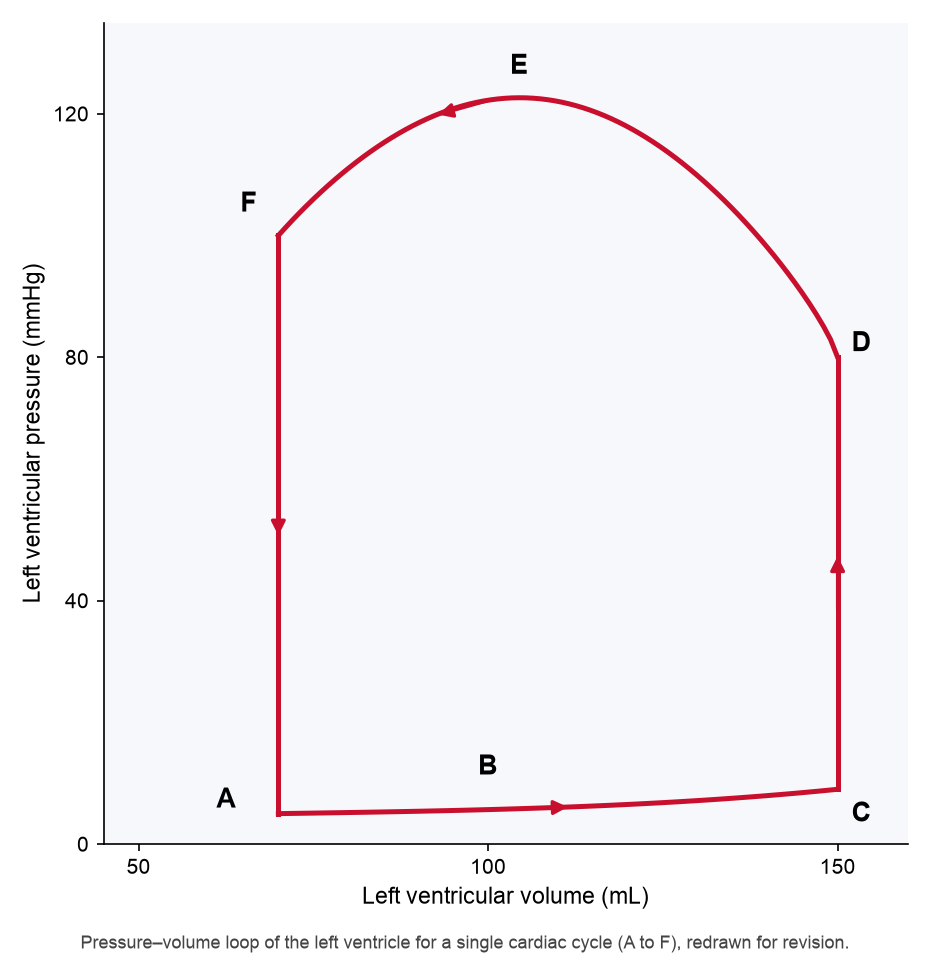
11. On the LV pressure–volume loop, at which point does the AORTIC VALVE CLOSE?
F is the top-left corner, the end of ejection, where ventricular pressure falls below aortic pressure and the ventricle is at its end-systolic volume. The valve opens at D, E is the peak pressure during ejection, A is where the mitral valve opens and C where it closes. See Pressure–Volume Loop, Starling’s Law and Contractility > 2. The pressure–volume loop.
12. On the LV pressure–volume loop, at which point is the 2nd HEART SOUND heard?
S2 is the sound of the semilunar valves closing, so it is heard at F. Valves make no sound when they open (A, D), and the first heart sound, from AV-valve closure, is at C. See Pressure–Volume Loop, Starling’s Law and Contractility > 2. The pressure–volume loop.
13. On the LV pressure–volume loop, at which point do the AV VALVES OPEN?
A is the bottom-left corner: isovolumetric relaxation (F to A) ends when ventricular pressure falls below atrial pressure, the mitral valve opens and filling begins along the bottom of the loop. See Pressure–Volume Loop, Starling’s Law and Contractility > 2. The pressure–volume loop.
14. On the LV pressure–volume loop, at which point does SYSTOLE BEGIN?
Systole begins at C, where the mitral valve closes (S1) and isovolumetric contraction starts; D is the start of ejection, not of systole, because the isovolumetric contraction between C and D is already systole. Atrial contraction, just before C, still counts as diastole. See Pressure–Volume Loop, Starling’s Law and Contractility > 2. The pressure–volume loop.
15. In the homeostasis of mean arterial blood pressure via the baroreceptor reflex, which of the following is NOT an effector organ:
The reflex acts on MAP = CO x TPR, and TPR is the resistance of the systemic circulation, so the four effectors are the SA node (HR), cardiac muscle (contractility, SV), systemic arterioles (TPR) and systemic veins (venous return, EDV, SV). Pulmonary arterioles are not part of TPR. See Arterial Blood Pressure – Measurement, Normal Values and the Baroreflex > 5. The baroreceptor reflex.
16. In relation to cardiac hypertrophy induced by hypertension, mark the INCORRECT statement:
Pressure-loaded hypertrophy is concentric: the wall thickens against the raised afterload without an increase in chamber size, and the capillaries, unchanged in number and diameter, end up further apart, so capillary density falls. Eccentric hypertrophy, with a larger chamber, is the endurance athlete’s heart. The professor’s answer is the intended one, but the question is flawed: his own slide (“no increase in chamber size”) makes “chamber radius is increased” incorrect too, and “contractility is increased” is not on the slides. In the exam, choose “eccentric”. See Hypertension – Causes, Mechanisms, Consequences and Treatment > 8. Ventricular hypertrophy.
17. Which one of the following responses is caused by acetylcholine?
ACh on muscarinic M2 receptors opens ACh-sensitive K+ channels, so K+ conductance and current rise and the node hyperpolarises; it also lowers cAMP, which reduces if and iCa and flattens the pacemaker slope. It never raises cAMP, Ca2+ permeability or the slope, and it hyperpolarises rather than depolarises. See Pacemaker Cells and Autonomic Control of Heart Rate > 3. Autonomic control of heart rate.
18. When travelling at –30° in the frontal plane, a ventricular depolarisation wave causes a large positive deflection in which lead?
This is the professor’s key, but it may be wrong. On the CVS4 hexaxial slide aVL lies at −30° and aVF at +90° (the answer to Q19), so a wave at −30° runs straight along aVL and gives its largest positive deflection there. aVF is 120° away from that direction, so it would show a small negative deflection. Lead III (+120°) is 150° away and also negative, and aVR (−150°) is at 120° and negative. See The ECG – Conduction, Leads and the Hexaxial System > 5. The twelve leads limb leads, the hexaxial system and chest leads.
19. When travelling at +90° in the frontal plane, a ventricular depolarisation wave causes a large positive deflection in which lead?
aVF runs from the midpoint of the two arm electrodes straight down to the foot, which is +90° (6 o’clock), so a wave travelling straight down is tallest in it; lead III (+120°) would see it a little smaller, aVL (−30°) and aVR (−150°) mainly downward. See The ECG – Conduction, Leads and the Hexaxial System > 5. The twelve leads limb leads, the hexaxial system and chest leads.
20. When travelling at +120° in the frontal plane, a ventricular depolarisation wave causes a large positive deflection in which lead?
Lead III (left arm negative, left leg positive) lies at +120°. The same wave is smaller in aVF (30° off), flat in aVR (90° off) and negative in aVL (150° off). See The ECG – Conduction, Leads and the Hexaxial System > 5. The twelve leads limb leads, the hexaxial system and chest leads.
21. In relation to autoregulation of blood flow in systemic circulation (which statement is correct):
Within the autoregulatory range (MAP 70–170 mmHg) a fall in pressure lowers wall tension and the arteriolar smooth muscle relaxes, the myogenic response, keeping flow to the brain, kidney and heart constant. A change in skin flow with temperature is thermoregulation, not autoregulation, and the gut is not an autoregulating organ on the slide; in haemorrhage its flow is sacrificed by sympathetic vasoconstriction. See Vascular Resistance – Pressure Profile, Radius and Control of Arterioles > 4. Autoregulation.
22. In relation to cardiac muscle contraction, mark the INCORRECT statement:
Myosin binds the myosin-binding sites on actin; tropomyosin only covers them until Ca2+ binds troponin C. Contraction is all-or-none because the myocardium is a functional syncytium, it develops active tension, and more Ca2+ entering through the L-type channels triggers more release from the SR and a stronger beat. See Excitation–Contraction Coupling – Calcium Cycle and Sympathetic Stimulation > 1. The contractile proteins.
23. The ventricular muscle resting membrane potential:
The resting potential (about −90 mV) comes from the high intracellular K+ and the high K+ permeability (the iK1 current), so it sits near EK (−94 mV), far from ENa; it is stable until excitation arrives (only pacemaker cells drift), Ca2+ permeability is very low at rest, and it lasts until the next action potential, not 100 ms. See Cardiac Action Potential – Resting Potential, Phases and Refractory Period > 2. The resting membrane.
24. In relation to arterial blood pressure (which statement is correct):
Baroreceptors in the carotid sinus (and aortic arch) sense arterial pressure. Pressure peaks during ejection in systole and is lowest at the end of diastole; the first Korotkoff sounds mark systolic pressure (diastolic is when they disappear); and systolic pressure rises with age as the aorta stiffens. See Arterial Blood Pressure – Measurement, Normal Values and the Baroreflex > 5. The baroreceptor reflex, Arterial Blood Pressure – Measurement, Normal Values and the Baroreflex > 2. Measuring arterial pressure and Arterial Blood Pressure – Measurement, Normal Values and the Baroreflex > 4. Normal values and age.
25. In relation to arterial blood pressure (MAP version — which statement is correct):
MAP is diastolic plus a third of the pulse pressure, not the simple average, because diastole occupies two-thirds of the resting cycle. The SA node senses nothing; it only receives the reflex’s commands. See Arterial Blood Pressure – Measurement, Normal Values and the Baroreflex > 3. Systolic, diastolic, pulse pressure and the mean.
26. Mark the correct option (haemodynamic relationship):
From MAP = CO x TPR and CO = SV x HR, MAP = SV x HR x TPR, so HR = MAP / (TPR x SV). The correct forms of the others are CO = MAP / TPR, MAP = SV x HR x TPR and SV = MAP / (HR x TPR). See Circulation Overview – Circuits, Vessels and the MAP Equation > 4. The three features and the one equation.
27. A conduction velocity of 0.05 m/s is most likely found in which part of the excitation–conduction pathway:
The AV node is the slowest part of the pathway (0.05 m/s), delaying the impulse about 0.1 s so that the atria empty before the ventricles contract; atrial and ventricular muscle conduct at 0.5 m/s, the bundle of His at 1.0 m/s and the Purkinje fibres fastest at 5 m/s. See The ECG – Conduction, Leads and the Hexaxial System > 1. How excitation spreads.
28. Shown is a Lead II ECG trace (25 mm/sec). The heart rate of the patient is in which range (beats/min):
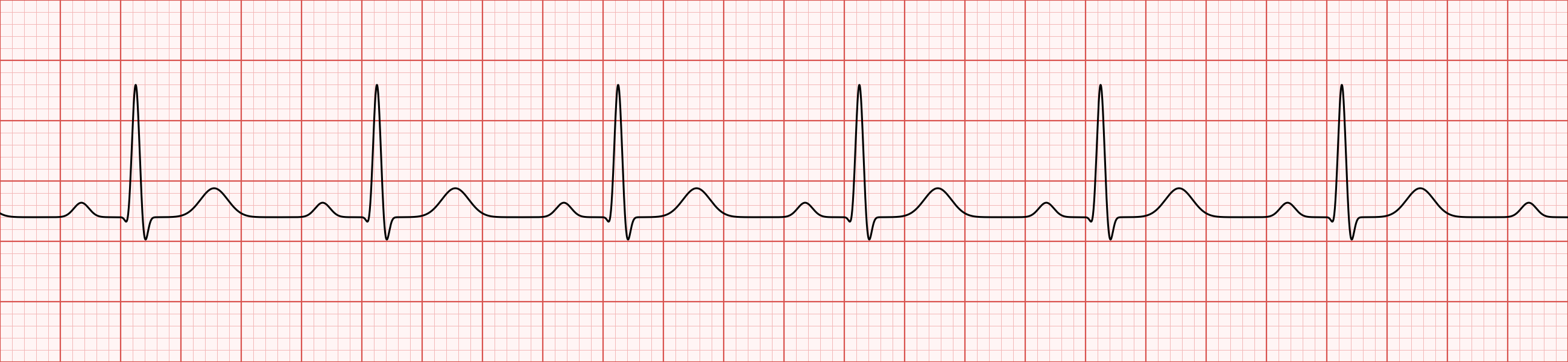
At 25 mm/s each large square is 0.2 s and a minute holds 300 of them, so heart rate = 300 divided by the number of large squares between two R waves; here the R waves are four large squares apart, 300/4 = 75 (the strip in the professor’s PDF gives about 4.3 squares, roughly 70). See The ECG – Conduction, Leads and the Hexaxial System > 6. Reading the paper calibration, intervals and heart rate.
29. In relation to blood vessels in systemic circulation, which statement is correct:
The arteries hold about an eighth of the blood and the capillaries only about a twentieth (huge total area, but each is very short). Capillary cross-sectional area (about 1000 cm²) is the largest, so velocity is lowest there (0.05 cm/s against 15 cm/s in the vena cava), and pressure keeps falling along the circulation, from 35–15 mmHg in capillaries to near 0 mmHg in the veins. See Circulation Overview – Circuits, Vessels and the MAP Equation > 6. Where the blood is, Circulation Overview – Circuits, Vessels and the MAP Equation > 5. Vessel numbers, cross-sectional area and velocity and Vascular Resistance – Pressure Profile, Radius and Control of Arterioles > 1. The pressure profile.
30. In relation to the cardiovascular system, which statement is correct:
The circuits are in series because each ends where the other begins, so both ventricles pump the same volume per minute. The left ventricle pumps into the aorta and the body (the right ventricle serves the lungs), pulmonary venous blood is oxygenated, and the blood volume is 4–6 L. See Circulation Overview – Circuits, Vessels and the MAP Equation > 2. Two circuits in series and Circulation Overview – Circuits, Vessels and the MAP Equation > 1. What the system is for.