Definition
Exercise acts on the whole body partly by modulating the immune system, and two classic theories ask whether that helps or harms. The J-shaped curve says that moderate exercise lowers the risk of upper respiratory tract infection (URTI) below average and very high workloads raise it above average. The open window hypothesis says that prolonged exhaustive exercise depresses immunity for 3 to 72 hours, most consistently seen as a fall in salivary IgA. The curve remains debated, partly because only about a third of athletes' upper respiratory symptoms are infections.
1. Why exercise immunology exists
Exercise immunology began in 1902, when transient leukocytosis, a temporary rise in the white blood cell count, was observed in marathon runners. Many studies since then show that exercise influences the differentiation, trafficking and function of immune cells and of inflammatory mediators, the chemical signals of inflammation (Inflammation – Acute, Chronic and CRP). Hence the lecture’s central statement: a central pathway by which exercise exerts systemic (whole-body) effects is through modulation of the immune system.
Historically, two theories have asked whether this modulation helps or harms: the J-shaped curve, about the dose of exercise, and the open window hypothesis, about the hours after one hard bout.
2. The J-shaped curve
The first theory, Nieman's J-shaped curve (1994, 1995), relates the amount and intensity of exercise to the risk of upper respiratory tract infection (URTI), meaning infection of the nose, throat and upper airways, such as a cold. The model links that risk to immunosurveillance, the immune system's continuous patrol for pathogens and abnormal cells: moderate workloads are associated with improved immunosurveillance and decreased URTI risk, and unusually high workloads with decreased immunosurveillance and increased risk.
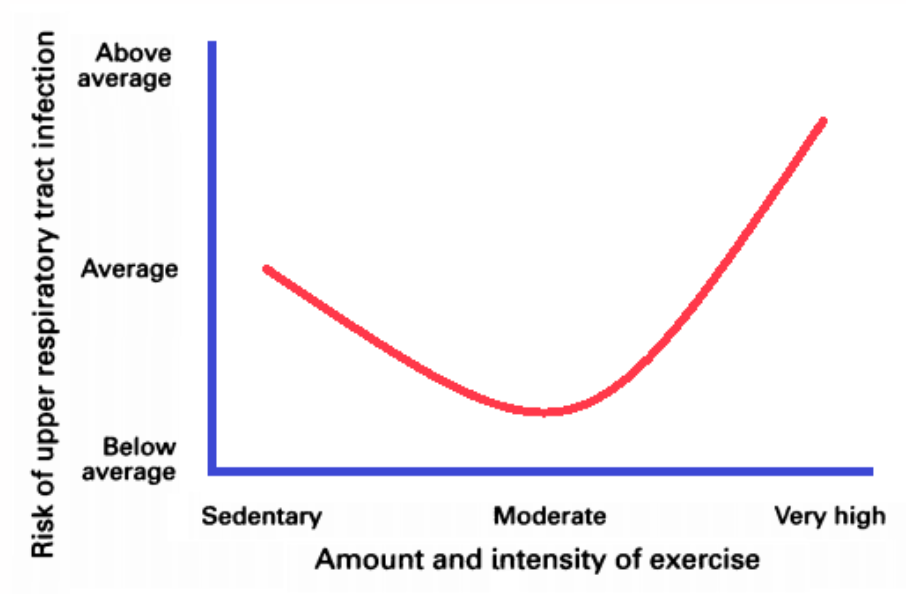
3. The evidence for the left arm: moderate activity
The left arm reflects how consistent moderate-intensity training improves immunosurveillance and reduces inflammation. It brings an increase in natural killer (NK) cell activity (Complement and Natural Killer Cells), and a diminished age-related decrease in T cell function, so these adaptive lymphocytes decline less with age. Further long-term adaptations are in Chronic Exercise and Immune Function – Moderate versus High Intensity.
In practice, near-daily brisk walking for 45 minutes per session was associated with significantly fewer days with URTI symptoms in two studies of 126 overweight women randomised to exercise and non-exercise groups, combined in the figure.
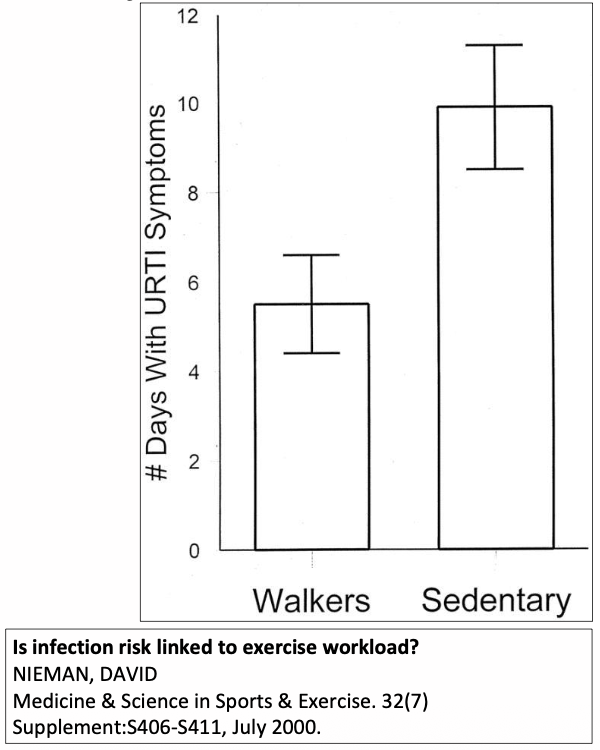
The vertical axis counts days with URTI symptoms, and the walkers’ bar reaches about 5.5 against about 10 for the sedentary women, roughly half. The error bars (the spread around each average) do not overlap, consistent with a significant difference.
4. The evidence for the right arm: intense training
The right arm comes from athletes, who experience a high incidence of URTI during intense training, even for a short time. Incidence, the share newly infected, exceeded 40% in competitive swimmers over 4 weeks of intense training, in elite hockey players at a 10-day training camp and in elite squash athletes over 10 weeks of training. In more than 500 long-distance runners there was a dose-response relationship between yearly training distance and URTI risk, which means the more of the exposure, the more of the effect.
Even so, not all studies support the J-shaped curve, and many variables can influence susceptibility to infection, which makes it a complex issue.
5. The open window hypothesis
The second theory, the open window hypothesis, concerns the hours after one hard bout, holding that prolonged exhaustive physical activity can severely reduce the immune response to infection for 3 to 72 hours, an open window through which a pathogen can get in.
Within that window, the most consistent observation is decreased salivary secretion of IgA, the antibody of secretions (B Cells and Antibodies). Because this IgA stops inhaled microbes from entering the lining of the mouth and airways, less of it weakens the first line of defence against URTIs. There are also changes in the numbers of circulating immune cells and in the functional capacity of white blood cells (WBC), and many studies were done in ultra-marathon runners, so the evidence comes from extreme exertion.
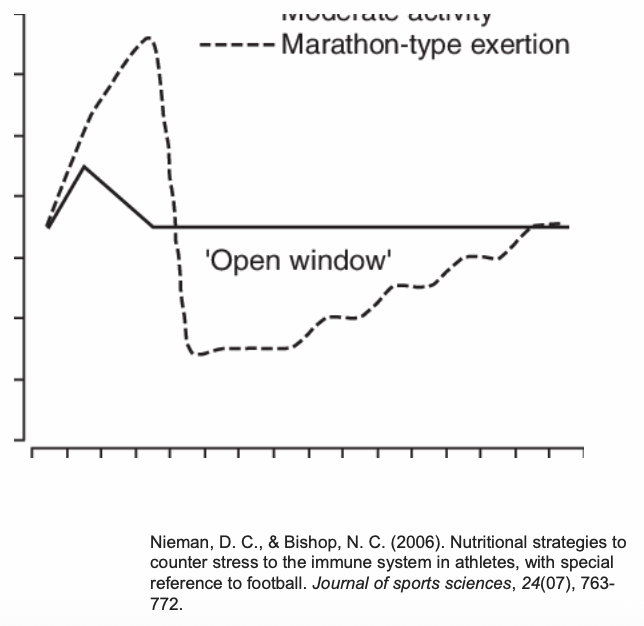
The figure plots that window, though the slide crops off its axis labels: time runs to the right and immune function upwards from a flat resting baseline. The solid line, moderate activity, rises slightly and returns to baseline, whereas the dashed line, marathon-type exertion, rises higher, plunges below baseline into the dip labelled ‘Open window’ and climbs back in steps. Exhaustive exercise thus buys a bigger boost at the price of suppression, which moderate exercise avoids.
The length of that dip depends on the source: the hypothesis and the lecture’s summary slide give 3 to 72 hours, whereas the leukocyte data in Mechanisms of Exercise-Induced Immune Changes put the deepest lymphocyte fall at 2 to 6 hours after exercise and say the window lasts no longer than 24 hours. Both figures can appear in an exam answer.
6. Infection or inflammation?
Both arms of the J rest on counted symptoms, but are those symptoms really infections? A 2011 position statement divides their causes, or aetiology, in elite athletes into thirds.
| Cause of upper respiratory symptoms in elite athletes | Share of cases |
|---|---|
| Infections | About 1/3 (≈5% bacterial, the remainder viral) |
| Identifiable non-infectious inflammatory diseases | About 1/3 |
| Unknown aetiology | About 1/3 |
So only about a third are infections, mostly viral, while another third are inflammation with no infection behind it, which means that many of the 'colds' counted in athlete studies are airway inflammation rather than infection (Inflammation – Acute, Chronic and CRP). That is one reason the J-shaped curve is debated.
Summary
Summary
Exercise immunology began with transient leukocytosis in marathon runners in 1902, and immune modulation is a central pathway of exercise’s systemic effects. Nieman's J-shaped curve puts sedentary people at average URTI risk, moderate exercise below average through better immunosurveillance (more NK activity, half the symptom days in brisk walkers) and very high workloads above average (over 40% incidence in intense training, a dose-response with distance). The open window hypothesis says that exhaustive exercise reduces the immune response for 3 to 72 hours (within 24 by the leukocyte data), most consistently by lowering salivary IgA. The curve remains debated, because not all studies support it and only about a third of athletes' upper respiratory symptoms are infections.