Definition
Inflammation is a normal, healthy immune response leading to microbial killing, wound healing and tissue regeneration, and it may be acute or chronic, localised or systemic. In acute inflammation, mediators dilate the local vessels, make them leaky and call in neutrophils, causing heat, redness, swelling, pain and loss of function. Chronic inflammation means the immune system stays activated, and C-reactive protein (CRP) is a non-specific blood marker of inflammation.
1. What inflammation is
The lecture defines inflammation as a normal, healthy immune response leading to microbial killing, wound healing and tissue regeneration. It may be acute (short-lived) or chronic (persistent), and localised, confined to one site like a swollen ankle, or systemic, which means affecting the whole body through the blood.
2. The acute inflammatory event, step by step
An acute inflammatory event has a rapid onset because its first responders are already in place. Tissue injury caused by infection, trauma, chemicals, heat and the like is detected by the resident sentinel cells, mast cells and macrophages, which stand guard in the tissues (Cells and Tissues of the Immune System).
The sentinels then release chemical signals called inflammatory mediators, chiefly cytokines (the immune system’s protein messengers, see Cytokines), histamine and prostaglandins. Histamine is stored in mast cells and dilates vessels and makes them leaky, while prostaglandins are lipid mediators that cause pain, fever and vasodilation. Complement, circulating plasma proteins activated in the presence of a pathogen (Complement and Natural Killer Cells), joins them, as do others.
Together the mediators cause vasodilation, which raises local blood flow, and increased permeability of peripheral blood vessels, which lets fluid and plasma proteins leak out. They also drive the recruitment of cells from the blood, mainly neutrophils, so acute inflammation is characterised by infiltration of neutrophils. These short-lived phagocytes engulf microbes by phagocytosis and release NETs (Innate Immunity – Pathogen Recognition and Phagocytosis). How they cross the vessel wall is explained in Mechanisms of Exercise-Induced Immune Changes
All these players belong to the fast, non-specific branch of defence, so the response is mainly innate. Its five symptoms follow from the changes above.
- Heat comes from the increased blood flow.
- Redness is that extra blood showing through the skin.
- Swelling is fluid leaking out of the leaky vessels.
- Pain comes from mediators such as prostaglandins acting on nerve endings and from the pressure of the swelling.
- Loss of function follows from the pain and swelling.
Once the stimulus is cleared, the neutrophils die by apoptosis, a tidy, programmed cell death, and the inflammation usually resolves within a few days.
3. Helpful or harmful: to treat or not
Is inflammation, then, helpful or harmful, and should it be treated? On the helpful side, pain and loss of function protect against further tissue damage, increased blood flow and the infiltration of immune cells protect against microbial infection, and some inflammatory mediators promote wound healing and tissue regeneration. Treatment should therefore ease the pain and swelling without abolishing these benefits.
The first option, cryotherapy (ice), applied within 24 to 48 hours of injury, reduces the transmission of sensory pain signals, causes vasoconstriction, narrowing the vessels to limit swelling, and reduces metabolism and oxidative stress (damage by reactive oxygen molecules). The last of these reduces secondary ischaemic injury, the extra tissue death around the original injury when swelling and poor blood supply starve the surrounding cells of oxygen. Cooled cells need less oxygen, so fewer of them die.
Anti-inflammatory medication targets the mediators instead. NSAIDs (non-steroidal anti-inflammatory drugs), for example ibuprofen, sold as Nurofen, block the production of prostaglandins, easing pain and swelling. They are meant for short-term use, either topical (on the skin over the injury) or oral.
On balance, both measures help when used early and briefly but hinder if prolonged. Inflammation can injure healthy tissue as well as protect it, partly through the enzymes and reactive oxygen molecules that neutrophils release, so curbing pain, swelling and secondary damage is worthwhile. Used for longer, ice would cut the blood flow that delivers immune cells and NSAIDs would mask protective pain, which is why the lecture limits both to the short term.
4. Chronic inflammation
Acute inflammation normally resolves, but chronic inflammation occurs when the immune system remains activated. A persistent stimulus, such as an ongoing infection, can cause this. So can a failure of regulation, as in autoimmune disease, where the immune system attacks the body’s own tissues, for example the joints in rheumatoid arthritis. So can metabolic dysfunction, such as obesity, because adipose (fat) tissue is an immunologically active tissue, containing macrophages and other immune cells. Unlike acute inflammation, chronic inflammation involves both innate and adaptive immune responses.
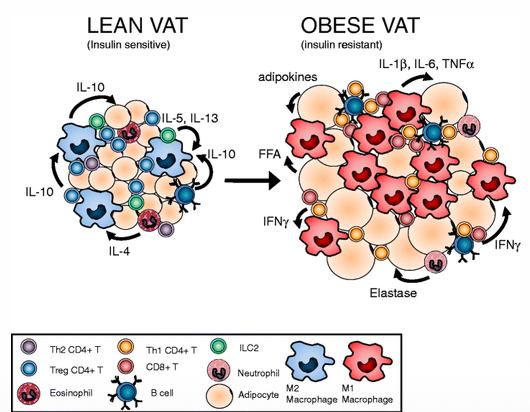
The figure compares visceral adipose tissue (VAT), the fat around the abdominal organs, in a lean person (left) and an obese person (right). The lean, insulin-sensitive tissue has small fat cells (adipocytes) among anti-inflammatory cells: mainly blue M2 macrophages, the anti-inflammatory state of the macrophage, plus regulatory T cells, which restrain immune responses (T Cells and Antigen Presentation), and eosinophils. The curved arrows show what they release, IL-10, IL-4 and IL-13. The obese tissue is insulin resistant, meaning it responds poorly to insulin, and its enlarged fat cells are crowded by red M1 macrophages, the pro-inflammatory state, plus inflammatory Th1 and CD8 T cells, neutrophils and B cells, which release IL-1 beta, IL-6, TNF-alpha, IFN-gamma and free fatty acids.
The take-home of this blue-to-red switch is that obesity turns fat into a source of chronic low-grade (mild but constant) inflammation, which is why fat reappears in the IL-6 paradox of IL-6 in Exercise, where IL-6 helps during exercise but harms when inflamed fat keeps it raised.
5. C-reactive protein
Both kinds of inflammation raise the blood level of C-reactive protein (CRP), a protein synthesised in the liver in response to injury. It is an acute-phase protein, one of the plasma proteins the liver pours out when IL-6 and other cytokines signal injury (IL-6 in Exercise).
CRP functions as a pattern recognition receptor (PRR), a molecule that recognises structures common to microbes (Innate Immunity – Pathogen Recognition and Phagocytosis). Having bound a microbe, it activates complement, functions as an opsonin, coating the microbe so that phagocytes grab it more easily (Complement and Natural Killer Cells), and regulates inflammatory responses.
As a marker of inflammation, CRP is used to screen for infection, chronic inflammation, heart disease and others. It is not specific to any disease, showing that inflammation exists but not where or why, so it is used to monitor and manage a condition already diagnosed.
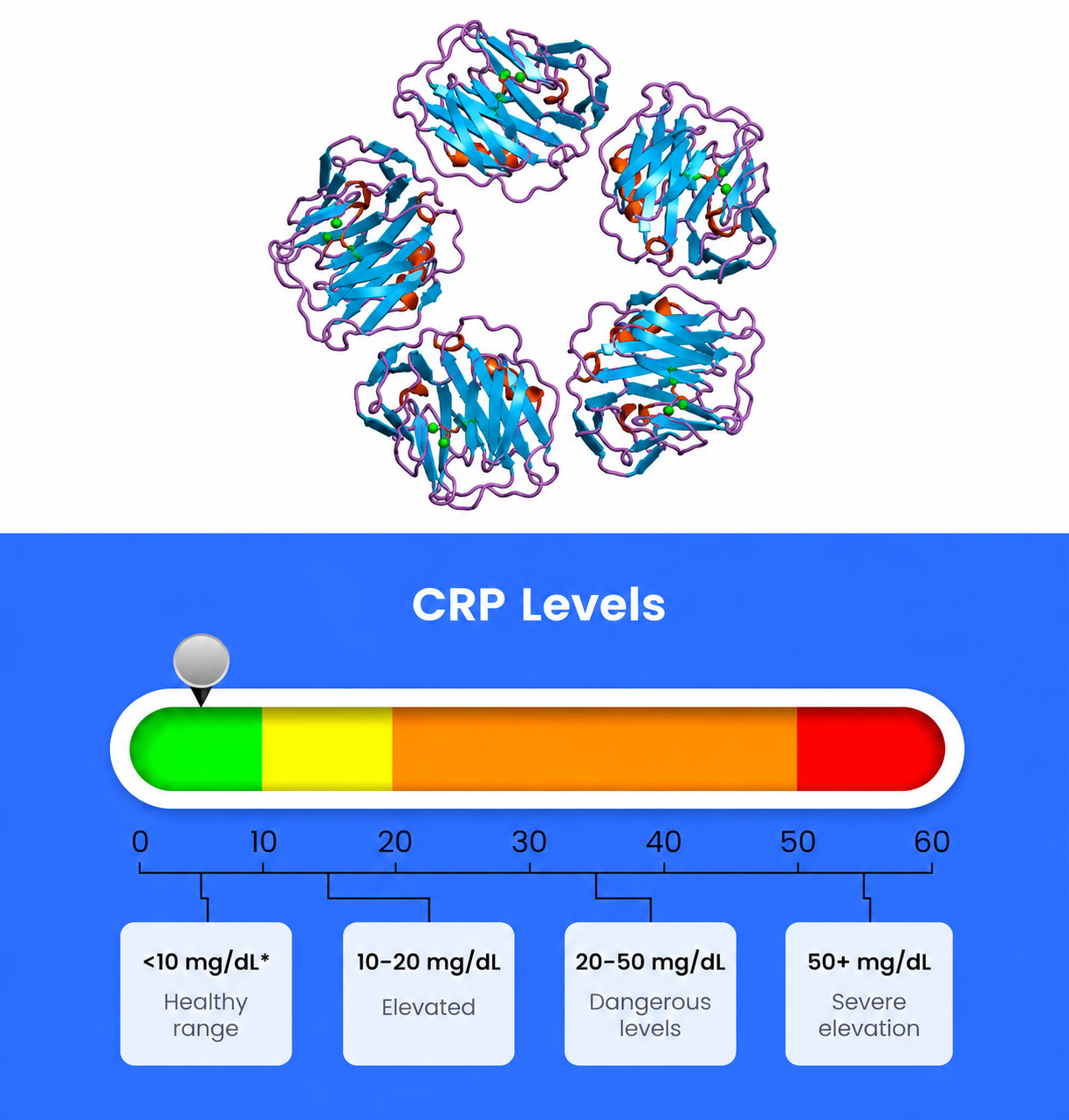
The top image is the CRP molecule, a ring of five identical units. The gauge shows that CRP is read on a graded scale from healthy (green) to severely elevated (red), rather than as a yes-or-no test. Do not memorise its cut-offs, which come from a consumer health website, not the lecture, and note that its units (milligrams per decilitre) are unusual.
In sport, a persistently elevated baseline CRP, a resting value that stays high, can indicate chronic overload, systemic stress or inadequate recovery between intense training blocks, whereas regular moderate training lowers CRP (Chronic Exercise and Immune Function – Moderate versus High Intensity).
Summary
Summary
Inflammation is a normal, healthy immune response, acute or chronic, localised or systemic. In acute inflammation, mast cells and macrophages release mediators that cause vasodilation, leaky vessels and an influx of neutrophils, producing heat, redness, swelling, pain and loss of function in a mainly innate response that resolves within a few days. Because these symptoms are protective, treatment is kept limited: ice within 24 to 48 hours and short-term NSAIDs, which block prostaglandins. Chronic inflammation stems from a persistent stimulus, failed regulation or obesity, and in obese fat the macrophages shift from anti-inflammatory M2 to pro-inflammatory M1. CRP, a liver-made acute-phase protein, is a non-specific marker whose persistently raised baseline in athletes signals overload or poor recovery.