Definition
IL-6 has two sources: immune cells in infection or injury, where it is usually pro-inflammatory, and contracting skeletal muscle, which makes it a myokine. In exercise it rises up to 100-fold after a marathon, more than any other cytokine, and lactate drives its release at high intensity. Short muscle pulses are metabolic and anti-inflammatory and mobilise NK cells, neutrophils and lymphocytes, whereas chronically elevated IL-6 is harmful, which is the IL-6 paradox.
1. Two sources, two faces
IL-6, or interleukin-6, is one of the Cytokines and a well-established mechanism of exercise-induced immunomodulation, meaning a main route by which exercise alters immunity. Several immune cells produce it, particularly in response to infection or injury, and there it is usually thought of as a pro-inflammatory cytokine.
Exercise adds a second source, because contracting skeletal muscle produces IL-6 in high levels, which makes it a myokine, a cytokine made and released by muscle. The IL-6 gene is silent in resting muscle but rapidly activated in exercise, and the size of the increase depends on exercise intensity, duration, the muscle mass involved and endurance, meaning training status.
Intensity matters because in high-intensity exercise, lactate causes an increase in IL-6 secretion. Lactate generated during strenuous cycling tracked closely with an approximately 5-fold increase in IL-6, and in adults with obesity doing a single bout of cycling at 80% of VO₂peak, a roughly 1.3-fold rise in IL-6 correlated with a roughly 3.8-fold rise in lactate. Whether lactate drives IL-6 release in lower-intensity exercise is unknown.
2. How much, and in what order
The muscle source is so large that IL-6 increases up to 100-fold following a marathon, which makes it the cytokine with the most significant rise in plasma during prolonged, intense endurance exercise.
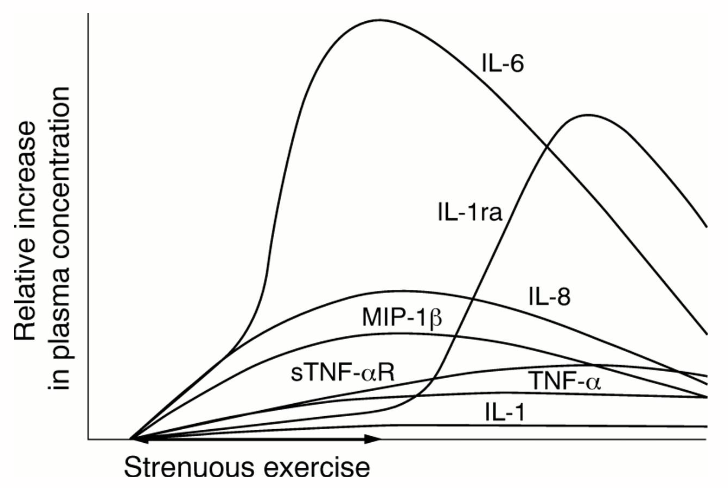
In this figure (Pedersen and Toft, 2000) the x axis is time, with the double arrow marking the strenuous exercise, and the y axis is the relative rise in plasma concentration. IL-6 rises first and towers over the rest, peaking at about the end of exercise, and IL-1ra peaks after it, IL-1ra being the IL-1 receptor antagonist, which blocks the pro-inflammatory cytokine IL-1. The chemokines IL-8 and MIP-1β (cytokines that attract white cells) rise modestly, while TNF-α (tumour necrosis factor alpha), its soluble receptor sTNF-αR, which mops it up, and IL-1 stay lowest. So, unlike an infection, exercise produces IL-6 without a large wave of the pro-inflammatory pair TNF-α and IL-1, and the IL-6 peak is followed by anti-inflammatory signals.
3. Metabolic effects in acute exercise
In acute exercise, meaning a single bout, this muscle IL-6 has anti-inflammatory and metabolic effects. Metabolically, it enhances glucose uptake by muscle, enhances fat oxidation to increase fat's availability as an energy source and so acts as a metabolic regulator.
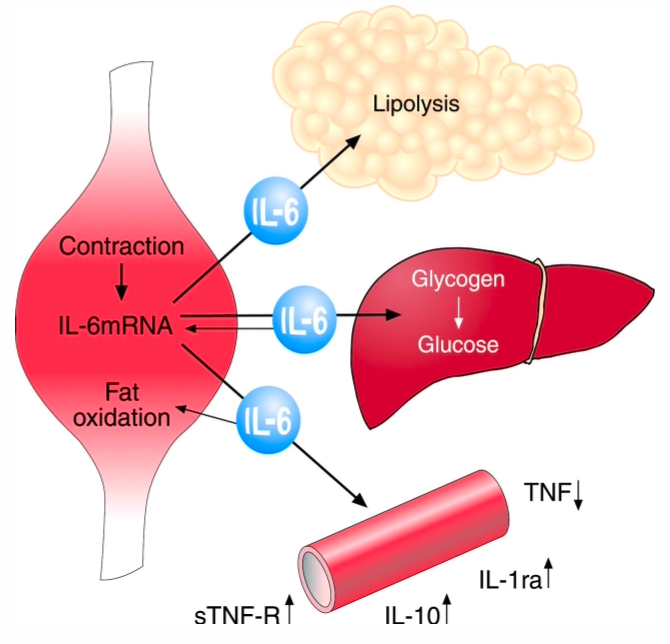
In this figure (Petersen and Pedersen, 2005) contraction switches on IL-6 mRNA in the red muscle fibre on the left, and the blue spheres are the released IL-6. Their arrows run to adipose tissue (yellow) for lipolysis, the breakdown of stored fat, to the liver for glycogen breakdown to glucose, back into the muscle for fat oxidation, and into the blood vessel, where small arrows show TNF falling and IL-1ra, IL-10 and soluble TNF receptor rising. The message is that one muscle signal releases fuel from fat and liver while tilting the blood towards an anti-inflammatory state.
Blood glucose benefits too, because acute elevations in IL-6, and training, stimulate secretion of GLP-1 (glucagon-like peptide-1, a gut hormone that boosts insulin release) from intestinal cells and pancreatic α-cells, improving insulin secretion and glycaemic control (blood glucose control). All these metabolic effects can indirectly support immune cell energy needs.
4. Immune effects of exercise-induced IL-6
IL-6 also acts on immune cells, first by moving them into the blood, the mobilisation described in Mechanisms of Exercise-Induced Immune Changes . It mobilises NK cells, the natural killer cells of Complement and Natural Killer Cells; IL-6-dependent NK recruitment into tumours supports anti-tumour immunity in B16 melanoma and 4T1 breast cancer. It also stimulates the mobilisation of neutrophils and lymphocytes into the circulation, which supports immune surveillance, patrolling for pathogens and abnormal cells.
The second effect, seen in the metabolic figure’s blood vessel, is anti-inflammatory in acute exercise, because IL-6 stimulates production of IL-10 and IL-1ra, which are anti-inflammatory cytokines, and decreases production of the pro-inflammatory TNF-α.
The third effect reaches the liver, where IL-6 triggers production of acute-phase proteins, plasma proteins that surge after infection or injury, such as C-reactive protein (CRP), the inflammation marker of Inflammation – Acute, Chronic and CRP. This is useful for the minor damage caused by exercise.
5. The IL-6 paradox
These benefits come from short pulses, and the reversal when IL-6 stays high is the IL-6 paradox. Chronically elevated circulating IL-6 is associated with cardiometabolic disease, heightened autoimmunity and inflammation, cancer progression and increased all-cause mortality. Such chronic disease involves sustained release from inflamed tissues, including visceral fat, the abdominal fat inflamed in obesity (Inflammation – Acute, Chronic and CRP).
The same can happen with relentless hard training. IL-6 produced under chronic high-intensity exercise tends to be pro-inflammatory and can contribute to inflammation, because it uses a different signalling mechanism. Put simply, brief muscle pulses of IL-6 signal in a way that does not switch on TNF-α and IL-1, whereas IL-6 that stays high, released by immune cells and inflamed tissue, signals in a way that amplifies inflammation.
The rule to remember is that short-lived, muscle-derived IL-6 pulses in exercise are anti-inflammatory and metabolic, whereas chronic IL-6 elevation from inflamed tissue or relentless high-intensity training is harmful. The long-term consequences for athletes are in Chronic Exercise and Immune Function – Moderate versus High Intensity.
Summary
Summary
IL-6, usually a pro-inflammatory cytokine of infection and injury, is also a myokine: its gene switches on in exercising muscle, and its release rises with intensity, duration, muscle mass and endurance and, at high intensity, with lactate. It rises up to 100-fold after a marathon and is followed by IL-1ra rather than TNF-α and IL-1. In acute exercise it boosts glucose uptake, fat oxidation, lipolysis, liver glycogen breakdown and GLP-1, mobilises NK cells, neutrophils and lymphocytes, raises IL-10 and IL-1ra, lowers TNF-α and triggers acute-phase proteins such as CRP. In the IL-6 paradox, chronic elevation from inflamed tissue such as visceral fat, or from chronic high-intensity training with its different signalling mechanism, is pro-inflammatory and linked to cardiometabolic disease, autoimmunity, cancer progression and all-cause mortality.