Definition
Cytokines are small proteins that cells secrete to signal to themselves (autocrine) or to their neighbours (paracrine) through specific receptors. Each immune cell’s cytokine profile can determine its function, and acting together as a network, cytokines drive and orchestrate immune responses. Pro-inflammatory cytokines push inflammation up and anti-inflammatory ones damp it down.
1. What a cytokine is
Immune cells (see Cells and Tissues of the Immune System) talk to each other through cytokines, which are small proteins of 5 to 20 kilodaltons (kDa). Cytokines are secreted by cells and act on the cell that made them (autocrine) or on cells nearby (paracrine), but only on cells that carry their specific receptor.
It’s important not to confuse cytokines with complement, a set of plasma proteins that circulate in an inactive state until a pathogen activates them. Cytokines, by contrast, are made by cells when needed and carry messages between cells.
Cytokines themselves fall into four families: interleukins (IL-1 to IL-22), interferons (IFN-α, β, γ), tumour necrosis factors (TNF-α, β) and transforming growth factor-β (TGF-β). The names record what each family was first seen to do: signal between leukocytes (the white blood cells), interfere with viruses, kill tumours and alter cell growth.
Whatever the family, each immune cell secretes a characteristic profile of cytokines that can determine that cell's function. Cytokines are therefore important effectors of immune function, meaning that cells do much of their work through them. They drive and orchestrate immune responses, switching cells on, calling them to a site and telling them when to stop.
2. Pro-inflammatory and anti-inflammatory cytokines
Starting and stopping a response are opposite jobs, so cytokines are usually grouped by their effect on inflammation. Inflammation is the local reaction that brings fluid and leukocytes from the blood into injured or infected tissue.
| Cytokine | Group | Main job |
|---|---|---|
| IL-1 | Pro-inflammatory | Makes local blood vessels let leukocytes out, and causes fever |
| TNF-α | Pro-inflammatory | Acts like IL-1, and activates neutrophils |
| IL-6 | Pro-inflammatory (see below) | Makes the liver release C-reactive protein, a blood marker of inflammation |
| IFN-γ | Pro-inflammatory | Activates macrophages to kill what they engulf |
| IL-10 | Anti-inflammatory | Switches macrophages off |
| IL-1ra | Anti-inflammatory | The IL-1 receptor antagonist, which blocks IL-1’s receptor |
| TGF-β | Anti-inflammatory | Holds back lymphocytes and macrophages |
Calling cells to a site falls to the chemokines, cytokines that attract leukocytes to where they are needed. IL-6 is the odd one out, with both a pro-inflammatory and an anti-inflammatory face, which is the subject of IL-6 in Exercise. T cells are a clear example of how the cytokines a cell releases decide what it does. Regulatory T cells suppress immune responses and make the anti-inflammatory cytokine IL-10, while helper T cells release cytokines that boost B cells, macrophages and other T cells (T Cells and Antigen Presentation).
3. The cytokine network
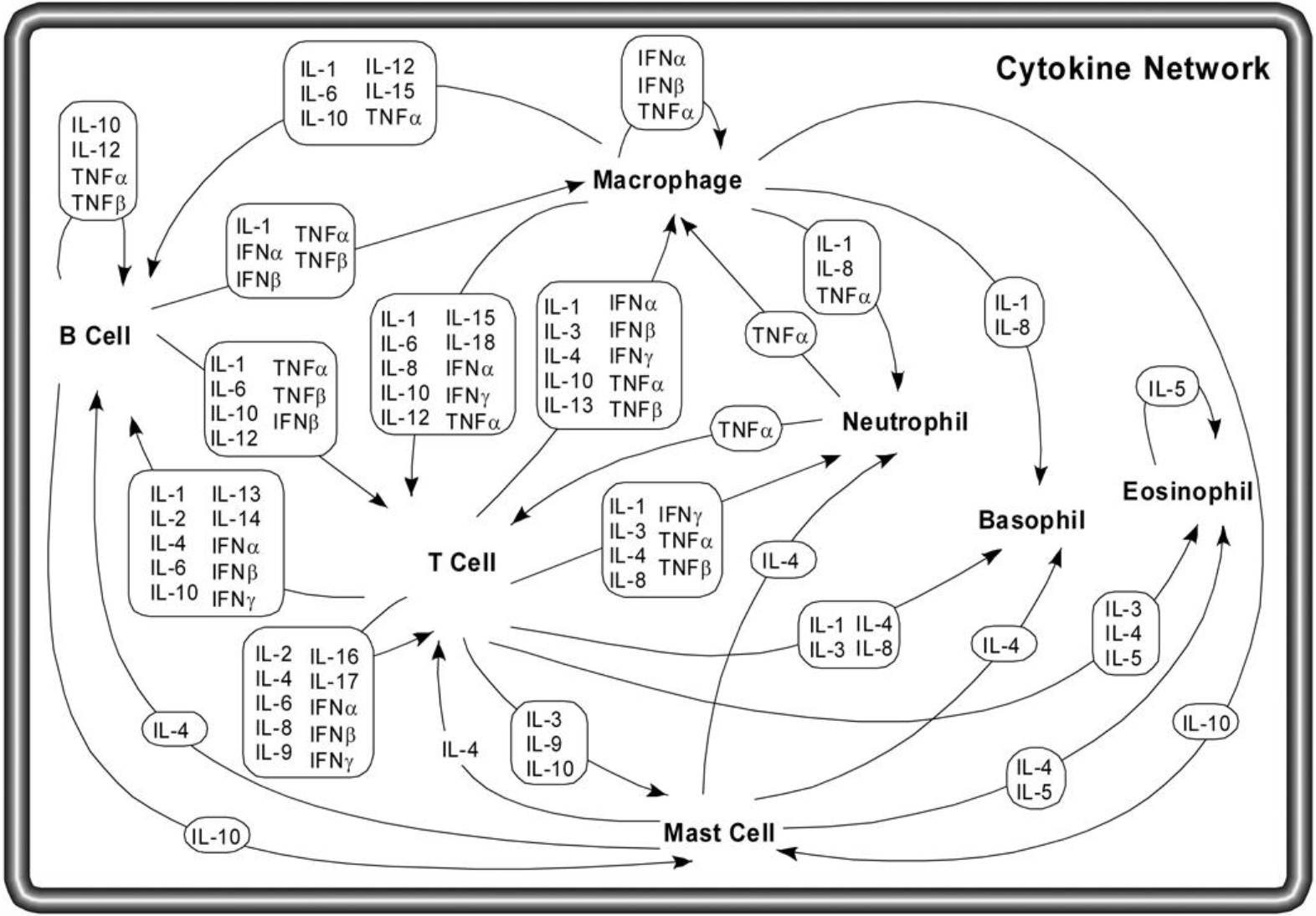
Each arrow runs from the cell that produces the cytokines in its box to the cell they act on. For example, the arrow from macrophage to neutrophil (IL-1, IL-8, TNF-α) shows macrophages calling in neutrophils. The loops back to the same cell are autocrine signals. Do not memorise the lists in the boxes. The message is that every cell type both sends and receives many cytokines. They therefore form a web rather than a chain, in which one activated cell can recruit and instruct many others.
Summary
Summary
Cytokines are small proteins (5 to 20 kDa) that cells secrete to act in an autocrine or paracrine manner through specific receptors. Their four families are interleukins (IL-1 to IL-22), interferons (IFN-α, β, γ), tumour necrosis factors (TNF-α, β) and TGF-β. IL-1, TNF-α, IFN-γ and usually IL-6 are pro-inflammatory, IL-10, IL-1ra and TGF-β are anti-inflammatory, and chemokines attract cells to a site. Each cell’s cytokine profile can determine its function, and together cytokines form a network that drives and orchestrates immune responses.