Definition
Immune cells are formed and mature in the primary lymphoid organs (bone marrow and thymus) and are concentrated and function in the secondary ones (lymph nodes, spleen and mucosal immune system). All come from one marrow stem cell by haematopoiesis, which splits them into a myeloid and a lymphoid family. Some circulate, while dendritic cells, macrophages and mast cells are resident sentinels. Only B and T cells are adaptive, so all the others, including neutrophils and natural killer cells, are innate.
1. Where immune cells are made and mature: the primary lymphoid organs
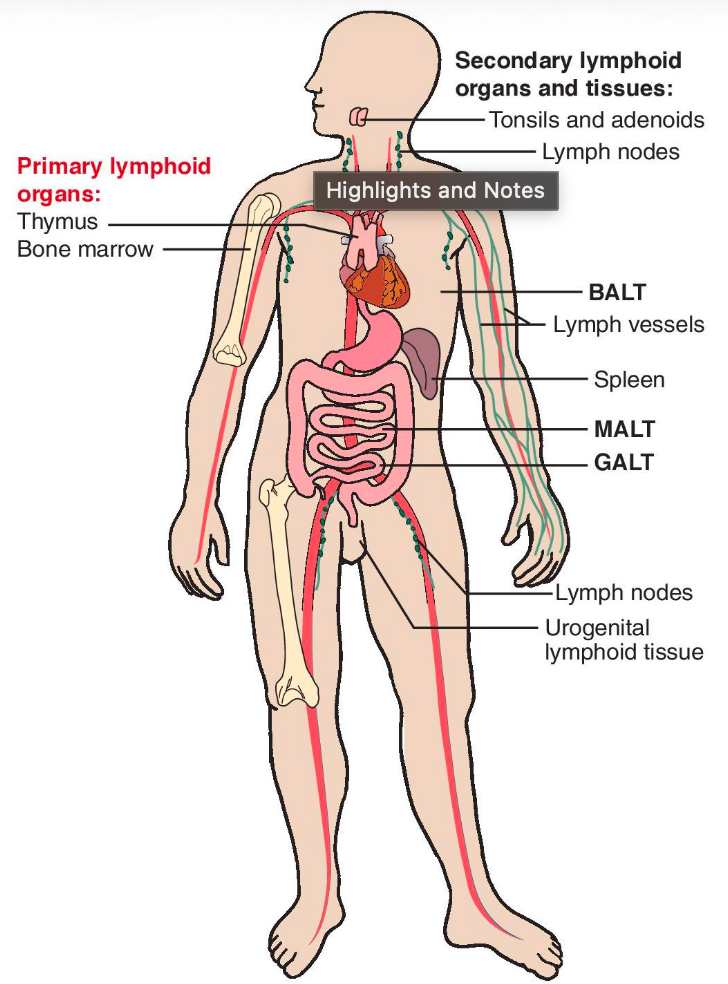
The cells of both branches met in Immune System Overview – Functions and the Two Branches are produced and gathered in lymphoid tissues. Lymphoid means made of, or housing, lymphocytes. These are a kind of white blood cell, chiefly the B and T cells, while the other kinds, such as neutrophils, appear in section 3. The primary lymphoid organs, the bone marrow and thymus, are where immune cells are formed and mature, that is, become ready to work. All immune cells are produced in the bone marrow, where B cells also mature, while T cells leave it early and mature in the thymus, a gland behind the breastbone.
2. Where immune cells gather and work: the secondary (peripheral) lymphoid organs
Once mature, the cells spread out to the secondary (peripheral) lymphoid organs, where they are concentrated and function: the lymph nodes, spleen and mucosal immune system. Lymph nodes filter lymph, the tissue fluid draining back towards the blood, and are where lymphocytes meet antigen; while the spleen filters the blood. The mucosal immune system is lymphoid tissue under the mucosa, the moist mucous membranes lining the gut, airways and urogenital tract, through which most microbes enter. The figure labels it MALT, GALT and BALT (mucosa-, gut- and bronchus-associated lymphoid tissue), with the tonsils and adenoids and the urogenital lymphoid tissue as further examples.
3. Haematopoiesis: one stem cell, two families
Back in the marrow, production has a name: haematopoiesis, the formation of blood cells. All blood cells, immune cells included, come from one haematopoietic stem cell, which gives rise to two progenitors. The common myeloid progenitor (myeloid meaning the non-lymphocyte family) produces erythrocytes (red cells), platelets and the white cells called monocytes (which become macrophages), neutrophils, eosinophils and basophils. The common lymphoid progenitor produces the lymphocytes. B cells end as plasma cells, which secrete antibodies, and memory cells, which remember an antigen, while T cells end as helper, cytotoxic (killer) and regulatory T cells, the last labelled suppressor, its older name, on the figure. The figure leaves out natural killer (NK) cells, which are lymphocytes too, and dendritic cells and mast cells, tissue guards met in the next section, which arise mainly from the myeloid family.
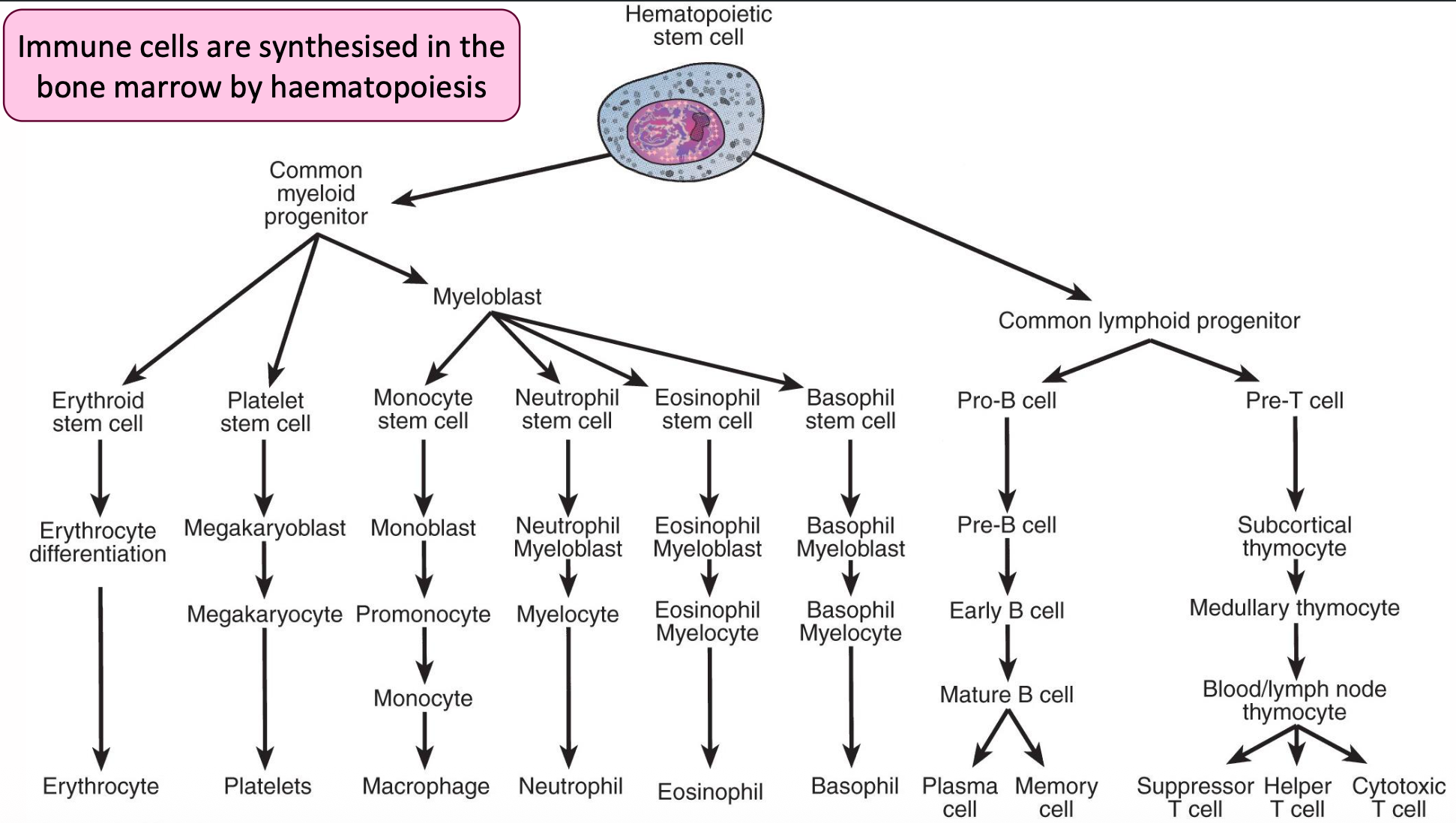
Skip the intermediate stages (myeloblast, promonocyte and so on), because the point is that every immune cell traces back to one stem cell.
4. Cells that circulate and cells that stand guard
Once made, immune cells follow one of two lifestyles: some circulate between the blood and the tissues, while others are resident in the tissues. The circulating cells, which can also enter tissues, are neutrophils, monocytes/macrophages, eosinophils and lymphocytes. The resident ones, dendritic cells, macrophages and mast cells, are sentinel cells, guards posted in the tissue to raise the alarm. Macrophages are on both lists because a monocyte in the blood becomes a macrophage once it settles in a tissue.
Each sentinel has its own job. The dendritic cell detects pathogens and presents them to lymphocytes, which means it catches disease-causing microbes and shows pieces of them to lymphocytes (T Cells and Antigen Presentation). The macrophage performs phagocytosis, engulfing and digesting microbes (Innate Immunity – Pathogen Recognition and Phagocytosis), and the mast cell handles allergy and defence against helminths, or parasitic worms.
5. The cast by branch
With every cell placed, the cast can now be sorted by branch. The innate cells are monocytes/macrophages, neutrophils, eosinophils, basophils, mast cells, dendritic cells and natural killer cells, and the adaptive cells are the lymphocytes, B cells and T cells. NK cells are therefore the odd ones out, lymphocytes by family but innate by branch.
The jobs can then be stated cell by cell. Neutrophils are the most abundant white cell and the first to arrive at an infection, where they phagocytose microbes, and being innate they are present and functional from birth, respond immediately and recognise microbes non-specifically, but do not develop or adapt over a lifetime. Monocytes/macrophages also present antigen, eosinophils and basophils act against parasites and in allergy, and NK cells kill virus-infected and cancerous body cells (Complement and Natural Killer Cells). B cells make antibodies (B Cells and Antibodies) and T cells carry out cell-mediated immunity, meaning defence by cells rather than by antibodies (T Cells and Antigen Presentation).
| Cell | Branch | Circulating or resident | Main job |
|---|---|---|---|
| Neutrophil | Innate | Circulating | Most abundant, first to arrive at infection, phagocytosis |
| Monocyte/macrophage | Innate | Monocyte circulates, macrophage resident | Phagocytosis, antigen presentation |
| Eosinophil | Innate | Circulating | Defence against parasites, allergy |
| Basophil | Innate | Circulating | Defence against parasites, allergy |
| Mast cell | Innate | Resident sentinel | Allergy, defence against helminths |
| Dendritic cell | Innate | Resident sentinel | Detects pathogens, presents them to lymphocytes |
| NK cell | Innate (a lymphocyte) | Circulating | Kills virus-infected and cancerous cells |
| B cell | Adaptive | Circulating | Makes antibodies |
| T cell | Adaptive | Circulating | Cell-mediated immunity |
Summary
Summary
Immune cells are made in the bone marrow, where B cells also mature, while T cells mature in the thymus, these being the primary lymphoid organs. They work in the secondary lymphoid organs: lymph nodes, which filter lymph, the spleen, which filters blood, and the mucosal immune system. Haematopoiesis gives a myeloid family (erythrocytes, platelets, monocytes, neutrophils, eosinophils, basophils, and mainly dendritic and mast cells) and a lymphoid family (B, T and NK cells). Neutrophils, monocytes/macrophages, eosinophils and lymphocytes circulate, while dendritic cells, macrophages and mast cells are resident sentinels. Only B and T cells are adaptive, so neutrophils, NK cells and the rest are innate.