Definition
The immune system fights infection and cancer, promotes wound healing and tissue regeneration and clears cell debris, and it works by telling self from non-self. Anything that provokes an immune response is an antigen. The innate branch is inborn, acts within hours and is non-specific, with no memory, whereas the adaptive branch develops throughout life, takes days and is highly specific, with memory. The two work together: innate cells switch on the adaptive branch, and antibodies call in innate defences.
1. What the immune system is for
The immune system has four functions: defence against infectious diseases, cancer fighting, promoting wound healing and tissue regeneration, and eliminating cell debris. Infections are caused by pathogens, which are microbes or other organisms that cause disease: bacteria, viruses, fungi and parasites such as helminths (worms).
Whatever the function, the immune system responds to antigens. An antigen is any molecule or structure that provokes an immune response; the name means anti-gen, antibody generating, because antigens trigger the production of antibodies, proteins that bind one particular antigen (B Cells and Antibodies). The whole system works by telling the body’s own material, called self, from foreign material, called non-self, such as a microbe.
2. Two branches, one system
Two branches share these functions as one system. The innate branch starts with physical barriers such as the skin and lysozyme in secretions, lysozyme being an enzyme in tears, saliva and mucus that breaks down bacterial cell walls. Behind them lies phagocytosis, in which phagocytes engulf and digest microbes (Innate Immunity – Pathogen Recognition and Phagocytosis). Then come natural killer (NK) cells, which kill infected cells, and complement, circulating plasma proteins that stimulate immune reactions when activated by a pathogen (both in Complement and Natural Killer Cells). Innate cells also release inflammatory mediators, chemical signals that set off inflammation, and antimicrobial peptides, small proteins that kill microbes directly.
The adaptive branch relies instead on white blood cells called lymphocytes. B cells (B lymphocytes) make antibodies, while T cells (T lymphocytes) carry out cell-mediated immunity, so called because the cells themselves do the work (T Cells and Antigen Presentation).
Each immune cell belongs to one of the two branches: B and T lymphocytes are adaptive cells, and all the others are innate cells, such as neutrophils and dendritic cells (Cells and Tissues of the Immune System).
3. Features of innate (natural) immunity
The branches also behave differently, and innate (natural) immunity has six features:
- We are born with it.
- It is always present and functional.
- It can respond immediately.
- It instructs the adaptive immune system, meaning that innate cells set the adaptive response going.
- It recognises non-self in a non-specific manner, detecting patterns shared by whole groups of microbes rather than one particular microbe.
- It has no ability to remember pathogens or to improve with experience.
4. Features of adaptive (acquired) immunity
Adaptive (acquired) immunity mirrors these, point for point. Where innate immunity is inborn, we are not born with adaptive immunity, which develops (adapts) throughout a lifetime as each antigen the body meets selects and multiplies the lymphocytes that recognise it (Adaptive Immunity – Principles and Clonal Selection). That multiplication takes time, so where innate immunity is immediate, adaptive immunity is slower to respond. Where innate recognition is non-specific, adaptive immunity recognises antigens with high specificity, meaning that each lymphocyte recognises one particular antigen. And where innate immunity has no memory, adaptive immunity has a memory function, so a second meeting with the same antigen brings a faster, stronger response (Immunological Memory – Primary and Secondary Responses).
5. Timescale: how the two branches work together
The timeline of a single infection shows the difference in speed.
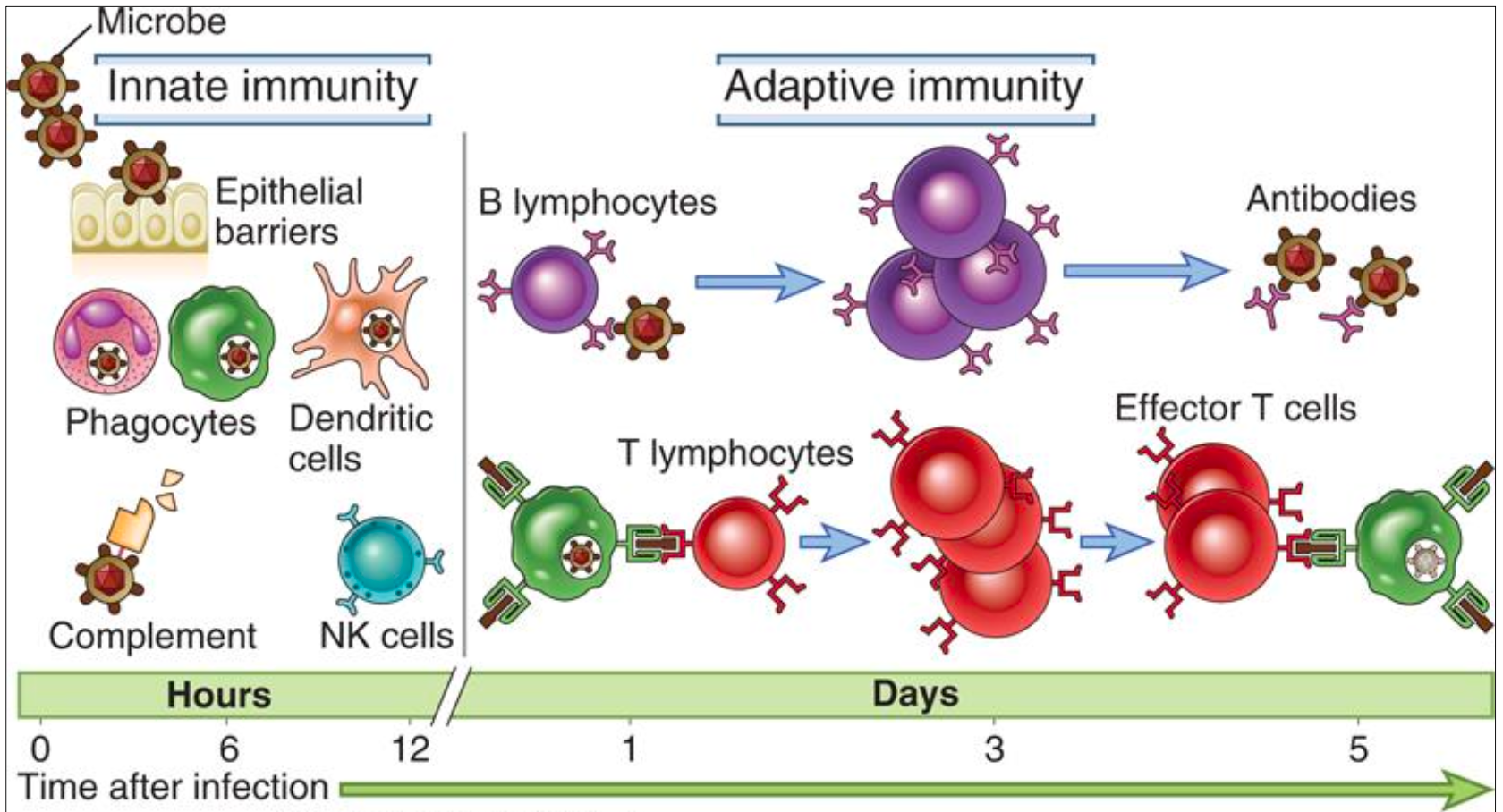
Time after infection runs from left to right, and the broken axis switches from hours to days. In the left panel, within hours (0 to 12), the microbe meets epithelial barriers, phagocytes, dendritic cells, complement and NK cells. In the right panel, over days (1 to 5), blue arrows mark each adaptive step. Purple B lymphocytes multiply and turn into antibody producers, whose Y-shaped antibodies coat the microbe. Red T lymphocytes, activated by a green cell displaying the microbe, multiply into effector T cells, the working form that here helps a phagocyte destroy the microbe it has engulfed. The message is that the innate branch buys time while the adaptive branch is being built.
Each branch also depends on the other. The innate branch instructs the adaptive one because an innate cell, the dendritic cell, carries the antigen to the T lymphocytes (T Cells and Antigen Presentation). The adaptive branch in turn borrows innate tools, because antibodies recruit complement and phagocytes.
| Feature | Innate (natural) | Adaptive (acquired) |
|---|---|---|
| Present at birth | Yes, always present and functional | No, develops throughout life |
| Speed | Immediate, hours (0 to 12) | Slower, days (1 to 5) |
| Specificity | Non-specific, shared microbial patterns | High, one antigen per lymphocyte |
| Memory | None | Faster, stronger second response |
| Main components | Barriers (skin, lysozyme), phagocytosis, NK cells, complement, inflammatory mediators, antimicrobial peptides | Antibodies, cell-mediated immunity |
| Main cells | Monocytes/macrophages, neutrophils, eosinophils, basophils, mast cells, dendritic cells, NK cells | B and T lymphocytes |
Summary
Summary
The immune system fights infection by pathogens and cancer, promotes wound healing and tissue regeneration and clears cell debris, by telling self from non-self and responding to antigens. Innate immunity (barriers, phagocytosis, NK cells, complement, inflammatory mediators, antimicrobial peptides) is inborn, immediate, non-specific and without memory, and it instructs the adaptive branch. Adaptive immunity (antibodies from B cells, cell-mediated immunity from T cells) develops through life, is slower and highly specific, and has memory. Innate defences act within hours and buy time while adaptive ones build over days, and the two cooperate because dendritic cells carry antigen to T lymphocytes and antibodies recruit complement and phagocytes.