Definition
Adaptive immunity relies on two kinds of lymphocyte: B cells, which mature in the bone marrow and make antibodies (humoral immunity), and T cells, which mature in the thymus and provide cell-mediated immunity. It follows three Rs: Recognise, Respond, Remember. In clonal selection, the antigen selects the rare pre-existing lymphocytes whose receptor fits and these divide into a clone of effector and memory cells, a process confined to T and B cells.
1. The adaptive branch and its two cell types
As Immune System Overview – Functions and the Two Branches showed, adaptive, or acquired, immunity is the branch we are not born with: it develops (adapts) throughout a lifetime, is slower to respond than the innate system, recognises antigens (the molecules its receptors bind) with high specificity, improves with each contact and has a memory function.
Its cells are the lymphocytes (Cells and Tissues of the Immune System), white blood cells of two kinds that mature, meaning become fully working cells, in different places and defend the body in different ways.
| Feature | B lymphocytes (B cells) | T lymphocytes (T cells) |
|---|---|---|
| Mature in | Bone marrow | Thymus |
| Role | Produce antibodies | Cell-mediated immunity |
These roles are the two arms of adaptive immunity. Antibodies, proteins that bind one particular antigen (B Cells and Antibodies), work dissolved in the body fluids, once called humours, hence humoral (antibody-mediated) immunity. In cell-mediated immunity, the T cells themselves act directly on other cells.
2. The three Rs
Whichever cell is involved, adaptive immunity follows the three Rs.
- First, each lymphocyte must Recognise its antigen: every cell has a specific receptor for a particular antigen, and recognition is followed by clonal selection.
- Then the lymphocytes Respond, by cytokine secretion (small signalling proteins, see Cytokines), antibody production and direct cell killing by T cells.
- Finally the system must Remember, through long-lived memory cells.
These three Rs are the scaffold of Immunology II: Recognise is explained below, Respond in T Cells and Antigen Presentation and B Cells and Antibodies, and Remember in Immunological Memory – Primary and Secondary Responses.
3. Clonal selection
Recognition rests on clonal selection, proposed by Burnet in 1957. Each lymphocyte has receptors to bind a single antigen, which defines its specificity. Since lymphocytes differ in specificity, the lymphocyte repertoire, meaning the full set of different lymphocytes in the body, is extremely diverse. So there are very few cells of any one specificity, and each is highly specific.
When one of these rare cells ‘finds’ its antigen, it binds and can become activated, that is, switched on. The activated cell divides rapidly to make many copies, a clone of identical cells sharing its receptor. This clonal expansion provides the large number of antigen-specific lymphocytes needed to keep pace with a multiplying microbe. The clone contains effector cells, which do the job now, and memory cells, which stay for the future.
The name stresses selection rather than instruction, because the antigen does not instruct a cell to make a matching receptor. The receptors exist before the antigen is ever met, and the antigen selects, out of millions of pre-existing lymphocytes, the few whose receptor fits, so only those expand.
Because it depends on these single-antigen receptors, clonal selection occurs for both T and B cells, the only cells that carry them. Innate cells such as monocytes, neutrophils and basophils do not undergo it.
4. Reading the figure
The figure draws this whole sequence for B cells.
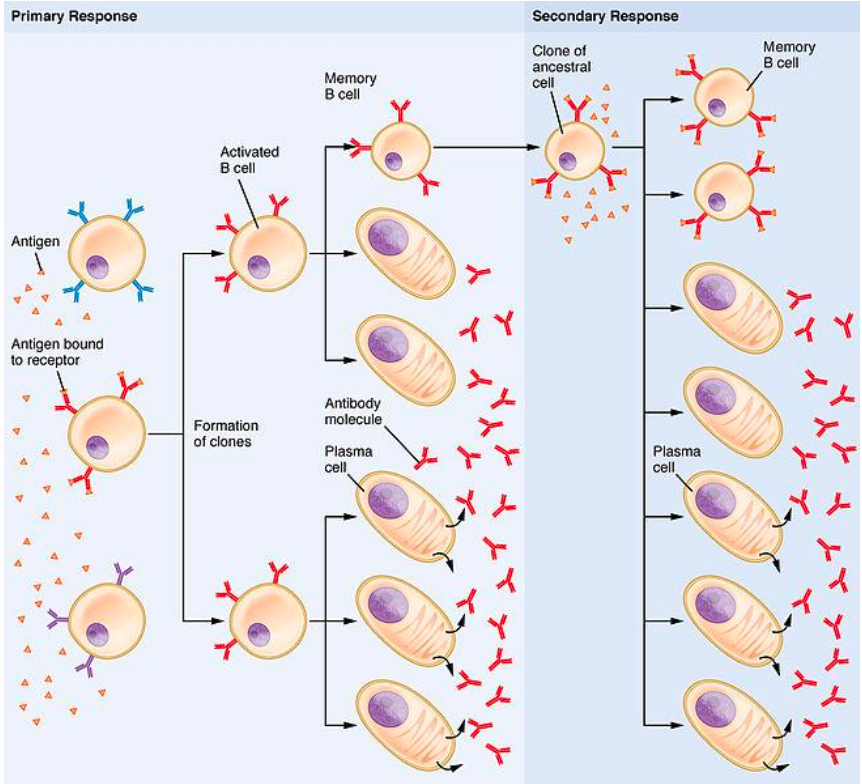
In the primary response column (the first meeting with antigen), three B cells carry blue, red and purple receptors, standing for three specificities. The antigen (small orange triangles) fits only the red receptors, so only that cell binds it and is selected. Its arrows, labelled formation of clones, lead to activated B cells that divide again: most become plasma cells, oval effector cells that secrete antibody (the red Ys, red because they fit the same antigen), and one becomes a memory B cell. In the shaded secondary response column, the returning antigen binds this memory cell, labelled clone of ancestral cell because it descends from the selected cell, and in one step it yields more plasma cells and more memory cells, standing for a faster, larger response.
The figure shows B cells, but the same logic applies to T cells, and Immunological Memory – Primary and Secondary Responses compares the first and second responses in full.
Summary
Summary
Adaptive (acquired) immunity is slow but highly specific, improves with each contact and remembers. B cells mature in the bone marrow and make antibodies (humoral immunity), while T cells mature in the thymus and act directly on other cells (cell-mediated immunity). Responses follow the three Rs: recognise through specific receptors, respond with cytokines, antibodies and killing by T cells, and remember through memory cells. In clonal selection (Burnet, 1957) the antigen selects, from an extremely diverse repertoire, the rare pre-existing cells whose receptor fits, and these divide rapidly into a clone of effector and memory cells. This happens in T and B cells, never in innate cells such as monocytes, neutrophils and basophils.