Definition
T cells must be ‘introduced’ to antigen by antigen-presenting cells (APCs), namely dendritic cells, macrophages and neutrophils, which phagocytose a microbe and display its fragments on the Major Histocompatibility Complex (MHC) to highly specific T cell receptors. This is how the innate branch instructs the adaptive branch. Activated helper T cells then release cytokines, cytotoxic (killer) T cells release perforin and granzyme, and regulatory T cells (Tregs) release IL-10.
1. T cells need an introduction
A T cell (T lymphocyte) recognises antigen with its T cell receptors (TCRs), surface proteins that are highly specific, each fitting one antigen only. Yet a TCR cannot recognise a free microbe, only a fragment displayed by another cell, so for pathogen recognition T cells need to be ‘introduced’ to antigen by an antigen-presenting cell (APC).
The APCs are dendritic cells, macrophages and neutrophils. Each engulfs the pathogen by phagocytosis (Innate Immunity – Pathogen Recognition and Phagocytosis), digests it, and uses the Major Histocompatibility Complex (MHC) to display fragments of the digested antigen on its surface. MHC is a family of surface proteins that work like display stands, each holding up a small piece of antigen (a peptide) to T cells, and the TCR recognises this antigen presented by MHC.
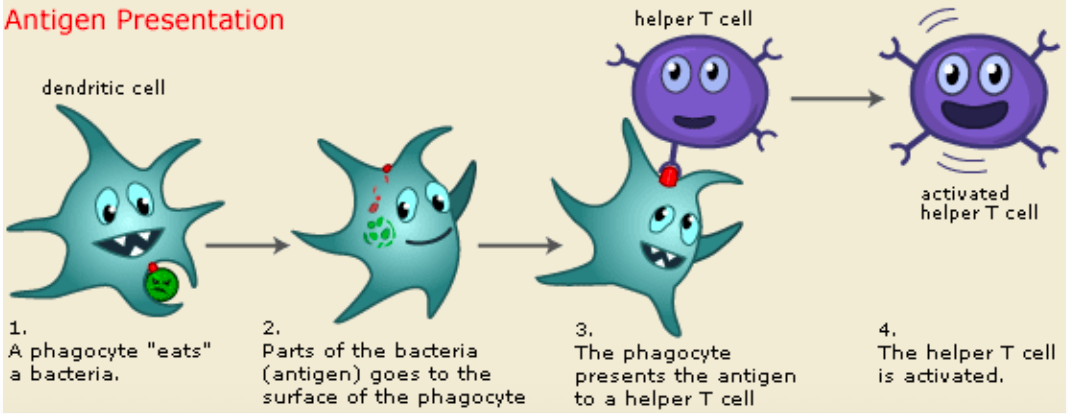
The cartoon leaves out the MHC, which in reality holds the antigen (red) on the phagocyte’s surface. It also shows only a helper T cell, but the other types of T cell, described in section 2, are switched on the same way.
Because APCs are innate cells and T cells adaptive ones, this hand-over is how the innate branch instructs the adaptive branch, the feature listed in Immune System Overview – Functions and the Two Branches. It also explains why Cells and Tissues of the Immune System described the dendritic cell as the cell that detects pathogens and presents them to lymphocytes. The activated T cell then multiplies into a clone by clonal selection (Adaptive Immunity – Principles and Clonal Selection).
2. Three kinds of T cell
What the clone does next depends on which of the three main types of T cell it belongs to. Helper T cells produce cytokines, small signalling proteins (Cytokines), to increase the activity of B cells, macrophages and other T cells, so they are the organisers. Because macrophages are innate cells, this help reaches back into the innate branch, while the help given to B cells is picked up in B Cells and Antibodies.
Where helper T cells organise, cytotoxic (killer) T cells kill foreign cells or infected host cells by releasing perforin and granzyme, the same weapons as natural killer (NK) cells (Complement and Natural Killer Cells). The difference is that a cytotoxic T cell is specific for one antigen and must first be presented with it, whereas an NK cell needs neither.
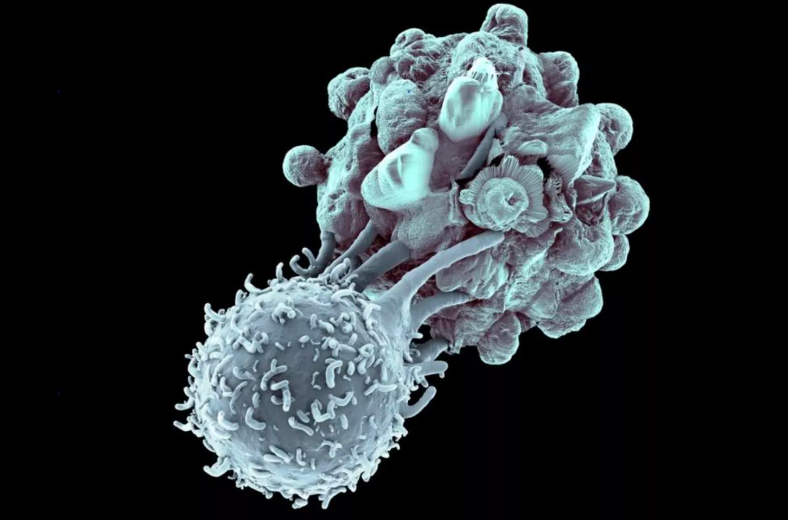
This scanning electron micrograph shows a killer T cell (left) attacking a cancer cell (right). The small T cell has latched onto the larger, lumpy cancer cell, showing that killer T cells kill by direct contact and also target body cells that turn cancerous.
The third type works in reverse, because regulatory T cells (Tregs) suppress the immune response. They produce the anti-inflammatory cytokine interleukin-10 (IL-10), which calms immune cells rather than stirring them up, so Tregs are the brakes. Tregs and IL-10 both return in the exercise notes.
| T cell type | What it does | What it releases |
|---|---|---|
| Helper T cell | Organiser: boosts B cells, macrophages and other T cells | Cytokines |
| Cytotoxic (killer) T cell | Kills foreign or infected host cells | Perforin and granzyme |
| Regulatory T cell (Treg) | Brake: suppresses the immune response | IL-10 (anti-inflammatory) |
Summary
Summary
T cell receptors are highly specific but cannot recognise a free microbe, so APCs (dendritic cells, macrophages and neutrophils) phagocytose it and present its fragments on MHC. This is how the innate branch instructs the adaptive branch, and the activated T cell then multiplies by clonal selection. Helper T cells release cytokines that boost B cells, macrophages and other T cells. Cytotoxic (killer) T cells kill foreign, infected or cancerous cells with perforin and granzyme, and regulatory T cells (Tregs) suppress the response with the anti-inflammatory cytokine IL-10.