Definition
Breathing only helps if oxygen crosses from the air into the blood and carbon dioxide crosses back out. This note explains the simple pressure rule that moves each gas, and why damaged lungs struggle in exercise.
1. What is in the air and how hard it presses
Air is a mixture of gases, mostly oxygen at 20.9 per cent and nitrogen at 78.9 per cent. The rest is 0.03 per cent carbon dioxide, 0.04 per cent water vapour and traces of other gases.
The moving gas molecules strike every surface, and their impacts add up to atmospheric pressure. At sea level this pressure holds up a column of mercury 760 mm high in a barometer, so it is written 760 mmHg (millimetres of mercury). Pressure is also measured in pascals, and hospitals often give gas pressures in kilopascals (kPa), where 1 kPa is about 7.5 mmHg.
2. Each gas pushes on its own: partial pressure
Each gas in a mixture pushes on its own, whatever other gases are around it. The part of the total pressure that comes from one gas is called its partial pressure. Adding up the partial pressures of all the gases gives the total pressure. This is Dalton's law.
A gas’s share of the pressure matches its share of the mixture. Oxygen makes up about a fifth of the air, so it supplies about a fifth of the air’s pressure. In other words, a gas’s partial pressure is its fraction of the mixture times the total pressure, Pgas = F x Ptotal, where F is that fraction and Ptotal is the total pressure. Oxygen is 20.9 per cent of air, a fraction of 0.209, so at sea level its partial pressure is 0.209 times 760 mmHg, which is 159 mmHg. Partial pressures are written with a P before the gas, so the oxygen pressure is PO2 and the carbon dioxide pressure is PCO2. The table below gives the same calculation for the three main gases in dry air at sea level, and also how many millilitres of each gas a litre of air contains.
| Gas | Percentage | Partial pressure (mmHg) | Volume in each litre of air (mL) |
|---|---|---|---|
| Oxygen | 20.9 | 159 | 209.3 |
| Carbon dioxide | 0.03 | 0.2 | 0.4 |
| Nitrogen | 78.9 | 600 | 790.3 |
Partial pressure drives diffusion, the spreading of molecules as they move about at random. A gas always diffuses from higher to lower partial pressure, as heat flows from hot to cold, whatever other gases are present. The difference between the two pressures is called the gradient, and a bigger gradient moves gas faster. The flow stops when the pressures are equal, a balance called equilibrium.
Diffusion is driven by partial pressure, not percentage. Pack twice as much air into the same space and it is still 20.9 per cent oxygen, but the oxygen pressure doubles from 159 to 318 mmHg. Gases dissolved in blood also have a partial pressure, so a pressure in the air can be compared directly with a pressure in the blood.
In the lungs, oxygen and carbon dioxide cross the same thin wall at once, in opposite directions. This alveolar-capillary membrane separates the air in each air sac (alveolus) from the blood in the fine vessels (capillaries) around it, as described in The Lungs and the Breathing Pump – Alveoli, Airways, Muscles, Surfactant and the Valsalva Manoeuvre.
3. The pressure staircase from air to muscle and back
Oxygen’s journey from the air to a muscle is a staircase of falling pressures, and carbon dioxide walks a similar staircase down from muscle to air. Breathed-in (inspired) air has an oxygen pressure of 159 mmHg and almost no carbon dioxide, about 0.2 to 0.3 mmHg. In the windpipe (trachea) the air is warmed and saturated with water vapour, which presses with 47 mmHg at body temperature. That leaves 713 mmHg for the other gases, so oxygen’s 20.9 per cent share falls to 149 mmHg.
In the alveoli the pressures settle at about 100 mmHg for oxygen and 40 mmHg for carbon dioxide. This is because each breath only partly refreshes the stale air in the lungs, while the blood keeps removing oxygen and adding carbon dioxide. Exchange with the blood is fast, reaching equilibrium in about 0.25 s. Blood therefore leaves the lungs with roughly the same pressures as the alveolar air, and this oxygen-rich blood is called arterial blood. A healthy arterial oxygen pressure lies between 75 and 100 mmHg, or 10.5 and 13.5 kPa.
At a muscle the exchange runs the other way, because muscle cells constantly use oxygen and make carbon dioxide. Even at rest, the pressures around them are about 40 mmHg for oxygen and 46 mmHg for carbon dioxide. Arriving arterial blood therefore gives up oxygen and takes up carbon dioxide. It returns to the lungs in the veins as venous blood, carrying the muscle’s pressures. In exercise the muscle uses oxygen faster, so both gradients steepen.
Back in the lungs, venous blood at 40 mmHg of oxygen meets alveolar air at 100 mmHg, a gradient of 60 mmHg. For carbon dioxide the gradient is only 6 mmHg, from 46 to 40 mmHg. That is enough because carbon dioxide dissolves so readily in body fluids that it crosses about 20 to 25 times more easily than oxygen. Nitrogen is neither used nor made by the body, so it is not exchanged. It matters only in diving, where it dissolves under high pressure and can bubble out on surfacing.
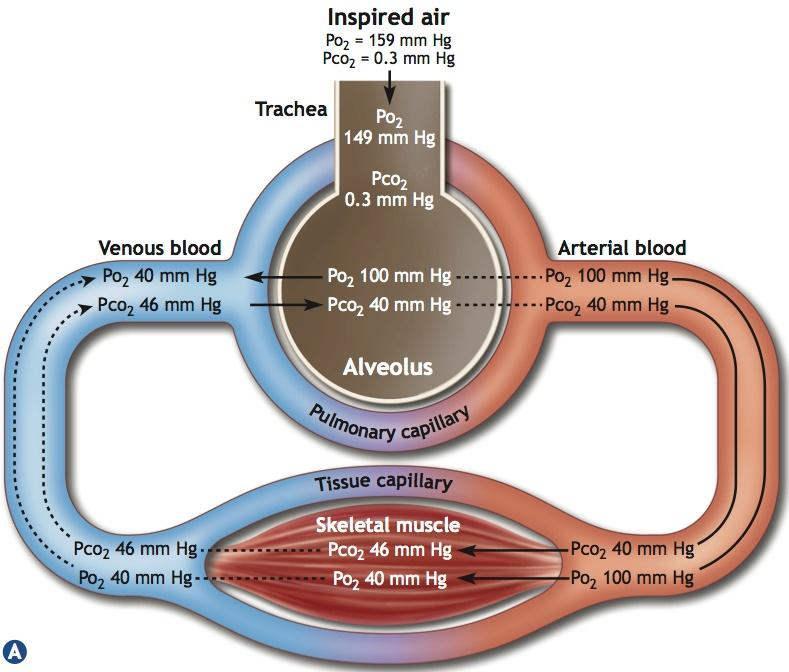
This diagram draws the loop at rest, with the pressures printed at each stop. Blood flows from the Alveolus at the top down the red side, labelled Arterial blood, to the Skeletal muscle. It returns up the blue side, labelled Venous blood. Read clockwise from Inspired air, oxygen steps down 159, 149, 100 and 40 mmHg, and each step is a gradient that moves it on. Read the same way, carbon dioxide climbs 0.3, 40 and 46 mmHg, because it travels from muscle to air.
4. When the exchange is impaired: thick membranes, lost surface and too little time
Because diffusion across the membrane takes time, anything that slows it can stop the blood from loading fully with oxygen. Two changes slow it: a thicker membrane and a smaller alveolar surface area. A membrane thickened by scarring, fluid or inhaled pollutants such as smoke gives each molecule a longer path. A smaller surface, as when emphysema destroys alveoli or pneumonia fills them with fluid, leaves fewer places to cross.
Either change lengthens the time the blood needs to reach equilibrium. At rest this rarely matters, because blood spends about 0.75 s in a lung capillary but needs only about 0.25 s. In exercise the heart pumps several times more blood through the lungs, so each red blood cell may stay only about 0.25 s. A healthy lung still loads the blood just in time, but a damaged lung cannot, so the blood leaves short of oxygen. This is why people with lung disease may cope at rest yet struggle and perform poorly in exercise.
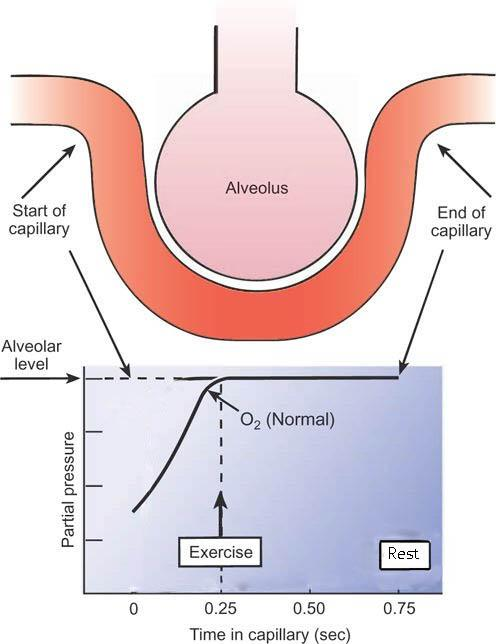
In this diagram, one capillary wraps around an alveolus, from Start of capillary to End of capillary. The graph beneath has Time in capillary along the bottom and the blood’s oxygen Partial pressure up the side. The curve labelled O2 (Normal) climbs to the dashed Alveolar level, the oxygen pressure in the alveolus, by about 0.25 s. The boxes labelled Exercise and Rest mark when the blood leaves, at about 0.25 s and 0.75 s. A thickened membrane would slow the climb, so blood leaving at Exercise would fall short. It is like a glass under a slow tap, which fills if you stroll past but not if you run.
In some highly trained athletes, even healthy lungs can reach this limit during very hard exercise, as Limits to Ventilation – Work of Breathing, Breathing Reserve, Exercise-Induced Hypoxaemia, Smoking and Cold explains. The same problem appears at altitude, where thinner air lowers the alveolar oxygen pressure and shrinks the gradient that loads the blood, as Altitude – Less Oxygen, Acclimatisation, Performance and Altitude Training explains. Once in the blood, little oxygen can stay dissolved, so most needs a carrier, haemoglobin, a protein in red blood cells that Oxygen in the Blood – Dissolved Oxygen, Haemoglobin and the Dissociation Curve introduces.
Summary
Summary
Air is 20.9 per cent oxygen at a total pressure of 760 mmHg, so by Dalton’s law oxygen’s partial pressure is 159 mmHg. Every gas diffuses from higher to lower partial pressure, whatever other gases are present. Oxygen steps down from 149 mmHg in the trachea to 100 mmHg in the alveoli and arterial blood and 40 mmHg in resting muscle and venous blood. Carbon dioxide needs a gradient of only 6 mmHg, from 46 to 40 mmHg, because it crosses 20 to 25 times more easily than oxygen. Blood reaches equilibrium in about 0.25 s, and a healthy arterial oxygen pressure is 75 to 100 mmHg, or 10.5 to 13.5 kPa. A thicker membrane or a smaller alveolar surface slows loading, which matters in exercise, when blood stays about 0.25 s instead of 0.75 s.