Definition
This note asks whether breathing itself ever holds back exercise. In most healthy people it does not, because breathing is cheap and the lungs have capacity to spare. The note then looks at where the lung does fall behind: the elite athlete, the smoker and exercise in cold air.
1. What breathing costs – compliance, airway resistance and the oxygen cost of breathing
Breathing is work, and this section explains what sets its price. In a healthy person the breathing muscles take only a small share of the body's oxygen, even in exercise. Two things decide the cost of each breath.
The first is compliance, which is how easily the lungs and chest stretch to let air in (The Lungs and the Breathing Pump – Alveoli, Airways, Muscles, Surfactant and the Valsalva Manoeuvre). A stiff lung, like a new balloon, takes more effort to inflate. Smoking-related COPD, ARDS and fibrosis all reduce compliance, because they stiffen or scar the lung (Lung Disease and Exercise – ARDS, Asthma and COVID).
The second is airway resistance, which is how much the airways resist the flow of air. Asthma and COPD raise airway resistance by narrowing the airways. Resistance follows the fourth-power rule, the same law that governs blood vessels (Vascular Resistance – Pressure Profile, Radius and Control of Arterioles). Halving an airway’s diameter raises its resistance 16-fold, because two to the power of four is sixteen. With lung disease, breathing can take up to 40 per cent of the oxygen used in exercise.
In healthy people the numbers are far smaller. At ventilations up to 10 L/min, each litre of air breathed costs 1.5 to 2.0 mL of oxygen. The cost per litre stays near this until ventilation reaches roughly 100 L/min. In moderate exercise breathing takes 3 to 5 per cent of total oxygen uptake. At VO2max, the highest rate at which the body can use oxygen (Oxygen Uptake – VO2, VO2max and the Lactate Threshold), it takes 8 to 11 per cent.
The share keeps climbing in highly trained endurance athletes, who breathe 150 L/min or more. For them the cost of exercise hyperpnoea, the deep and rapid breathing of exercise, reaches 15 per cent or more of total oxygen uptake.
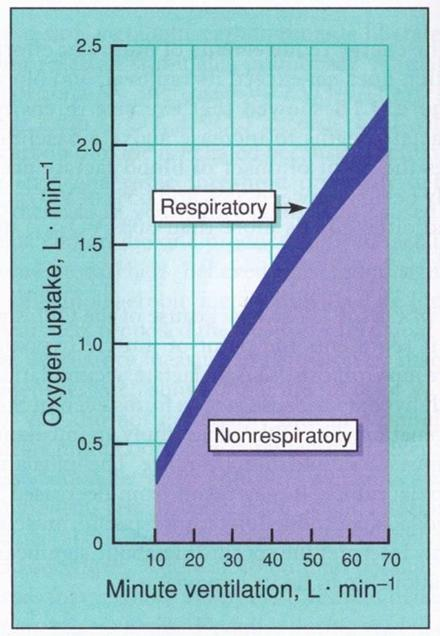
The graph plots total oxygen uptake, in litres per minute, against minute ventilation from 10 L/min to 70 L/min. The lower band labelled nonrespiratory is the oxygen used by everything other than breathing, mostly the working muscles. The thin wedge on top labelled respiratory is the oxygen used by the breathing muscles. At 10 L/min it is a sliver, so breathing is almost free. By 70 L/min it has widened, because pushing air faster through the same airways costs more per litre. Breathing is cheap until it is not.
2. Competition for blood between the breathing muscles and the limbs
The rising cost matters because the breathing muscles have no private blood supply. The cost of breathing can be read as a percentage of total oxygen uptake or as millilitres of oxygen per litre of air. Both climb steeply at high ventilations.
At the top end the breathing muscles and the limb muscles become rivals. They are vascular beds in parallel, side branches fed from the same arteries. They therefore share one cardiac output, the volume of blood the heart pumps each minute (Circulation Overview – Circuits, Vessels and the MAP Equation). In intense exercise the two compete for oxygen and blood flow. Eventually the breathing muscles take oxygen that the limbs could have used, most of all in elite athletes, whose ventilation is so large.
3. The breathing reserve – why ventilation does not limit healthy people
Breathing has a cost, so it is fair to ask whether the lungs set the upper limit on how much oxygen a healthy person can use. Three facts show that they do not. First, training raises VO2max a great deal, yet aerobic training changes the lung far less than it changes the heart, blood and muscles. If the lung were the limit, VO2max could not rise until the lung itself improved. So the lung must already have more capacity than the body needs.
Second, in strenuous effort healthy people hyperventilate, which means they breathe more than is needed to clear the carbon dioxide they produce (Control of Breathing – Brainstem Centres, Chemoreceptors and the Three Phases of Exercise Ventilation). The extra fresh air flushes carbon dioxide out of the alveoli and tops up their oxygen. So alveolar carbon dioxide falls and alveolar oxygen rises slightly.
Third, there is a measurable breathing reserve. Maximum voluntary ventilation, or MVV, is the most air a person can move in 15 seconds of the fastest, deepest breathing possible. That volume is then scaled up to a full minute. Even at VO2max, ventilation reaches only 60 to 85 per cent of MVV, so part of the lung’s pumping capacity is never used. In healthy people, therefore, ventilation does not normally limit aerobic power, the conclusion also reached in Minute and Alveolar Ventilation – Dead Space, the Ventilation–Perfusion Ratio and Shunt.
4. The exception – exercise-induced arterial hypoxaemia
The reserve has limits, and in some people the lung does fall behind in intense exercise. Exercise-induced arterial hypoxaemia, or EIH, is a fall in arterial oxygen saturation during intense exercise. Saturation is the share of the blood’s haemoglobin that is carrying oxygen (Oxygen in the Blood – Dissolved Oxygen, Haemoglobin and the Dissociation Curve). A fall means the blood leaving the lung is not fully loaded.
It happens above all in endurance athletes, whose training has built an exceptional heart and muscles while leaving the lung almost unchanged. Three possible causes are recognised, the first two explained in Minute and Alveolar Ventilation – Dead Space, the Ventilation–Perfusion Ratio and Shunt:
- Air and blood are matched unevenly across the lung, so some alveoli receive blood but too little air (ventilation–perfusion inequality).
- Some blood shunts from the venous to the arterial side without meeting ventilated alveoli, so it never picks up oxygen.
- Blood leaves the alveolar capillary before it has equilibrated with alveolar gas, because a very high cardiac output pushes it through too fast. This is the transit-time problem explained in The Respiratory Gases – Composition of Air, Partial Pressures and Exchange across the Alveolar Membrane.
Whatever the cause, the sign of EIH is a widening alveolar–arterial oxygen gradient at maximal exercise, with a fall in arterial oxygen pressure. The gradient is the difference in oxygen partial pressure, the measure of how much oxygen is present, between alveolar air and arterial blood. Normally the two stay close, because blood equilibrates with air. In EIH they separate, because hyperventilation raises alveolar oxygen while arterial oxygen falls.
The working muscles make the fall worse. They extract more oxygen, so the venous blood returning to the lung carries less oxygen than at rest. Any blood that misses the air through mismatch or shunt therefore drags the arterial value down further.
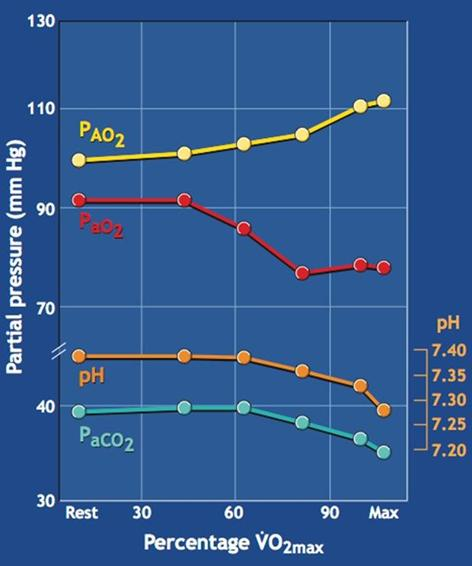
The graph follows four measurements in athletes exercising from rest to maximum. The horizontal axis is intensity as a percentage of VO2max, the left axis is partial pressure in mmHg, and the right axis is pH. The alveolar oxygen line, PAO2, rises from about 100 mmHg to above 110 mmHg because of hyperventilation. The arterial oxygen line, PaO2, holds near 90 mmHg until about 60 per cent of VO2max and then falls below 80 mmHg. The widening gap between these two lines is the alveolar–arterial gradient, exercise-induced hypoxaemia drawn as two diverging lines.
Below them, pH drifts from about 7.40 to 7.30 as acid builds up in the blood. Arterial carbon dioxide, PaCO2, falls from about 40 mmHg to the mid-30s as hyperventilation blows it off.
5. What training changes in the lung, and why women reach their limit sooner
The lagging lung raises the question of what training changes in the respiratory system at all. Training makes no structural change in the lung. What adapts is the pump around it. The diaphragm and chest muscles gain endurance and strength like any other trained muscle. In elite athletes this can raise vital capacity, the largest breath a person can take in and blow out, by 25 to 30 per cent. Swimmers gain most, because they breathe in against the weight of water pressing on the chest.
The ratio of ventilation to oxygen uptake in maximal effort also rises, because a trained athlete can move far more air. Even so, lung function tests do not separate elite endurance athletes from healthy people, and many professional players have below-average vital capacities. Lung size is largely genetic, and the tests are used to spot illness rather than fitness.
Women meet the same fixed lung with a smaller starting size. Compared with men they have smaller lungs and narrower airways, a smaller diffusion surface and lower lung function measures. Airways have a ceiling on how fast air can flow out, and in maximal exercise a woman’s airways reach it. This is called expiratory flow limitation. She works harder to breathe and uses up the ventilatory reserve a man would keep. That can hurt oxygen transfer from alveoli to blood, most of all in highly trained women.
6. Smoking – acute effects of one cigarette and chronic damage
Smoking is the commonest way a healthy lung becomes a limiting one, and its effects come in two layers. The acute effects follow a single session of 15 puffs over 5 minutes. Airway resistance rises threefold for about 35 minutes, in smokers and non-smokers alike. The cause is a vagal reflex. The vagus nerve tightens the smooth muscle of the airways. Here it is triggered by nicotine acting on nicotinic receptors, and probably by smoke particles irritating the airway lining.
This narrowing matters little in light exercise. At high intensity it raises the oxygen cost of breathing from about 9 to as much as 15 per cent of oxygen uptake. At similar ventilations, each litre of air costs more oxygen after smoking than without it. The airway effects reverse within 24 hours.
Smoke also delivers carbon monoxide, which binds to haemoglobin and blocks oxygen from binding (Oxygen in the Blood – Dissolved Oxygen, Haemoglobin and the Dissociation Curve). After one day without cigarettes the exercise heart rate is 5 to 7 per cent lower. Smoking also slows the cilia of the mucociliary escalator, the moving carpet that sweeps mucus out of the airways (The Lung’s First Line of Defence – Nose, Cilia, Mucus and Antimicrobial Peptides), both acutely and chronically.
The chronic effects build over years and work down the respiratory tract. In the mouth, larynx and pharynx, hot gas and particles cause constant irritation, giving hoarseness, cough and wheeze. In the bronchi, chemicals and particles stop the cilia, so mucus clogs the airways. This is chronic bronchitis, the first stage of COPD.
Deeper still, the alveoli lose their elastic tissue and break down, so they transfer less oxygen. This is emphysema, and COPD then limits exercise tolerance until strenuous exercise is impossible for many. In the lung’s blood vessels, tobacco causes atherosclerosis, which raises the pressure in them, called pulmonary hypertension. Finally, smoking blunts the rise of heart rate in exercise (Pacemaker Cells and Autonomic Control of Heart Rate), so a smoker can look fit on a heart-rate test.
7. Cold air – oxygen uptake, ventilation, airway water loss and endurance
Cold is the last limit, and it acts on the whole body as much as on the lung. In the cold, resting oxygen uptake rises, and so does oxygen uptake in submaximal exercise. Heat flows from warm to cold at a rate set by the temperature difference, the thermal gradient. Cold air widens that gradient between skin and surroundings. More heat is then lost by conduction, which is direct contact, and by convection, which is moving air carrying heat away.
The body burns extra fuel to replace that heat, and the fuel needs oxygen. Wet clothing makes it worse, because water carries heat away far faster than air. Sudden cold raises ventilation, and submaximal ventilation stays higher than usual. Only at high intensity do the responses become similar to normal.
Cold air rarely damages the airways, because they warm it quickly on the way in. But warm air holds far more moisture than cold air, so the airways must moisten each breath as they warm it. In doing so they lose water and heat, most of all in strenuous exercise. This fluid loss contributes to dehydration, a dry mouth, a burning throat and irritation of the airways.
Endurance falls in the cold for reasons that add up. Keeping warm raises the metabolic cost of everything. A cooled body reaches a lower maximal heart rate, so maximal cardiac output and VO2max fall with it. Cold also shifts the oxygen dissociation curve to the left, so haemoglobin holds its oxygen more tightly and unloads less in the muscle (Unloading Oxygen and Carrying Carbon Dioxide – Bohr Effect, 2,3-DPG, Myoglobin and Bicarbonate). Blood flow to the working muscle falls as well.
Summary
Summary
The price of breathing is set by compliance, how easily the lungs and chest stretch, and by airway resistance, which obeys the fourth-power rule: halve the diameter and resistance rises 16-fold. Breathing takes 3 to 5 per cent of oxygen uptake in moderate exercise, 8 to 11 per cent at VO2max and 15 per cent or more in elite athletes. Even then ventilation does not limit healthy people, because at VO2max they hyperventilate and use only 60 to 85 per cent of MVV. The exception is exercise-induced arterial hypoxaemia in endurance athletes, where ventilation–perfusion mismatch, shunt or too short a transit time widen the alveolar–arterial oxygen gradient and lower arterial saturation. Training changes no lung structure, only the breathing muscles, so lung function tests cannot tell athletes from healthy people, and women’s smaller lungs and airways reach their flow limit sooner. One cigarette triples airway resistance for 35 minutes by a vagal reflex, and chronic smoking brings chronic bronchitis, emphysema and pulmonary hypertension. Cold air raises oxygen uptake, dries the airways and lowers maximal heart rate, cardiac output and VO2max while shifting the dissociation curve left.