1. The gate in the substantia gelatinosa
Nociceptive afferents synapse in the dorsal horn onto projection neurons whose axons ascend in the lateral spinothalamic tract (see Pain in the Spinal Cord and the Withdrawal Reflex for where these afferents terminate and how lamina II is built, and Ascending Pain Pathways for the tract itself). The substantia gelatinosa, lamina II, is where this transmission is controlled and works as a gate: C fibre activity opens it, Aβ fibre activity closes it, and the balance of the two, mediated by dorsal horn interneurons, sets what reaches the brain (modulation from above and from non nociceptive input is covered in Pain Experience and Descending Modulation).
2. The circuit
The circuit behind the gate is built around an inhibitory local circuit neuron sitting between the two afferent inputs and the dorsal horn projection neuron. The C fibre from the nociceptor does two things at once: it excites the projection neuron directly, driving the pain pathway, and it inhibits the inhibitory interneuron, removing the brake on the projection neuron. Both actions push the gate open. The Aβ fibre from the mechanoreceptor does the opposite: it excites the inhibitory interneuron, which then inhibits the projection neuron, dampening transmission into the anterolateral system and closing the gate. The output of the projection neuron thus reflects which input is dominating, nociceptive C fibre drive or mechanoreceptive Aβ drive.
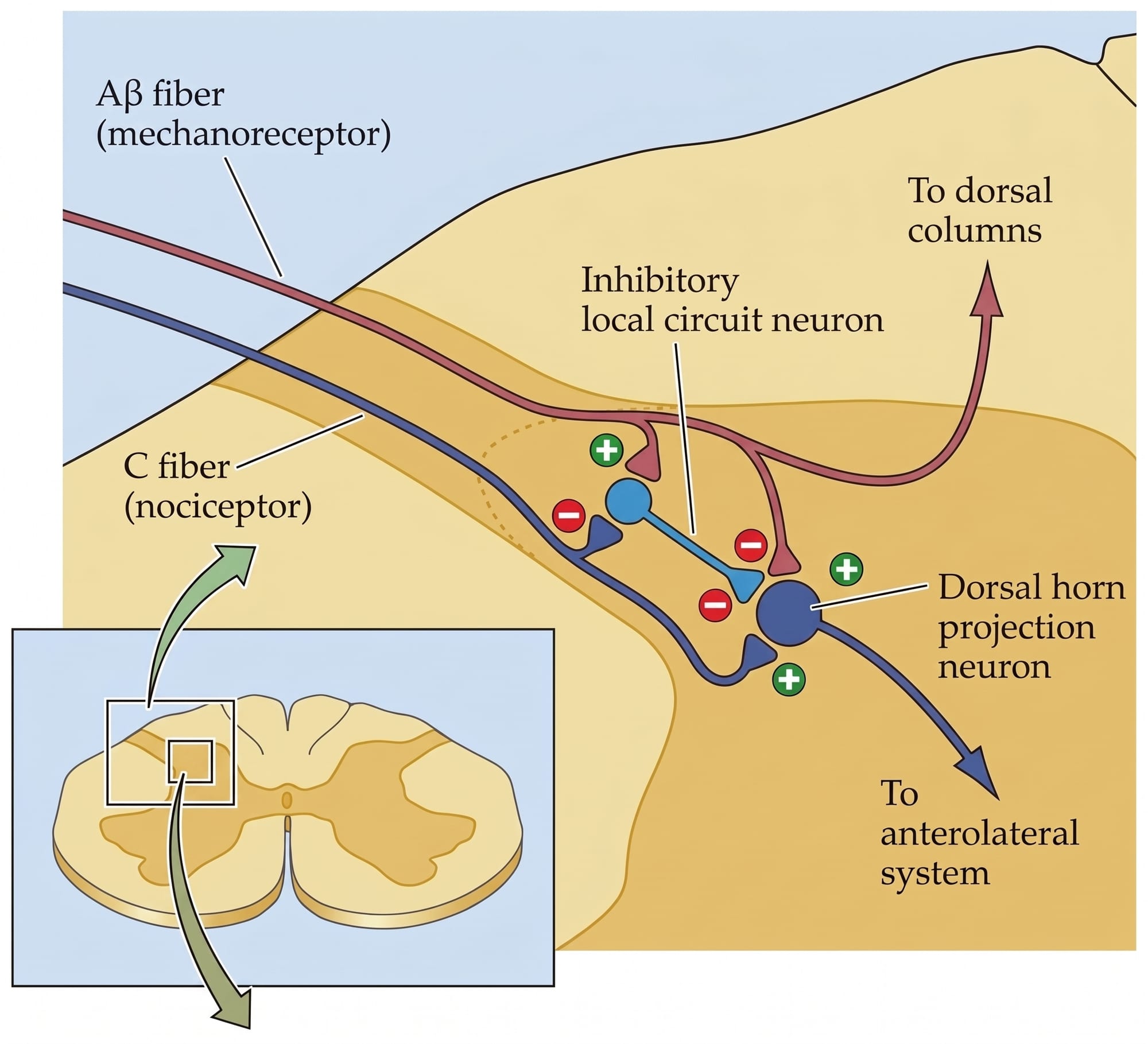
Green ⊕ marks an excitatory synapse and red ⊖ an inhibitory one: the Aβ fibre excites (⊕) the inhibitory local circuit neuron, which then inhibits (⊖) the dorsal horn projection neuron and closes the gate; the C fibre excites (⊕) the projection neuron directly and inhibits (⊖) the interneuron, lifting the brake and opening the gate.
3. Everyday and clinical correlates
The theory explains why rubbing or scratching a painful site relieves pain: these manoeuvres recruit large myelinated Aβ mechanoreceptor afferents, whose activity closes the gate and competes with the C fibre signal. The same principle is exploited clinically by TENS (transcutaneous electrical nerve stimulation), where electrodes on the skin deliver electrical pulses that selectively activate the large Aβ fibres, closing the gate and reducing the pain that reaches higher centres. Manual therapy works through the same mechanism: the pressure, stretch and movement applied to skin and soft tissue drive Aβ mechanoreceptor input into the dorsal horn, exciting the inhibitory interneuron and suppressing the projection neuron. Dry needling likewise recruits large afferent input, as the needle inserted into the muscle stimulates local mechanoreceptive afferents whose activity competes with nociceptive C fibre transmission at the gate, adding to the inhibitory drive that keeps it closed.
Summary
Summary
The substantia gelatinosa (lamina II) acts as a gate on pain transmission. C fibres open the gate by exciting the dorsal horn projection neuron directly and inhibiting the inhibitory interneuron that normally restrains it, facilitating lateral spinothalamic tract activation. Aβ fibres close the gate by exciting that inhibitory interneuron, which suppresses the projection neuron and inhibits tract activation. The perceived intensity of pain reflects the balance between the two inputs, set by dorsal horn interneurons, and this is why rubbing, scratching and TENS, all of which drive Aβ mechanoreceptor fibres, reduce pain.