Definition
A photopigment is the light absorbing molecule of a photoreceptor, and rhodopsin, the pigment of rods, is composed of an opsin protein bound to retinal. Photoactivation of this pigment, and the varied absorption of the different opsin isoforms found in rods and cones, underlie both the electrical response to light and colour vision.
Rhodopsin: opsin plus retinal
Rhodopsin is built from two components: opsin, the protein part, and retinal, the light absorbing part. Retinal derives from vitamin A and rests within the opsin, positioned to capture photons, while the protein determines which wavelengths the pigment absorbs best.
The retinal isoforms and photoactivation
Retinal exists in two isoforms. In non activated rhodopsin the retinal is in the 11 cis configuration, a bent form of the molecule. When a photon is absorbed, light converts 11 cis retinal into all-trans retinal and the molecule straightens. With this change opsin and retinal split, and the pigment becomes metarhodopsin II, the activated form of rhodopsin, which excites the electrical change in the photoreceptor; what metarhodopsin II triggers downstream is covered in The Dark Current and Phototransduction.
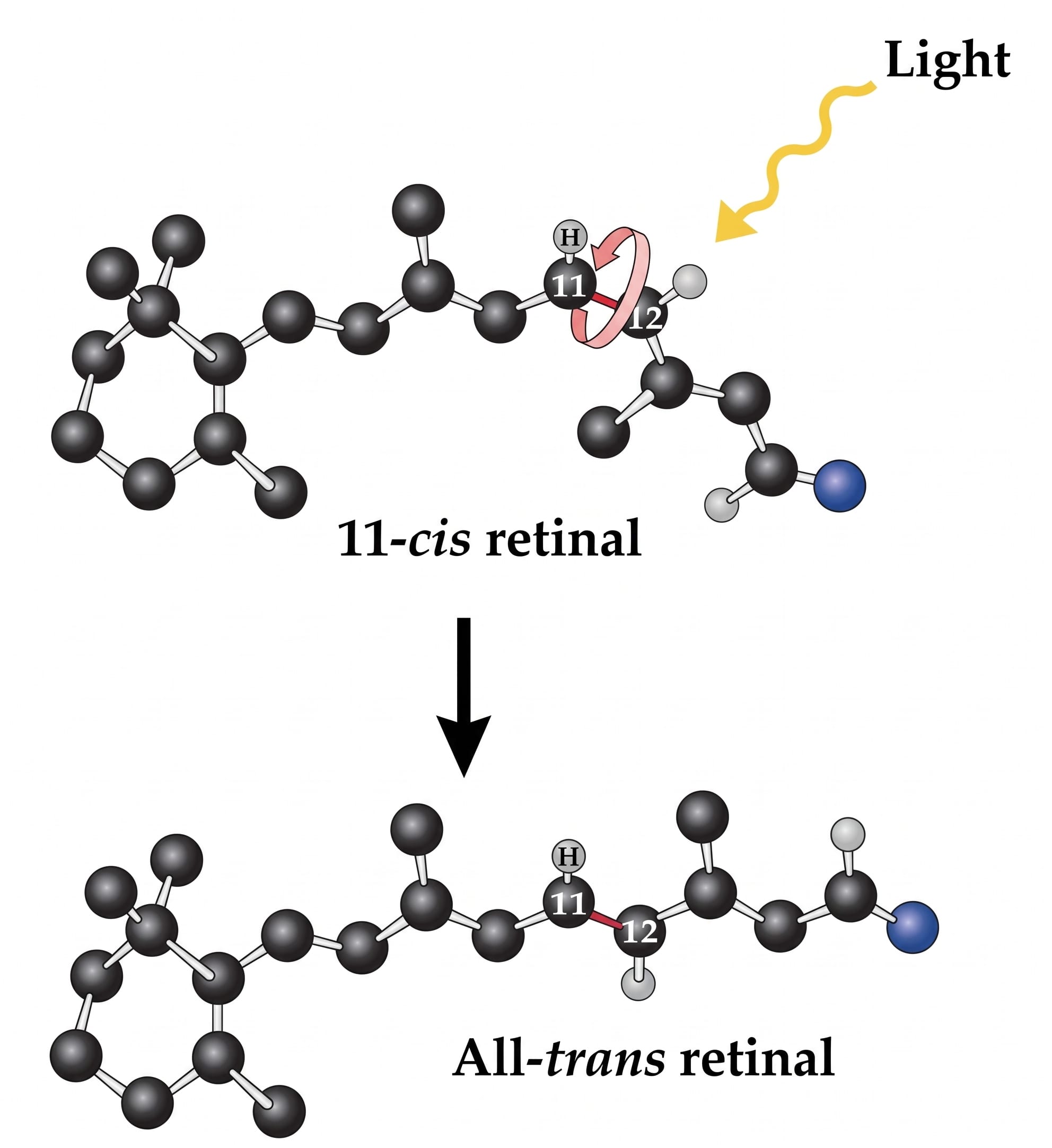
The figure shows the isomerisation itself: the 11 cis molecule is kinked at the double bond between carbons 11 and 12, and absorption of a photon breaks that bond so the chain straightens into the all trans form, the single structural change that activates the pigment.
Opsin isoforms in rods and cones
Rods and the different cone types contain different isoforms of opsin, so their pigments have varied absorption characteristics. Rods carry scotopsin, while cones carry photopsins.
Colour vision depends on three cone photopsins, each absorbing light best at a different wavelength: S (blue) at 420 nanometers (nm), M (green) at 540 nm and L (red) at 570 nm. Each cone expresses one of these, so the three cone classes sample the short, medium and long wavelength ranges respectively.
Colour blindness and X linkage
Colour blindness affects 8% of males (most cases are mild enough to go unnoticed without formal testing) and only 0.5% of females, and the reason is genetic: the L and M opsin genes are X linked and together make up 90 to 95% of opsins. Males carry a single X chromosome, so one faulty copy is enough to produce the defect, whereas females would need both copies affected. M cone problems account for 75% of cases.
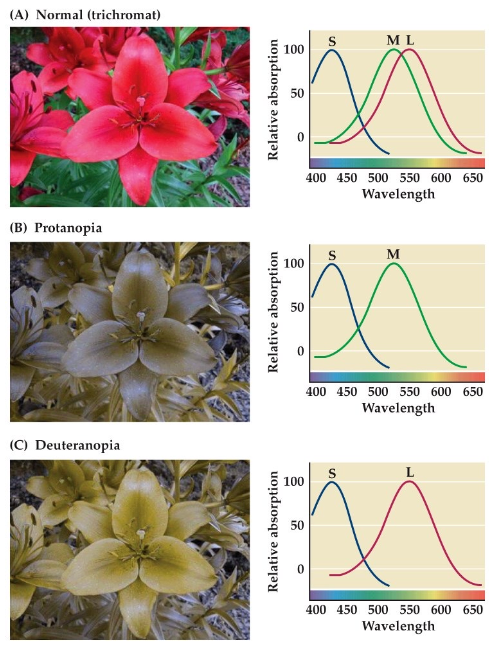
The figure pairs photographs of red lilies with the corresponding cone absorption spectra. In the normal trichromat (A) the S, M and L curves overlap across the spectrum and the flowers stand out vividly red against the green foliage. In protanopia (B) the L curve is missing, leaving only S and M, and in deuteranopia (C) the M curve is missing, leaving only S and L; in both, the red blooms wash out towards yellowish grey, illustrating the red and green confusion caused by losing either X linked opsin.
Summary
Summary
Rhodopsin is opsin plus retinal, and light activates it by flipping 11 cis retinal to the all trans form, after which the two split and the resulting metarhodopsin II excites the photoreceptor’s electrical change. Opsin isoforms tune absorption: scotopsin in rods, and the photopsins S (420 nm), M (540 nm) and L (570 nm) in cones. Because the L and M opsin genes are X linked and make up 90 to 95% of opsins, colour blindness affects 8% of males but only 0.5% of females, and M cone problems cause 75% of cases.