Definition
The dark current is the continuous influx of Na⁺ into the photoreceptor outer segment that keeps the cell depolarised at about −40 mV in darkness, possible because cGMP holds the sodium channels open. Phototransduction is the cascade by which light lowers cGMP, closes these channels and hyperpolarises the cell, converting light into an electrical signal.
The dark current
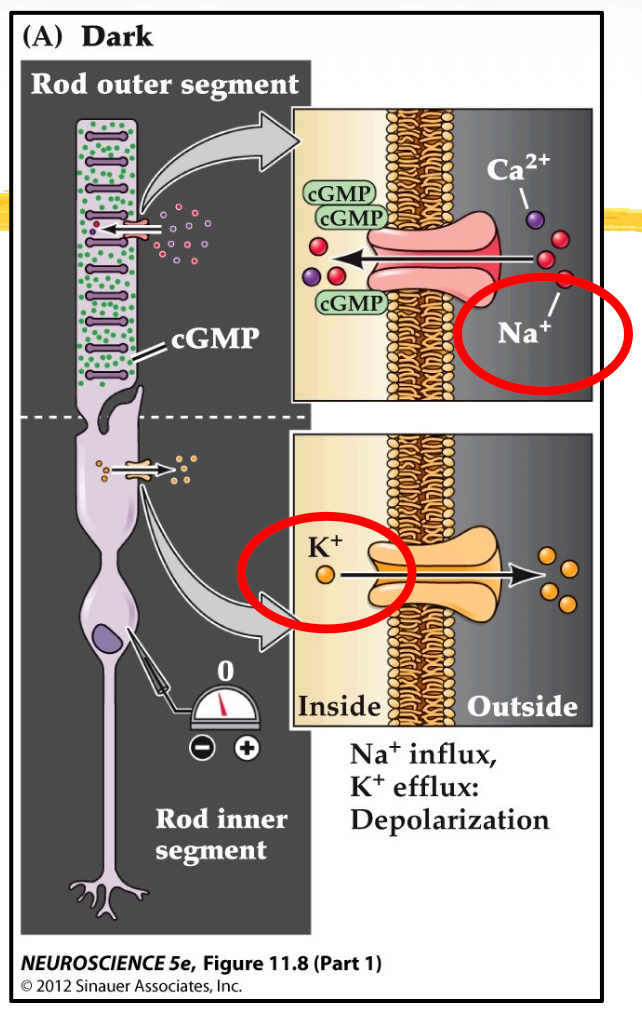
In darkness the photoreceptor rests in a depolarised state. Na⁺ flows into the outer segment through cGMP gated sodium channels (with some Ca²⁺, which the same channels admit), and this sodium influx is the dark current itself: it depolarises the cell and sets a membrane potential of about −40 mV. The channels stay open because cGMP splints them open; as long as cGMP is bound, the inward current persists. Opposing it, K⁺ flows out of the inner segment through its own channels, so the steady −40 mV reflects the balance between sodium influx and potassium efflux.
As stressed in class, this resting potential is unusually high: a typical neuron rests near −70 mV (see Membrane Potential), while the photoreceptor already sits partly depolarised at −40 mV before any stimulus arrives.
The light cascade
Light activates the photopigment, and activated rhodopsin, metarhodopsin II, starts the cascade. Metarhodopsin II switches on the G protein transducin, and transducin activates cGMP phosphodiesterase, the enzyme to know by its full name, as stressed in class.
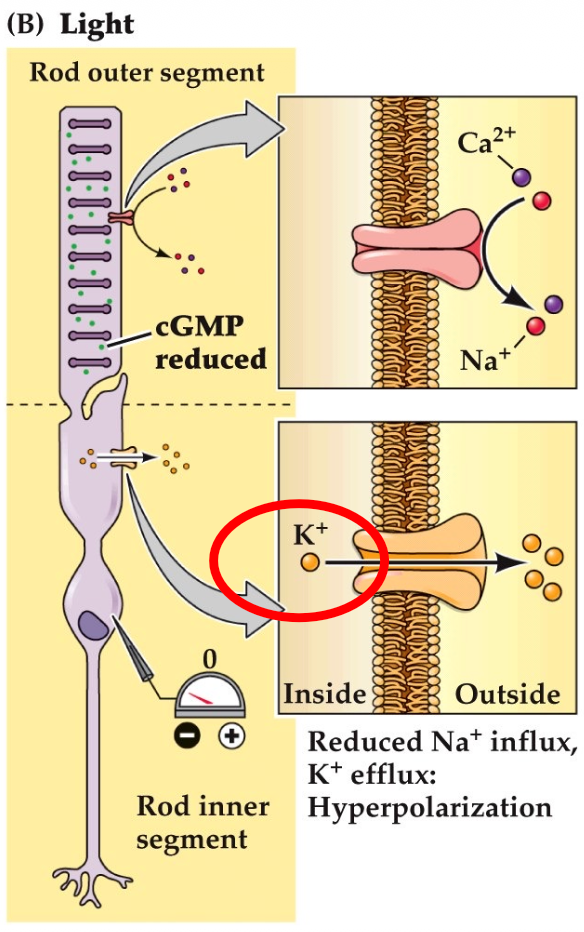
Two enzymes control cGMP levels: guanylyl cyclase which builds cGMP from GTP, while cGMP phosphodiesterase breaks cGMP down into 5′GMP. The phosphodiesterase is active in the light, so illumination tips the balance toward breakdown and cGMP levels fall. With cGMP gone the splint is removed, the cGMP gated ion channels close, and the dark current is cut off.
Hyperpolarisation in the light
Once the channels close, the Na⁺ inward current stops while the K⁺ outward current of the inner segment is maintained. Positive charge keeps leaving the cell but no longer enters, so the interior becomes more negative and the cell hyperpolarises: light produces the opposite of the depolarising receptor potential seen in most sensory receptors.
Key numbers and names to memorise
Dark membrane potential ≈ −40 mV, against ≈ −70 mV in a typical neuron. Cascade order: light → metarhodopsin II → transducin (the G protein) → cGMP phosphodiesterase → cGMP falls → cGMP gated channels close → hyperpolarisation. Enzymes: guanylyl cyclase converts GTP to cGMP; cGMP phosphodiesterase converts cGMP to 5′GMP and is active in the light.
Summary
Summary
Most neurons signal by depolarising: a stimulus drives the membrane toward threshold and an action potential follows. The photoreceptor works the other way round: it rests already depolarised in the dark, held near −40 mV by the dark current, and signals light by hyperpolarising, because the light cascade lowers cGMP, the splinted sodium channels close, and the unopposed K⁺ efflux makes the interior more negative. Same ionic logic as an ordinary neuron, with the sign reversed.