Definition
Muscles burn oxygen to release energy, and the harder they work, the more they burn. This note shows how that oxygen use is measured and what its upper limit says about fitness. It also shows how much of that limit a person can really use.
1. Oxygen used equals oxygen taken in
Oxygen is used deep inside the muscles, yet it can be measured at the mouth. This works in submaximal steady state, meaning a constant effort below maximum that the body has settled into. The body is then neither storing up oxygen nor drawing on its stores, so whatever oxygen the lungs take up, the tissues must be using.
This is written QO2 = VO2, where QO2 is oxygen utilisation by the tissues and VO2 is oxygen uptake at the lungs, also called oxygen consumption. Likewise, the carbon dioxide the cells produce (QCO2) equals the carbon dioxide breathed out (VCO2).
The lung is also assumed to be sealed except at the airway, so oxygen enters and carbon dioxide leaves only by the mouth or nose. So external respiration, the gas exchange measured at the mouth, represents internal respiration, the oxygen used and carbon dioxide made by the cells. This is why a mouthpiece can measure the oxygen the muscles use, the whole basis of fitness testing.
Measured this way, VO2 is about 0.25 litres per minute (L/min) at rest. In hard exercise it rises to about 3 to 4 L/min in an untrained person.
2. Measuring VO2 from the air breathed
VO2 is measured with a mouthpiece and a gas analyser, a method called open-circuit spirometry. Because the body keeps some of the oxygen it inhales, VO2 is the oxygen breathed in minus the oxygen breathed out, per unit of time.
As a formula, VO2 = [(VI x FiO2) - (VE x FeO2)] / t, where VI and VE are the volumes inspired and expired, FiO2 and FeO2 are their oxygen fractions, and t is the time. Fresh air is 20.9 per cent oxygen, as The Respiratory Gases – Composition of Air, Partial Pressures and Exchange across the Alveolar Membrane explains, so its oxygen fraction is 0.209. Expired air holds about 16 per cent oxygen at rest, because the body has kept some, and about 12 to 14 per cent in exercise.
The volumes breathed in and out are nearly equal. So suppose a resting person breathes 6 L in and 6 L out in one minute. That air brings in about 1.25 L of oxygen at 20.9 per cent and takes about 0.96 L back out at 16 per cent. The body keeps the difference, about 0.29 L/min, which is close to the typical resting VO2 of 0.25 L/min.
3. The ceiling: VO2max and how it is tested
As exercise gets harder, VO2 rises until it reaches a ceiling, called VO2max or maximal oxygen uptake. VO2max is the maximum capacity of the body to transport and use oxygen during incremental exercise, which gets harder in steps. It is a standard measure of aerobic, or oxygen-powered, fitness.
VO2max is given in L/min or in millilitres per kilogram of body weight per minute (mL/kg/min). A larger body uses more oxygen simply because it has more muscle, so dividing by body weight lets athletes of different sizes be compared. Roughly, ordinary young adults score 35 to 45 mL/kg/min and elite endurance athletes 70 to 85 mL/kg/min.
VO2max is measured with the cardiopulmonary exercise test (CPX test), a graded test in which the workload rises in steps. It is run on a treadmill or a cycle ergometer, a stationary exercise bike. For example, the treadmill slope may rise every 2 minutes through 0, 3, 6 and 8 per cent over eight and a half minutes. Meanwhile, the volume of air breathed (ventilation) and the oxygen and carbon dioxide in the inhaled and exhaled air are measured.
The test must be long and hard enough to fully tax the aerobic system, because VO2max is reached only at the plateau. This is the point where oxygen consumption stops rising even though the workload keeps increasing. Estimates from easier, submaximal tests are less accurate.
VO2max measures aerobic endurance potential, but it does not necessarily predict performance, because long races are run below it.
4. How much of the ceiling you can use: the lactate threshold
The share of VO2max a person can sustain is marked by the lactate threshold. Lactate is made whenever muscle breaks down sugar (glucose) faster than oxygen can finish the job.
At low intensity, blood lactate stays at or near resting levels. Other tissues, such as the heart, burn lactate for fuel and so clear it as fast as it is made. As intensity increases, there comes a break point where production outruns clearance and blood lactate rises sharply. This point, at which blood lactate accumulates above resting levels, is the onset of blood lactate accumulation (OBLA), also called the lactate threshold. Strictly, though, the two names are often kept apart. The lactate threshold is then the first rise, and OBLA is a slightly later point, when blood lactate reaches 4 millimoles per litre (mmol/L).
The break marks the shift from mainly aerobic to mainly anaerobic energy production. Anaerobic production uses no oxygen and releases far less energy from each molecule of glucose. The same break shows up in breathing as the ventilatory threshold, where breathing starts to outpace oxygen uptake, as Control of Breathing – Brainstem Centres, Chemoreceptors and the Three Phases of Exercise Ventilation explains. Lactate also comes with acid, which the body must neutralise, as Acid–Base Balance in Exercise – Buffers, Ventilation and the Kidney explains.
In healthy untrained people the threshold occurs at 55 to 65 per cent of VO2max. In highly trained endurance athletes it can be at 80 per cent of VO2max or more.
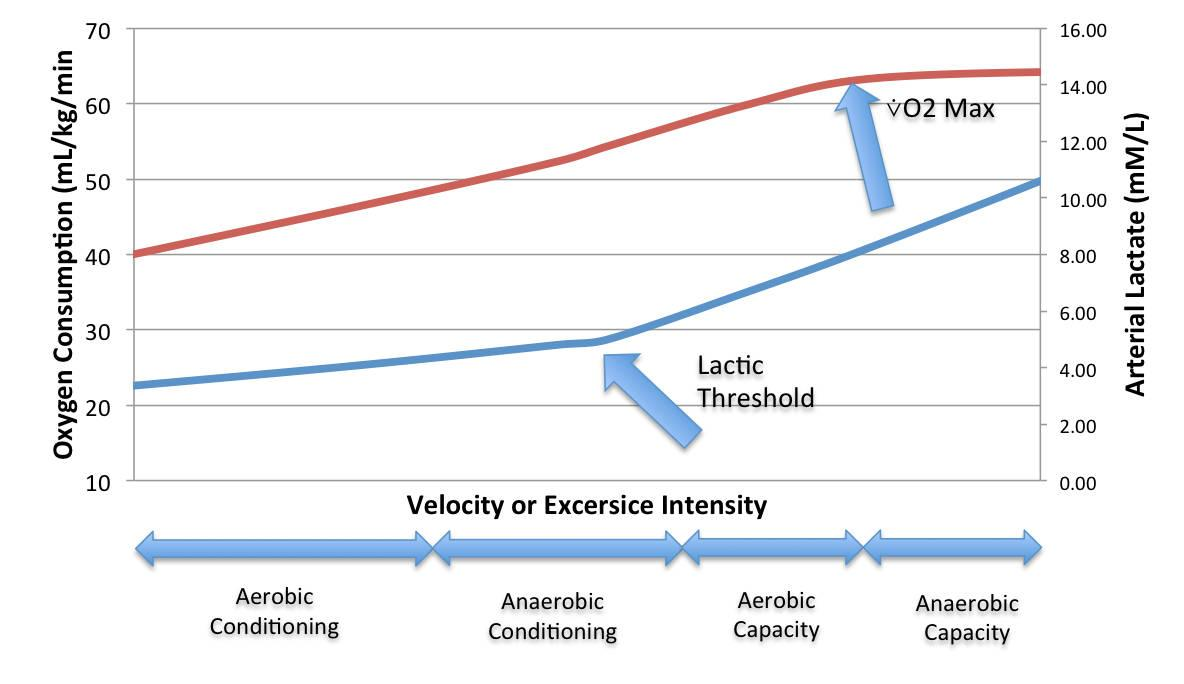
The gap between the two arrows is the room an athlete has to improve without changing VO2max. Endurance training often moves the threshold higher without raising VO2max, because trained muscles make less lactate and clear it faster. So two people with the same VO2max can perform very differently, and the threshold predicts endurance performance better than VO2max does.
Summary
Summary
In submaximal steady state the tissues use exactly the oxygen the lungs take up, QO2 = VO2, so external respiration represents internal respiration. VO2 is the oxygen breathed in minus the oxygen breathed out per unit time, VO2 = [(VI x FiO2) - (VE x FeO2)] / t, about 0.25 L/min at rest. VO2max is the maximum capacity of the body to transport and use oxygen, given in L/min or, for comparing people of different sizes, in mL/kg/min. It is measured with a graded CPX test and reached at the plateau, when oxygen consumption stops rising although the workload keeps increasing. The lactate threshold, or OBLA, is the break point where lactate production outruns clearance and blood lactate starts to climb. It lies at 55 to 65 per cent of VO2max in untrained people and at 80 per cent or more in trained endurance athletes. Training can raise it without raising VO2max, and it predicts endurance performance better than VO2max does.