Definition
Immunological memory, the third R of adaptive immunity, means that a second response to the same antigen is more rapid, larger and better able to eliminate it, and in the antibody response this is the work of memory B cells. The primary response takes 5 to 10 days, with a low antibody titre (concentration) and mainly IgM. The secondary response takes 1 to 3 days, with a much higher titre and mainly IgG, and its antibody fits better through affinity maturation. Memory is specific to the antigen already met, which is why vaccination works.
1. Why the second time is different
The third R of adaptive immunity, Remember, means that in the second encounter with an antigen, memory B cells produce a different antibody response: on second exposure to the same antigen, the secondary response is more rapid, larger and better able to eliminate the antigen than the primary response to the first exposure.
The cause is that clonal expansion in the first response (Adaptive Immunity – Principles and Clonal Selection) leaves memory B cells that far outnumber the few naive B cells (never before exposed to antigen) that began it. They are already selected and ready, so there is no long wait for a rare matching cell to find the antigen and multiply.
T cells remember in the same way, because clonal selection occurs for both T and B cells. A T cell that recognises its antigen divides into effector cells, which fight the current infection and then mostly die, and memory T cells, which survive for the next one. On a second exposure, memory helper T cells (which release cytokines that boost B cells, macrophages and other T cells) and memory cytotoxic T cells (which kill infected cells) also respond faster and in larger numbers. These slides show only B cells because they measure the response as antibody in the blood, and T cells make no antibody, so T cell memory is real but does not appear on these graphs.
2. The primary response
The primary response is the adaptive response to the first exposure to an antigen, and it is mounted by naive B cells, of which only a few can recognise any one antigen. Relying on so few cells, it is slow and small: antibody takes 5 to 10 days to appear and reaches only a low antibody titre. The titre is the concentration of antibody in the blood, measured as how far the serum can be diluted and still show antibody. This antibody is mainly IgM, the first antibody made against a new infection (B Cells and Antibodies).
3. The secondary response
The secondary response is the adaptive response to a second or later exposure to the same antigen, and it is mounted by the memory B cells left behind by the primary response. Antibody now appears within 1 to 3 days, reaches a much higher titre and is mainly IgG. The move from IgM to IgG is called class switching, in which the B cell keeps its antigen specificity but changes the constant region of its heavy chain, the part that sets the isotype.
Secondary antibody also tends to be more specific, meaning it fits its antigen more closely, so its affinity, how tightly an antibody binds its antigen, is higher. This comes from affinity maturation: as B cells divide, small random changes in their variable-region genes make some antibodies fit better, and the B cells whose antibodies fit best are selected to expand, so the average antibody fits the antigen better than before.
| Feature | Primary response | Secondary response |
|---|---|---|
| Time for antibody to appear | 5 to 10 days | 1 to 3 days |
| Antibody titre | Low | Much higher |
| Main isotype | IgM | IgG |
| Specificity | Less specific | More specific (affinity maturation) |
4. Reading the memory figure
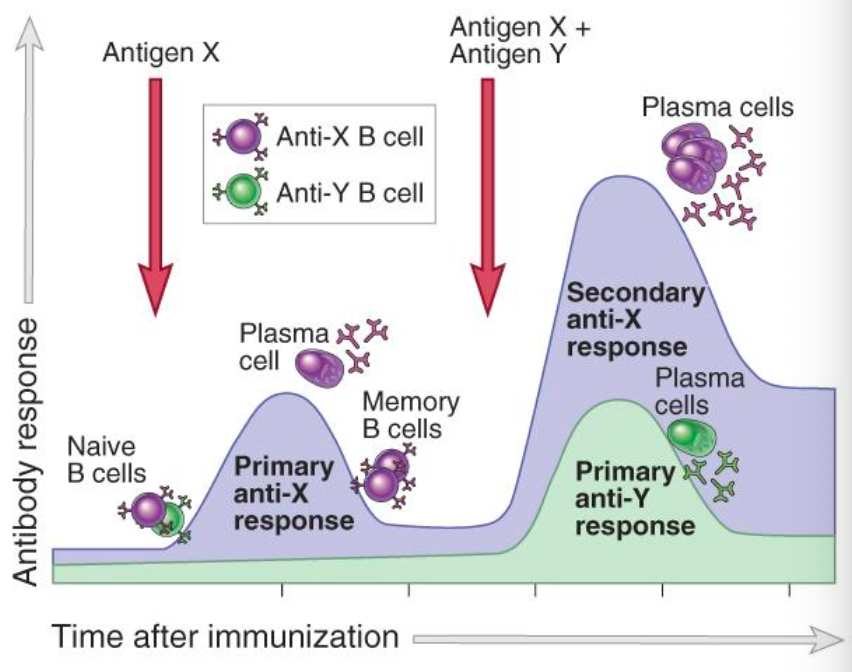
The x axis is time after immunisation (giving the antigen) and the y axis is the antibody response. Antigen X is given at the first red arrow, and naive anti-X B cells (purple) mount a small, slow primary anti-X response, leaving plasma cells, which secrete antibody, and memory B cells. At the second arrow, X is given again with a new antigen, Y. The anti-X response is now fast and large, the secondary anti-X peak, because memory cells respond, whereas Y, never seen before, gets only a small primary anti-Y response from naive anti-Y cells (green). The lesson is that memory is specific to the antigen already met.
Specific memory is the principle behind vaccination: a vaccine is a first, controlled exposure to an antigen, so that the real infection meets a secondary response. Memory is also why adaptive immunity develops throughout a lifetime and improves with each contact with antigen, unlike innate immunity (Immune System Overview – Functions and the Two Branches).
Summary
Summary
Memory B cells left by the first response are numerous and ready, so a second exposure to the same antigen gives a response more rapid, larger and better able to eliminate the antigen. The primary response takes 5 to 10 days, with a low titre and mainly IgM, and the secondary 1 to 3 days, with a much higher titre and mainly IgG after class switching. Secondary antibody also tends to be more specific, through affinity maturation. Memory is specific to the antigen already met, the basis of vaccination.