Definition
Breathing moves air in and out of the lungs, but only the air that reaches the air sacs can load oxygen into the blood. This note counts how much of the air moved each minute does useful work, and how that air is matched to the blood flowing past. It ends with what one bout of exercise asks of the lung.
1. Two ways to count breathing
Ventilation, the moving of air in and out of the lungs, can be counted in two ways. The first counts all the air moved in and out of the whole respiratory tract in a minute. The second counts only the air that reaches the alveoli each minute, the tiny air sacs where oxygen passes into the blood. The second is what matters for oxygenating the blood, because air that never reaches an alveolus cannot give up oxygen. But it is hard to measure directly, so the first is what is usually measured, at the mouth.
2. Minute ventilation and its numbers
The first way of counting is called minute ventilation. It is breathing rate times tidal volume, VE = f x VT, where VE is the air moved per minute, f is breaths per minute and VT is the volume of one breath. Like a bucket chain, breathing delivers more by passing more buckets or by using bigger buckets.
At rest about 12 breaths per minute of 0.5 L each give about 6 L/min. In strenuous exercise a healthy adult breathes 35 to 45 times per minute with breaths of 2 to 2.5 L, which is about 100 L/min. Male endurance athletes reach about 160 L/min, and some people go above 200 L/min. Both rate and depth rise to get there, and at the extreme the rate reaches 48 to 60 breaths per minute, up from 12 to 15 at rest, with breaths of 2.5 L or more. One bout of exercise also shifts each lung volume, as the table in Lung Volumes and Capacities – Spirometry, FEV1 and FVC shows.
3. How trained athletes grow the breath first
The two ways of raising minute ventilation are not used equally. In moderate exercise, well-trained athletes keep their alveolar ventilation up mainly by taking bigger breaths, with only a small rise in rate. As effort rises, tidal volume levels off at about 60 per cent of forced vital capacity, the most air a person can force out after breathing in as deeply as possible. Beyond that, minute ventilation keeps rising only because the rate rises, without any conscious decision.
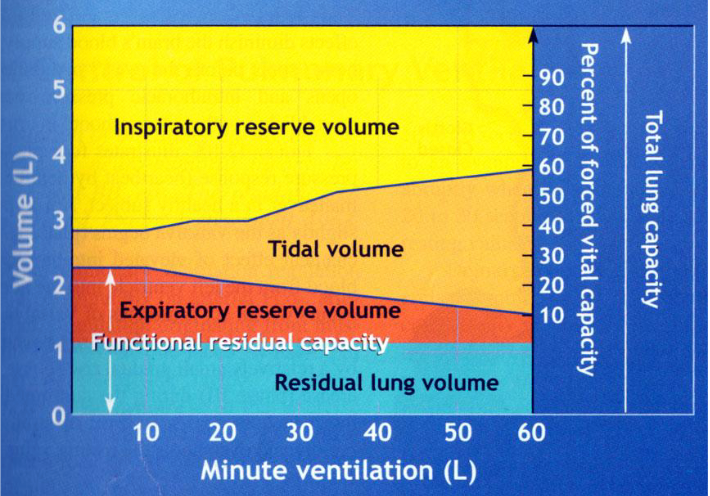
Not all of a breath does useful work. Minute ventilation is the air reaching the alveoli each minute plus the air wasted in the airways on the way, VE = VA + VD, where VA is alveolar ventilation and VD is dead-space ventilation.
4. Dead space and alveolar ventilation
The wasted air sits in the anatomic dead space, the conducting airways where air travels but no gas exchange happens, as The Lungs and the Breathing Pump – Alveoli, Airways, Muscles, Surfactant and the Valsalva Manoeuvre explains. It holds about 150 to 200 mL of each breath, usually rounded to 150 mL, and that air never reaches the alveoli. Alveolar ventilation is the portion of inspired air that reaches the alveoli and takes part in gas exchange. It sets the gas levels at the alveolar–capillary membrane, the thin wall between air and blood. Of a 500 mL resting breath, about 350 mL reaches the alveoli and mixes with the air already there.
Alveolar ventilation is therefore tidal volume minus dead space, times breathing rate. At rest that is 500 mL minus 150 mL, which is 350 mL, times 12 breaths per minute. The result is about 4.2 L/min of the 6 L/min moved at the mouth.
The dead space is paid on every breath whatever its size, so fast shallow breathing ventilates poorly. Take 24 breaths per minute of 250 mL each. Minute ventilation is still 6 L/min, but each breath now loses 150 mL and delivers only 100 mL, so alveolar ventilation falls to only 2.4 L/min. In other words, a deeper breath ventilates the alveoli better than a faster one, because it pays the dead-space toll fewer times. That is why trained athletes grow the breath before the rate.
5. Matching air to blood: the ventilation–perfusion ratio
Fresh air in the alveoli is only useful if blood flows past to collect the oxygen, so the air supply must match the blood supply. Blood flowing through the lung’s capillaries is called perfusion. The match is the ventilation–perfusion ratio, alveolar ventilation divided by pulmonary blood flow. At rest in a healthy adult man, about 4.2 L of air ventilates the alveoli each minute while about 5.0 L of blood flows through the pulmonary capillaries. That 5.0 L is the whole cardiac output, explained in Circulation Overview – Circuits, Vessels and the MAP Equation, because all the blood the heart pumps passes through the lungs. So the average ratio is about 0.84, meaning 0.84 L of fresh alveolar air for every litre of blood.
The match matters because a region with too little air for its blood exchanges gas poorly and sends that blood on short of oxygen. In light exercise the ratio stays at about 0.8, because ventilation and blood flow rise together. In intense exercise the ratio rises above 5.0, because ventilation rises far more than blood flow, for example 100 L/min of alveolar ventilation against 20 L/min of blood. The lung therefore has air to spare, which is one reason the respiratory system itself is rarely the limiting factor in athletic performance, as Limits to Ventilation – Work of Breathing, Breathing Reserve, Exercise-Induced Hypoxaemia, Smoking and Cold explains.
6. Blood that misses the air: pulmonary shunt
The match can also fail the other way, when blood passes through the lung without meeting fresh air. A pulmonary shunt is blood that passes from the right side of the heart to the left without taking part in gas exchange. Blood flowing past poorly ventilated alveoli leaves without picking up oxygen. Exercise can add to this. As blood flow to the lungs rises, the higher pressure and faster flow can force open vessels that were closed at rest. Some of these are shortcut vessels that bypass the alveoli, so the blood in them passes through without picking up oxygen.
Shunted blood is still low in oxygen when it mixes with the oxygen-rich blood from well-ventilated alveoli, so the oxygen pressure in arterial blood falls. That pressure is PaO2, the partial pressure of oxygen in arterial blood, which The Respiratory Gases – Composition of Air, Partial Pressures and Exchange across the Alveolar Membrane explains. At the same time the alveolar–arterial (A-a) oxygen gradient widens. This gradient is the difference between the oxygen pressure in alveolar air and in arterial blood, and a wider gap means the lung is transferring oxygen less well.
A large shunt is life-threatening in a patient who needs oxygen support, because extra oxygen in the air cannot help blood that never meets the air. Some congenital heart defects shunt blood through a hole in the heart. In healthy exercise, though, the fall in blood oxygen seen in some athletes comes mostly from uneven matching and from blood rushing past the alveoli too fast, which Limits to Ventilation – Work of Breathing, Breathing Reserve, Exercise-Induced Hypoxaemia, Smoking and Cold covers.
7. What acute exercise asks of the lung
Everything above comes together when exercise starts. The working muscles use more oxygen, so their blood vessels dilate, which means they widen to let more blood through. The muscles also extract more oxygen from each litre of blood. To supply them, cardiac output rises, and because all of that blood passes through the lungs, pulmonary blood flow rises by the same amount.
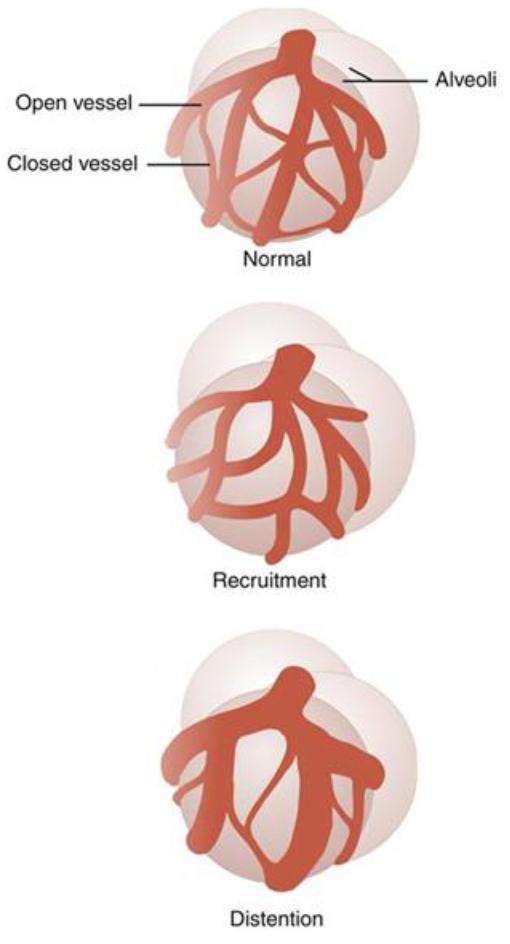
Each of the three drawings is the net of capillaries around one alveolus, labelled normal, recruitment and distention. In the normal drawing, at rest, some vessels are open and others closed. They are closed because blood pressure in the lung is low at rest, too low to push every vessel open, so part of the exchange surface goes unused.
Recruitment comes first. As exercise raises blood flow, the pressure becomes high enough to open the closed capillaries, which spreads the blood over more of the alveolar wall. Distention takes over as the pressure keeps rising, once most vessels are already open. The thin capillary walls stretch and the open capillaries widen, so each carries more blood.
Both are normal, healthy responses to exercise. They let the lung take several times its resting blood flow without a large rise in pressure in its blood vessels. They also keep the blood from rushing past the air too fast to load oxygen. Ventilation rises to match, so fresh air keeps arriving beside all the new blood. Once breathing and blood flow have caught up with the effort, the oxygen the whole body uses each minute equals the oxygen it takes from the air, which is the oxygen breathed in minus the oxygen breathed out. That amount is the oxygen uptake, which Oxygen Uptake – VO2, VO2max and the Lactate Threshold explains.
Summary
Summary
Minute ventilation is breathing rate times tidal volume, about 6 L/min at rest and about 100 L/min in strenuous exercise, with endurance athletes reaching 160 L/min or more. Each breath leaves about 150 mL in the dead space, so only about 350 mL of a 500 mL resting breath reaches the alveoli and alveolar ventilation is about 4.2 L/min, which is why deep breathing beats fast shallow breathing. Trained athletes grow the breath first, until tidal volume levels off at about 60 per cent of forced vital capacity, and then the breathing rate takes over. The ventilation–perfusion ratio is alveolar ventilation divided by pulmonary blood flow, 0.84 at rest, about 0.8 in light exercise and above 5.0 in intense exercise, because ventilation rises far more than blood flow. A shunt is blood that crosses from the right side of the heart to the left without exchanging gas, so it lowers PaO2 and widens the A-a oxygen gradient. In acute exercise cardiac output and pulmonary blood flow rise, and the lung copes by recruiting closed capillaries and distending open ones while ventilation rises to match.