Definition
Climb high enough and every breath brings in less oxygen, although the air itself has not changed. This note follows the body through that challenge in time: arrival, the first days, the first weeks, and then exercising and training up there.
1. Less oxygen in every breath
The problem at altitude is thin air, not different air. Altitude is graded by height. Moderate altitude is 1,500 to 3,000 m, high altitude 3,000 to 5,500 m and extreme altitude anything above 5,500 m. The upper limit of permanent human habitation is 5,820 m.
Air at any height is still 20.9 per cent oxygen. What falls is barometric pressure, the weight of the air above you. Oxygen’s partial pressure, its share of that total (The Respiratory Gases – Composition of Air, Partial Pressures and Exchange across the Alveolar Membrane), falls with it. The rule is PO2 = 0.2093 x barometric pressure, where PO2 is the oxygen pressure in mmHg and 0.2093 is oxygen’s fraction of the air.
The numbers make the loss concrete. At sea level 760 mmHg gives 159 mmHg of oxygen. At Pikes Peak in Colorado (4,300 m) 450 mmHg gives about 94 mmHg, and on Everest (8,850 m) 235 mmHg gives about 49 mmHg.
| Altitude (m) | Ambient pressure (mmHg) | Ambient oxygen pressure (mmHg) |
|---|---|---|
| 0 | 760 | 159 |
| 1,500 | 634 | 133 |
| 3,000 | 526 | 110 |
| 4,000 | 462 | 97 |
| 5,000 | 405 | 85 |
| 7,000 | 308 | 64 |
| 9,000 | 230 | 48 |
The effects begin low down. Maximal oxygen uptake (VO2max), the most oxygen the body can use in a minute (Oxygen Uptake – VO2, VO2max and the Lactate Threshold), starts to fall above about 1,500 m in most people. In elite athletes it can fall from as low as 580 m. The body’s defence is acclimatisation, the adaptive responses in physiology and metabolism that improve tolerance of altitude hypoxia, hypoxia being a shortage of oxygen.
2. The pressure staircase sags
Oxygen travels down a staircase of pressures. The first step is inspired air, the second the air in the alveoli, the lung’s air sacs. Then come arterial blood and finally venous blood, once the tissues have taken their share. This is the oxygen transport cascade, and at altitude every step starts lower because the first step is lower.
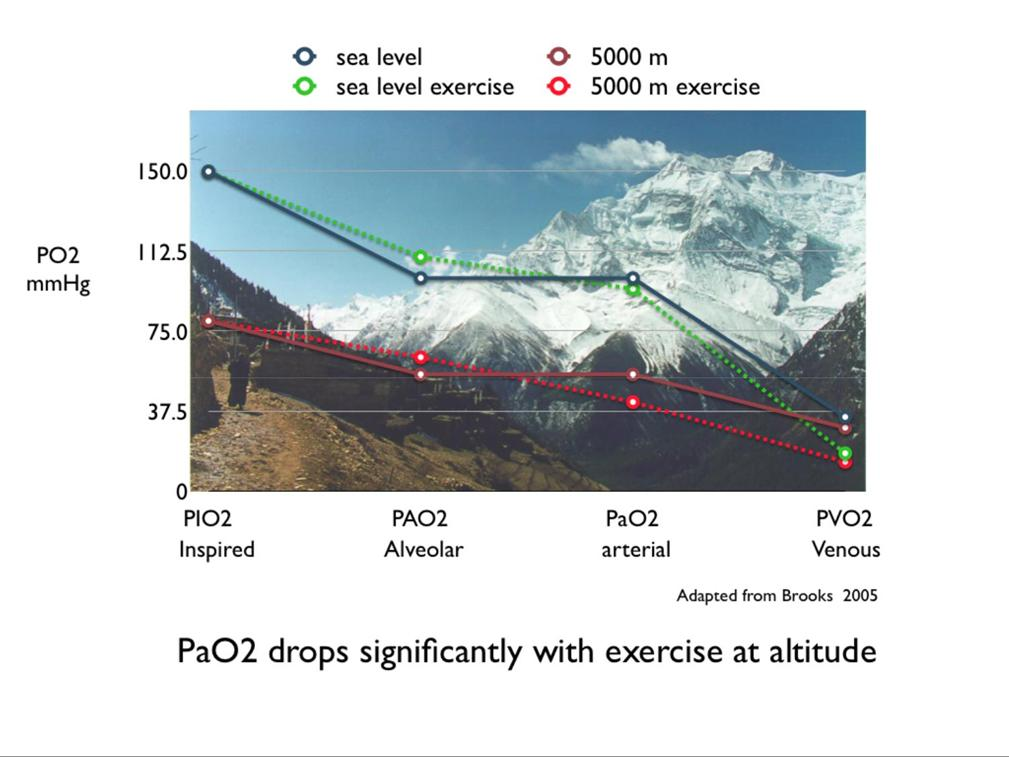
The graph plots oxygen pressure in mmHg at the four stops, PIO2 inspired, PAO2 alveolar, PaO2 arterial and PVO2 venous. The four lines are sea level, sea-level exercise, 5,000 m and 5,000 m exercise, and the altitude lines start at about 80 mmHg instead of 150 mmHg. Every line steps down, but the steepest drop is on the 5,000 m exercise line, between the alveolar and arterial stops. That drop is the diffusion limitation of exercise at altitude: the blood leaves the lung before it is fully loaded. The mountain behind the lines is decoration.
The sag matters because of the oxygen dissociation curve (Oxygen in the Blood – Dissolved Oxygen, Haemoglobin and the Dissociation Curve). This is the S-shaped graph of how fully haemoglobin, the oxygen carrier in red cells, is loaded at each oxygen pressure. Its top is flat, so at about 2,000 m haemoglobin is still about 90 per cent saturated despite the lower arterial pressure. At high altitude the arterial pressure drops onto the steep part of the curve. There each further mmHg lost unloads a lot of oxygen, so saturation collapses.
3. The first days: the acute response
Within hours the body fights the low oxygen with what it already has. The heart beats faster at rest and in submaximal exercise, meaning exercise below full effort. More oxygen therefore reaches the tissues each minute, although each litre of blood carries less. Breathing becomes deeper and faster, which raises alveolar oxygen pressure but also blows off carbon dioxide. Carbon dioxide and hydrogen ions therefore fall in the blood and in the fluid around the brain, and the usual carbon-dioxide signal to breathe fades.
Breathing is now kept going by the hypoxic drive. The peripheral chemoreceptors, oxygen sensors in the main arteries, detect the low oxygen and keep the brainstem ventilating (Control of Breathing – Brainstem Centres, Chemoreceptors and the Three Phases of Exercise Ventilation). Losing carbon dioxide also makes the blood alkaline, which shifts the dissociation curve to the left (Unloading Oxygen and Carrying Carbon Dioxide – Bohr Effect, 2,3-DPG, Myoglobin and Bicarbonate). Haemoglobin then holds its oxygen more tightly and unloads less in the muscles. Acute mountain sickness can follow.
The circulation tightens too. Blood pressure rises because vascular resistance rises, resistance being how hard it is to push blood through narrowed small arteries (Vascular Resistance – Pressure Profile, Radius and Control of Arterioles). Catecholamines, the stress hormones adrenaline and noradrenaline, rise and increase the resistance and the production of lactate, the by-product of making energy without oxygen. VO2max falls, so exercise capacity falls. Blood, muscle and liver change little at first.
Ventilation keeps rising for about two weeks, driven by hypoxia. The alkalosis, the rise in blood pH, must be countered. The kidneys therefore begin to excrete bicarbonate, the alkali the blood uses to soak up acid. As arterial carbon dioxide drops, the central and peripheral chemoreceptors become more sensitive, so ventilation answers any further signal more strongly.
Intense exercise adds the diffusion limitation. Arterial oxygen pressure falls because the blood leaves the lung capillary before it has caught up with the alveolar air. Two things cause this. The driving pressure is lower, so loading is slower, and exercise shortens the time each red cell spends in the capillary (The Respiratory Gases – Composition of Air, Partial Pressures and Exchange across the Alveolar Membrane).
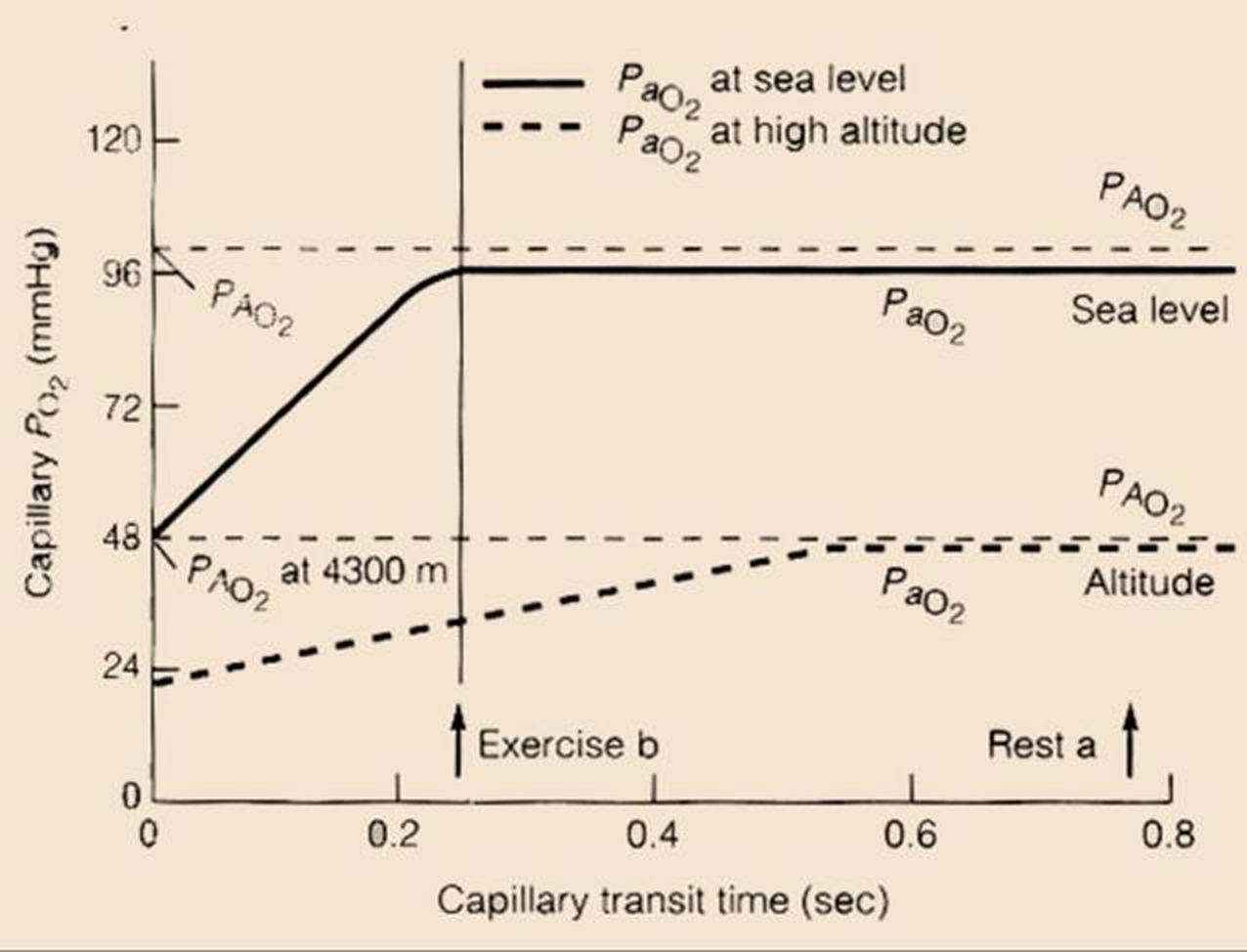
The graph plots the oxygen pressure of blood in the lung capillary, in mmHg, against time spent there, in seconds. The solid line, PaO2 at sea level, reaches its ceiling well before the exercise transit time of 0.25 s, marked b. The ceiling is the alveolar pressure PAO2, drawn as a dashed horizontal line. The dashed line, PaO2 at 4,300 m, has a ceiling under 50 mmHg and climbs more slowly. At 0.25 s it is still rising, so the blood leaves under-filled, like a bucket filled from a weaker tap in less time.
Behind the rises in pressure and resistance is a stress response that builds over days. Sympathoadrenal activity, the sympathetic nerves and the adrenal medulla acting together, rises progressively at rest and in exercise. The sign is a steady rise in the noradrenaline excreted in the urine. Noradrenaline is the fight-or-flight transmitter, and it also shifts the fuel mix. In the longer term its receptors are downregulated, so the tissues make fewer of them and the response is damped.
4. The first weeks: acclimatisation
Over the following weeks the blood, the cells and the acid-base balance, how acid or alkaline the blood is, all adjust, each at a price.
Low arterial oxygen makes the kidneys release erythropoietin (EPO) (Oxygen in the Blood – Dissolved Oxygen, Haemoglobin and the Dissociation Curve). This hormone drives the bone marrow to make more red cells, and so more haemoglobin. The haematocrit, also called the packed cell volume, is the fraction of blood volume made up of red cells. It is normally 45 per cent in men and 40 per cent in women. Men have 4.7 to 6.0 million red cells per microlitre, women 4.2 to 5.4 million.
At altitude the haematocrit rises in two stages. First the plasma volume, the liquid part of the blood, shrinks within days, which concentrates the cells already there. Then over weeks new red cells are added. Too high a haematocrit thickens the blood dangerously, the risk when athletes abuse injected EPO or blood transfusions.
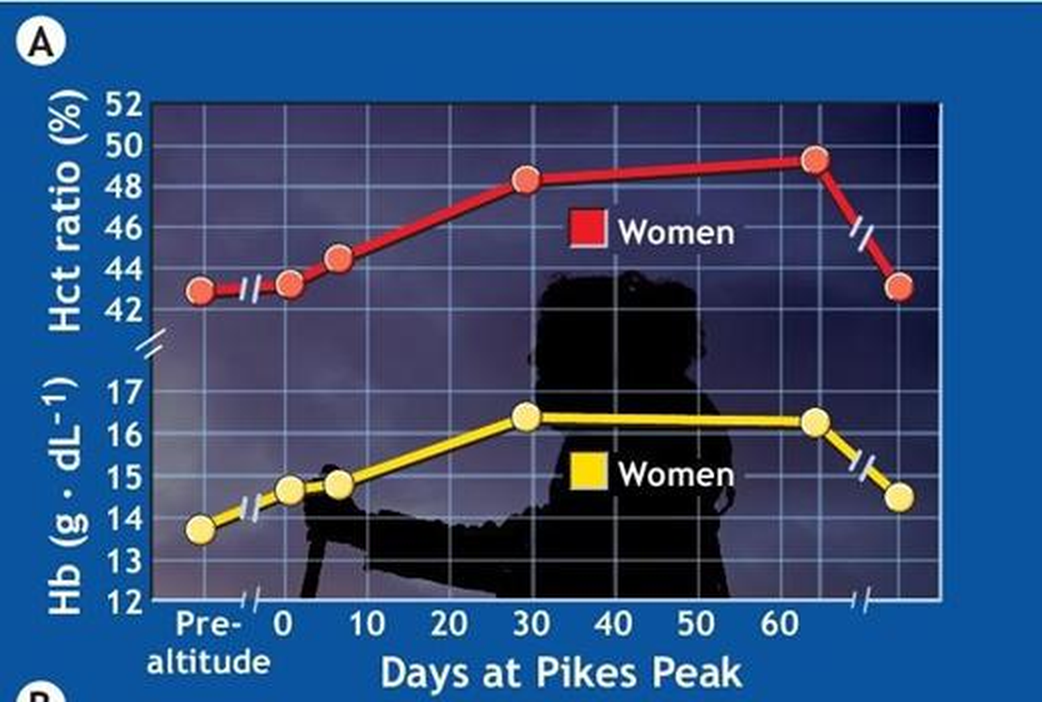
The upper panel plots haematocrit in per cent, and the lower panel haemoglobin concentration in g/dL, against days at Pikes Peak in women. Both lines jump in the first days as the plasma volume shrinks. They then climb more slowly for a month as new red cells arrive, and fall back after the return to sea level.
The cells adapt to take up oxygen more easily. Capillaries, the smallest blood vessels, remodel and new ones form, which shortens the diffusion distance between blood and tissue. Myoglobin, the muscle’s own oxygen store, rises, and mitochondria, the cells’ aerobic power stations, increase a little. The red cells make more 2,3-DPG, a molecule that loosens haemoglobin’s grip on oxygen. The dissociation curve therefore shifts slightly right and more oxygen is unloaded.
The heart remodels as well. The wall between its two pumping chambers (the ventricles) thickens, the left ventricle shrinks and the right ventricle grows larger and thicker. Low oxygen narrows the lung’s small arteries, which raises the pressure in the lung’s vessels (pulmonary hypertension). The right ventricle pumps into those vessels, and a ventricle that pumps against a higher pressure thickens (Hypertension – Causes, Mechanisms, Consequences and Treatment).
The kidneys finish the acid-base repair. They slowly excrete bicarbonate until the pH, raised by the loss of carbon dioxide, is normal again. A normal pH lets the brainstem’s respiratory centre respond even more strongly to hypoxia, so ventilation rises further. The price is a loss of alkaline reserve. With less bicarbonate, the blood has less capacity to buffer, that is to soak up, the acid of hard exercise (Acid–Base Balance in Exercise – Buffers, Ventilation and the Kidney).
Lactate behaves oddly over the same weeks. On arrival a given submaximal exercise produces more lactate than at sea level. The oxygen-starved muscle leans more on anaerobic glycolysis, the fuel pathway that makes lactate. After some weeks the same exercise produces less lactate, yet the tissues are no better supplied with oxygen. Less oxygen giving less lactate is the lactate paradox.
There are two smaller costs. Dry mountain air must be moistened in the airways, so water loss rises, especially with the heavy breathing and sweating of exercise, and dehydration follows. And the lower the arterial saturation, the more sensory and mental function suffer.
The table gathers the adjustments by system. Cardiac output is the blood the heart pumps each minute, which is heart rate times stroke volume, the volume of one beat (Circulation Overview – Circuits, Vessels and the MAP Equation).
| System | Immediate | Longer-term |
|---|---|---|
| Pulmonary acid-base | Hyperventilation. Body fluids become more alkaline from the loss of carbon dioxide. | Hyperventilation continues. The kidneys excrete bicarbonate and the alkaline reserve falls. |
| Cardiovascular | Submaximal heart rate and cardiac output rise. Stroke volume is unchanged or slightly down. Maximal cardiac output is unchanged or slightly down. | Submaximal heart rate stays up. Submaximal cardiac output falls to sea-level values or below. Stroke volume falls. Maximal cardiac output falls. |
| Haematologic | No immediate change. | Plasma volume falls. Haematocrit, haemoglobin concentration and red-cell number rise. |
| Local | No immediate change. | More muscle capillaries are possible. More 2,3-DPG, more mitochondria and more aerobic enzymes. Loss of body weight and lean mass. |
5. Time, and mountain sickness
Acclimatisation cannot be hurried. A slow ascent to 5,500 m can be made with few symptoms. Allow 2 weeks to adjust to altitudes up to 2,300 m. Then allow another week for each 610 m up to 4,600 m.
A rapid ascent brings acute mountain sickness (AMS) within hours. Its symptoms are headache, nausea, irritability, weakness, poor appetite, vomiting, a fast heart rate and disturbed breathing. The disturbed breathing includes Cheyne-Stokes breathing, in which bouts of fast breathing alternate with slow or absent breathing.
AMS is common above 3,000 m. People whose breathing responds weakly to hypoxia are more susceptible, because they do not raise their alveolar oxygen. A slow ascent and acclimatisation hikes, day trips higher before returning to sleep lower, reduce the risk.
6. Exercising up there
How much altitude hurts depends on how long the event lasts. Events of 2 minutes or less are unaffected, because they run on anaerobic energy, made without oxygen. Decrements appear from 1,600 m for events of 2 to 5 minutes. For events of 20 minutes or more they appear from only 600 to 700 m.
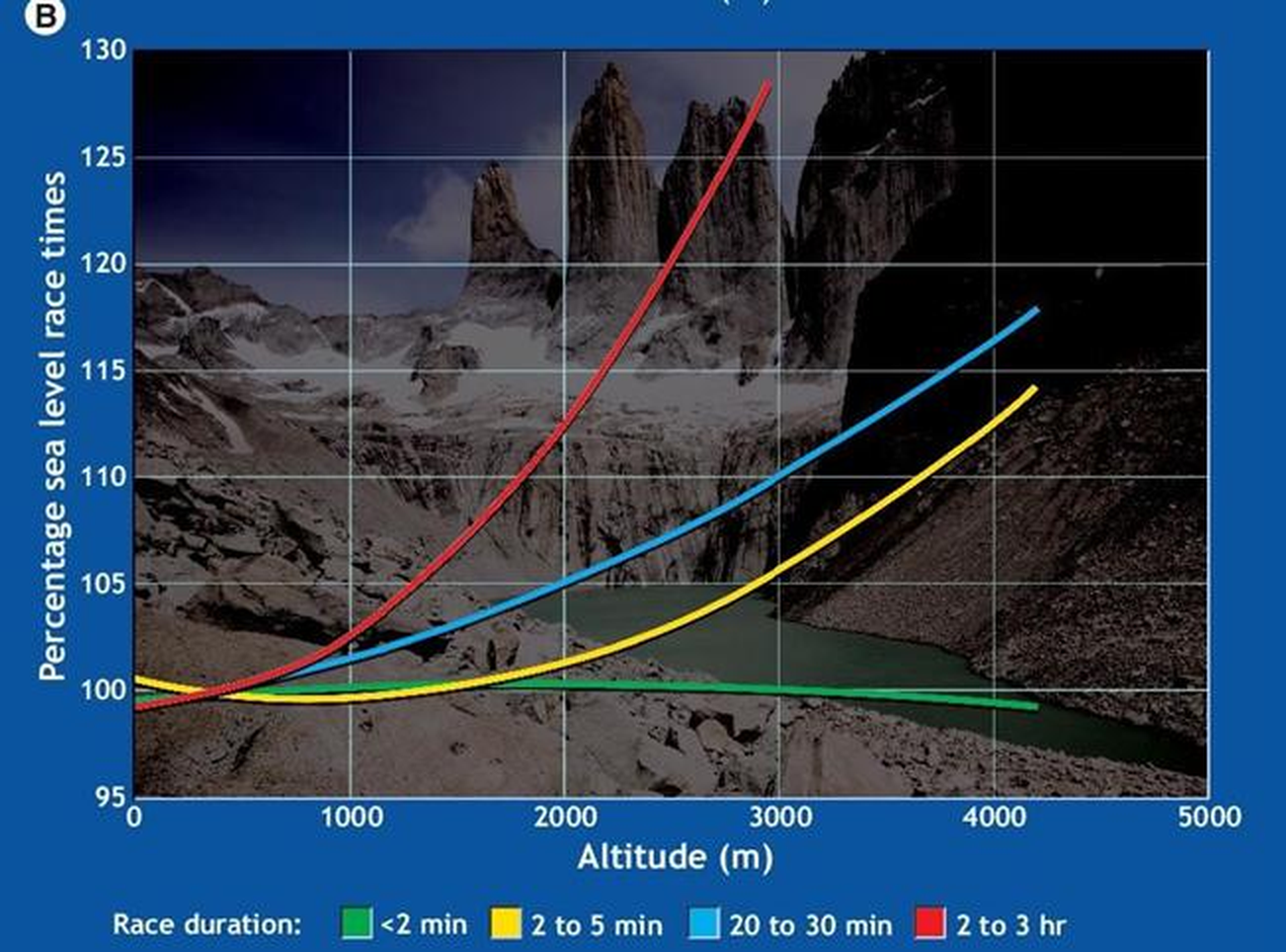
The graph plots race time as a percentage of the sea-level time against altitude in metres, one line per race duration. A line that climbs means a slower race. The line for races under 2 minutes stays flat, and the longer the race, the earlier and more steeply its line climbs. The 2 to 3 hour line reaches nearly 130 per cent by 3,000 m, because the longer the event, the more it depends on oxygen delivery.
Aerobic capacity falls steadily with height: VO2max falls about 3 per cent for every 300 m. Above 6,000 m the body deteriorates progressively towards death. The oxygen cost of a given task is the same as at sea level, because the muscles do the same work. But that cost is now a larger share of a smaller VO2max, so the effort feels harder.
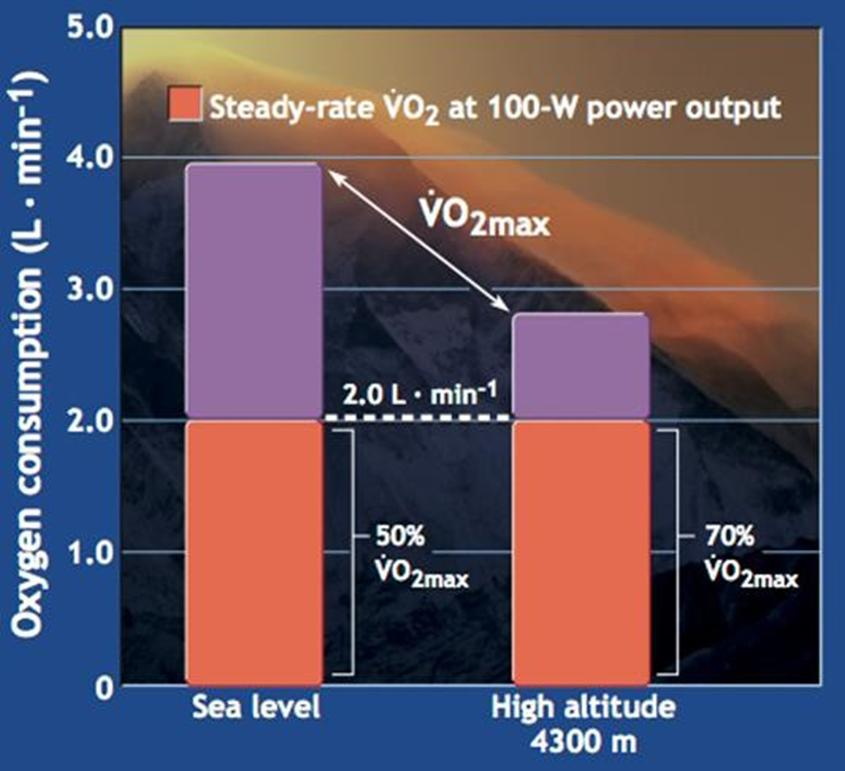
The graph shows oxygen consumption in L/min as two stacked bars, at sea level and at 4,300 m. The orange part is the oxygen uptake during steady cycling at 100 W, about 2 L/min in both. The purple part on top reaches up to VO2max, about 4 L/min at sea level but under 3 L/min at altitude. The same 2 L/min is therefore 50 per cent of maximum at sea level and 70 per cent at 4,300 m. The task is unchanged but the ceiling has come down.
Acclimatisation lifts endurance a little even though VO2max does not recover. Three things explain it: ventilation is higher, arterial saturation and the cells’ aerobic function are better, and the lactate response is blunted.
7. Altitude training
Living at altitude does not improve sea-level performance when VO2max is the yardstick. The gain in the blood’s oxygen-carrying capacity is cancelled by losses. Muscle is lost, maximal heart rate and stroke volume fall, and so maximal cardiac output falls. Three strategies try to keep the gain and avoid the losses:
- Live high, train high gives the most altitude exposure but limited sea-level gains, because hard training is impossible in thin air.
- Live low, train high uses high-intensity sessions in thin air, including chambers at about 15 per cent oxygen. There is substantial evidence that it helps endurance, sprint and strength athletes.
- Live high, train low combines the adaptations of simply living at altitude with full-intensity training near sea level, which is why it works best.
Live high, train low is done in two ways. Athletes live at 2,200 to 3,500 m, high enough to stimulate red-cell production without AMS. Each day they drive down to train below 1,200 m. Or they sleep in a hypoxic tent at about 14 per cent oxygen, an inspired oxygen pressure of 106 mmHg. The adaptation then happens while they sleep.
The results in elite runners were clear. The method raised VO2max and running endurance and improved 3,000 m times. It worked only in the responders, those whose EPO rose at altitude and whose haematocrit rose with it.
Summary
Summary
The air at altitude is still 20.9 per cent oxygen, but barometric pressure falls and PO2 = 0.2093 x barometric pressure falls with it. Every step of the oxygen transport cascade starts lower, and on the steep part of the dissociation curve saturation collapses. Within hours the heart rate rises and the hypoxic drive raises ventilation, which lifts alveolar oxygen but blows off carbon dioxide and shifts the curve left. Over weeks EPO raises the haematocrit, capillaries, myoglobin and 2,3-DPG increase, the right ventricle thickens, and the kidneys excrete bicarbonate at the cost of alkaline reserve. Lactate falls without better oxygenation, the lactate paradox. Acclimatisation needs 2 weeks up to 2,300 m and a week per 610 m beyond, or acute mountain sickness strikes within hours. Events under 2 minutes are unharmed, VO2max falls 3 per cent per 300 m, and live high, train low works best, in responders whose EPO rises.