Definition
Every movement, heartbeat and thought needs energy, and all of it comes from food in the human body. This note explains what energy is, the two rules it always obeys and the kinds of work it lets the body do.
1. Energy and work
Energy is the capacity to do work. It cannot be seen directly, and it shows itself only when something changes, such as a muscle shortening. The more biologic work the body does, the more energy it transfers.
Work is expressed in mechanical units, but nutrition measures energy in kilocalories. One kilocalorie (kcal) is the heat needed to warm 1 kg of water by 1 degree Celsius. The study of how energy flows and is exchanged within a living system is called bioenergetics.
2. The first law
The first law of thermodynamics states that energy cannot be created or destroyed. It can only change from one form into another, without being used up. This is the principle of conservation of energy. So the body does not produce or consume energy. It transforms it, for example turning the chemical energy of food into movement and heat.
This law explains energy balance. Energy eaten equals energy given out as work and heat, plus energy stored. So the body’s stores, mainly fat, change only when intake and output differ.
3. Potential and kinetic energy
Energy is either stored or moving, and the total energy of a system is its potential energy plus its kinetic energy. Potential energy is stored energy that comes from structure or position. Examples are water held at the top of a dam, the chemical bonds of a glucose molecule and a drawn bow.
Kinetic energy is the energy of motion. Examples are falling water, a moving limb and heat, which is the motion of molecules. The example of water behind a dam returns later as the picture of how mitochondria, the cell’s power stations, store energy, in Oxidative Phosphorylation.
4. The second law
The second law describes in which way energy moves. Each time potential energy changes form, it loses some of its capacity to do work. Stored energy turns into energy of motion, and at every step a little of it ends up as heat, the form that is hardest to use. In the end, all of it becomes heat. None of the energy disappears, because whatever one form loses, another gains. What is lost is its usefulness, much as water that has run downhill is still there but can no longer turn a wheel.
The growing disorder this brings is called entropy. Its effects are familiar. A battery runs down even when it is not used. No energy conversion is 100 per cent efficient, because some energy escapes as heat at every step. In the same way, the energy in food ends as body heat once it has done its work.
5. Reactions that release or absorb energy
Chemical reactions can be sorted by what happens to their energy. The key quantity is free energy, the part of a system’s energy that is available to do work. Some reactions release energy to their surroundings, and these are called exergonic. Because they give energy away, their free energy falls, so they are said to run downhill. Other reactions do the opposite, absorbing energy and storing it, and these are called endergonic. Their free energy rises, so they run uphill. Every piece of biologic work, such as building a molecule, needs an uphill reaction of this kind.
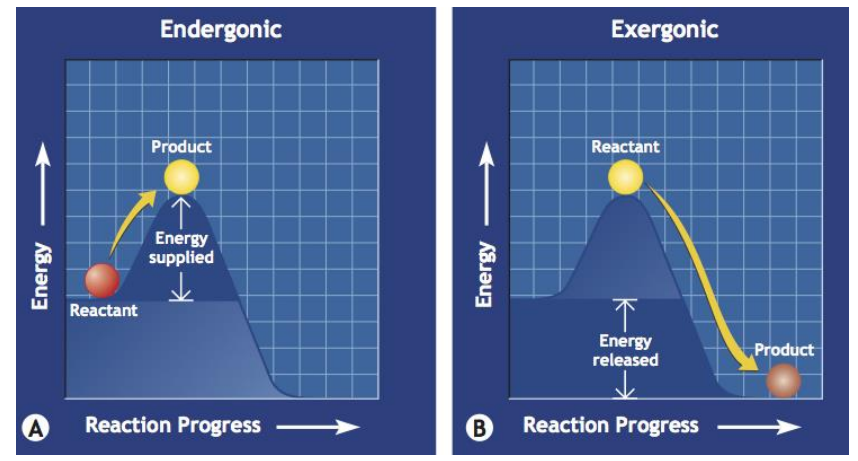
In the body the two kinds work as a pair. The energy released by a downhill reaction is used at once to drive an uphill one, which is called a coupled reaction. This is how the energy of food is loaded into ATP, the molecule cells spend to do work, explained in ATP and Phosphocreatine.
The main example of uphill work is biosynthesis, the building of new molecules. The energy bound in one substance is passed directly to others to raise their potential energy. This joins atoms of carbon, hydrogen, oxygen and nitrogen into new molecules and tissues, such as bone and the fatty (lipid) membrane around each cell.
6. Photosynthesis and respiration
Energy exists in six forms: chemical, mechanical, heat, light, electrical and nuclear. Each can be converted into the others, and life depends on two such conversions. The sun releases energy by nuclear fusion, which reaches the earth as light. In photosynthesis, plants capture that light with the green pigment chlorophyll. They use its energy to build carbon dioxide and water into glucose, releasing oxygen.
Photosynthesis is endergonic, because the sun’s energy ends up stored as potential energy in carbohydrates, lipids and proteins. Overall, 6 CO2 + 6 H2O + light energy → glucose + 6 O2.
Respiration, in this case cellular respiration, is the process inside cells that releases energy from food, rather than breathing. It is the reverse of photosynthesis, and it is exergonic. Cells turn glucose and oxygen back into carbon dioxide and water. The stored energy is released and coupled to making ATP. Overall, glucose + 6 O2 → 6 CO2 + 6 H2O + energy. So animals live on solar energy that plants stored first, like a rechargeable battery that the plant charges and the body runs down.
7. Three forms of biologic work
The energy released by respiration pays for three forms of biologic work, all through ATP.
- Chemical work is biosynthesis. Examples are building glucose into glycogen, its storage form, building glycerol and fatty acids into triacylglycerol (triglyceride) and building amino acids into protein.
- Mechanical work is muscle contraction. Examples are the arm muscles bending the elbow and the heart pumping blood.
- Transport work moves substances among cells and across their membranes. One example is the pump that moves sodium out of a cell and potassium in. Both travel against their concentration gradients, from where they are scarce to where they are plentiful.
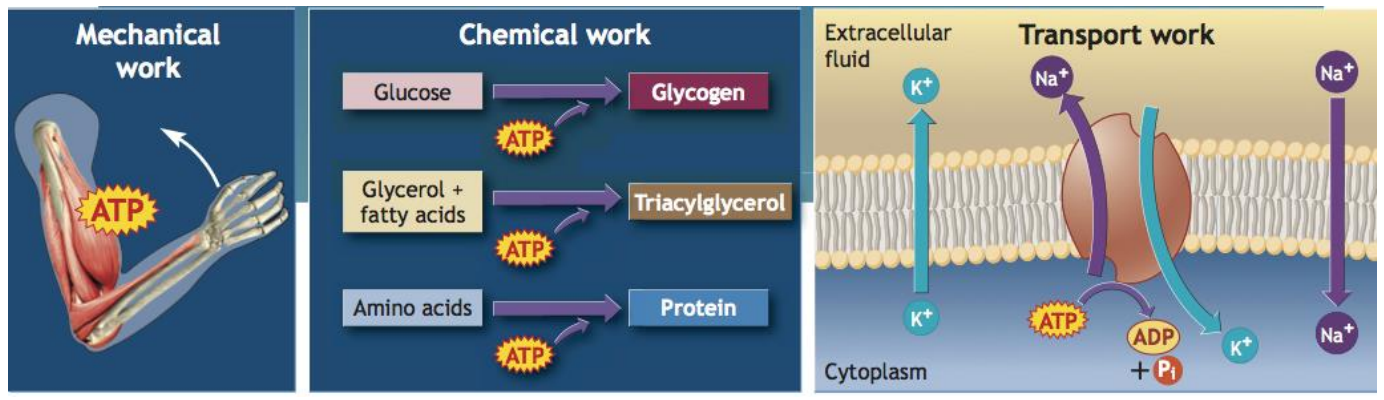
In every case the energy comes from food and passes through ATP. Much of it becomes heat straight away, because no step is fully efficient. The part that does work becomes heat later, once the movement, molecule or gradient it produced is undone.
Summary
Summary
Energy is the capacity to do work, and nutrition measures it in kilocalories. The first law says energy is never created or destroyed, only transformed. The second law says every transfer lowers its capacity for work, until it all ends as heat. Potential energy is stored by structure or position, and kinetic energy is the energy of motion. Exergonic reactions release free energy and endergonic reactions absorb it, so coupled reactions use the first to drive the second. Photosynthesis stores the sun’s energy in glucose, respiration releases it to make ATP, and ATP pays for chemical, mechanical and transport work.