Definition
Almost all the energy in food is finally turned into ATP on one membrane deep inside the mitochondria. This note follows the hydrogen collected by earlier pathways as its electrons fall towards oxygen and their energy is captured. It also explains why the body needs oxygen at all.
1. Two names for one process
Food releases its energy mainly through redox reactions, in which electrons pass from one molecule to another (Hydrolysis, Condensation and Redox). Earlier pathways have stripped hydrogen from the fuel and loaded it onto two carriers, NADH and FADH2. Most of it comes from the Krebs cycle (also called the citric acid cycle or TCA cycle, Krebs Cycle). In cellular oxidation, the mitochondria take the electrons from this hydrogen and pass them along until they reach oxygen. ATP is made during these redox reactions.
The process has two halves that always run together. The first is electron transport, also called the respiratory chain, which is the passing of electrons along specific carrier molecules to oxygen. The second is oxidative phosphorylation, the making of ATP from ADP with the energy that electron transport releases.
Together they form the final common pathway of aerobic metabolism. This means that hydrogen taken from carbohydrate, fat and protein all ends up here. It is also the largest source of energy, because more than 90 per cent of the body’s ATP is made this way. The earlier pathways make little ATP themselves, because their main job is to load the carriers that this pathway cashes in.
2. The setting: the inner membrane
All of this takes place inside the mitochondrion, so its layout comes first. A mitochondrion is wrapped in two membranes, a smooth outer one and a folded inner one. The narrow gap between them is the intermembrane space. The space inside the inner membrane is the matrix, where the Krebs cycle runs.
The carriers of the electron transport chain are built into the inner membrane, and so is the enzyme that makes ATP. Hydrogen ions cannot cross this membrane by themselves. This is what makes the system work. The membrane can hold hydrogen ions on one side, storing potential energy (Energy and Thermodynamics) the way the wall of a dam holds water.
3. Electrons step down to oxygen
The chain begins when NADH and FADH2 reach the inner membrane and give up their hydrogen. Each hydrogen atom splits into a hydrogen ion (a proton, H+) and an electron. The hydrogen ions stay in the matrix and the electrons enter the chain. NADH hands them over at the top, and FADH2 one step lower.
The electrons then pass from one carrier to the next, like a bucket along a line of people. Many carriers are cytochromes, proteins that contain iron. This iron is held in the same kind of structure as the iron of haemoglobin, the oxygen carrier of red blood cells (Oxygen in the Blood – Dissolved Oxygen, Haemoglobin and the Dissociation Curve). Each iron atom accepts an electron, so it is reduced, and passes it on, so it is oxidised again.
Each carrier pulls on electrons a little more strongly than the one before. So the electrons move one way only, losing a little energy at each step. This matters because energy can be captured only in manageable packets. A river that comes down a hillside over several small waterfalls can turn a turbine at each one. A single great fall would release the same energy at once and waste most of it.
At the end of the chain, oxygen is the final electron acceptor. For each pair of hydrogen atoms, two electrons flow down the chain and reduce one oxygen atom. That atom then joins two hydrogen ions to form water. In symbols this is 2 H+ + 2 electrons + ½ O2 → H2O, where ½ O2 is one oxygen atom. The emptied carriers, NAD+ and FAD, return to glycolysis and the Krebs cycle to collect more hydrogen.
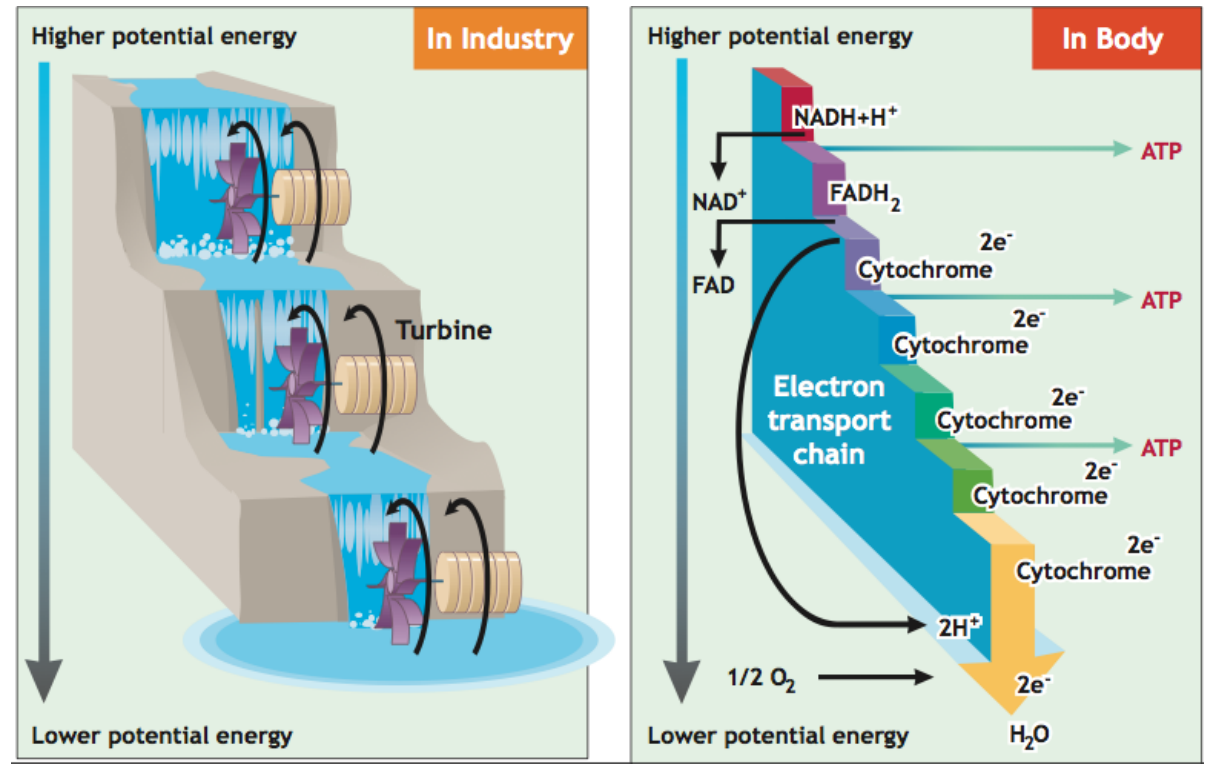
In both panels the vertical axis runs from higher potential energy at the top to lower potential energy at the bottom. In Industry, water falls down three steps and turns a turbine at each. In Body, hydrogen arrives on NADH + H+ at the top and on FADH2 one step lower, leaving NAD+ and FAD behind. Pairs of electrons (2e) then step down a staircase of cytochromes, and ATP is released at three levels, as power is at each turbine. At the bottom the electrons, 2 H+ and ½ O2 form H2O.
4. Pumping hydrogen ions
The energy of the falling electrons does not make ATP directly. Instead, at three points along the chain, it is used to pump hydrogen ions out of the matrix into the intermembrane space. This is uphill work, because the ions are pushed towards the side where they are already crowded.
So hydrogen ions pile up in the intermembrane space, where their concentration is high and the pH low, which means more acidic. In the matrix they become scarce, so the pH is high. Because each ion carries a positive charge, the pumping also leaves the outer side of the inner membrane positive compared with the matrix side. This electrical difference is the membrane potential.
The concentration difference and the membrane potential together make up the proton gradient, a store of potential energy. The ions tend to flow back into the matrix, but the membrane holds them. This is water held behind a dam, ready to do work once a gate opens.
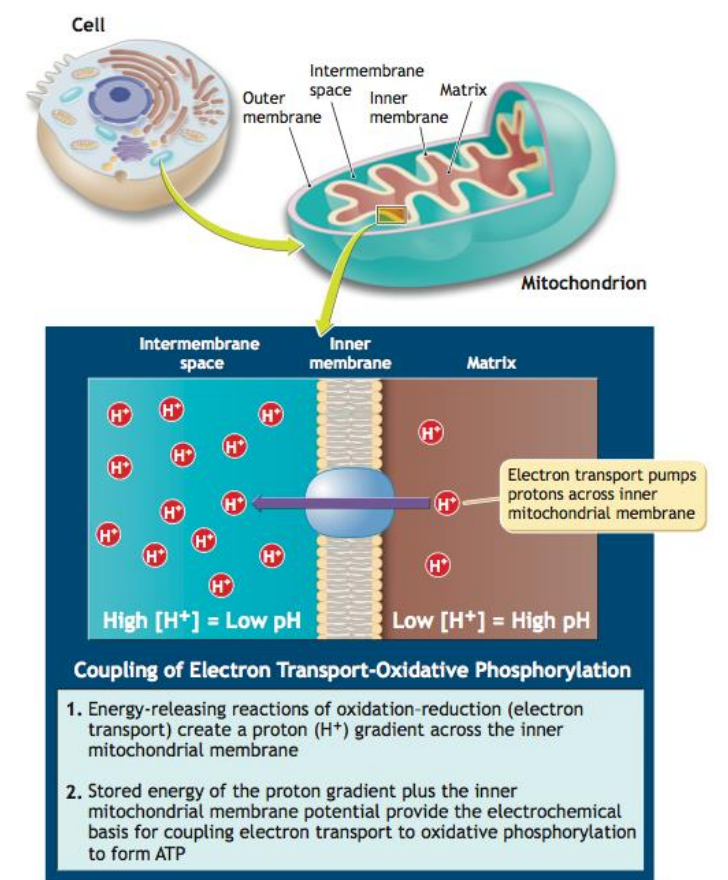
The figure zooms from a cell into one mitochondrion, labelled outer membrane, intermembrane space, inner membrane and matrix. The enlarged box shows a patch of inner membrane. H+ ions crowd the intermembrane space side, labelled high H+ and low pH, while few remain on the matrix side, labelled low H+ and high pH. The arrow shows electron transport pumping protons from right to left. That crowding, like people pressing at a closed door, is the stored energy.
5. ATP synthase, the turbine
The only way back into the matrix is through ATP synthase, an enzyme that forms a channel through the inner membrane. As hydrogen ions flow down their gradient through it, the enzyme uses the energy of the flow to join ADP and inorganic phosphate (Pi) into ATP. ATP synthase is the turbine at the foot of the dam. Making ATP by a flow of ions across a membrane is called chemiosmosis.
This explains the word coupling, which means that one process cannot run without the other. The energy releasing reactions of electron transport build the proton gradient. The stored energy of that gradient, plus the membrane potential, then couples electron transport to ATP synthesis. In other words, the chain and ATP synthase are two separate machines, and the gradient is the only thing connecting them. If the chain stops pumping, the gradient runs down and ATP synthase stops too.
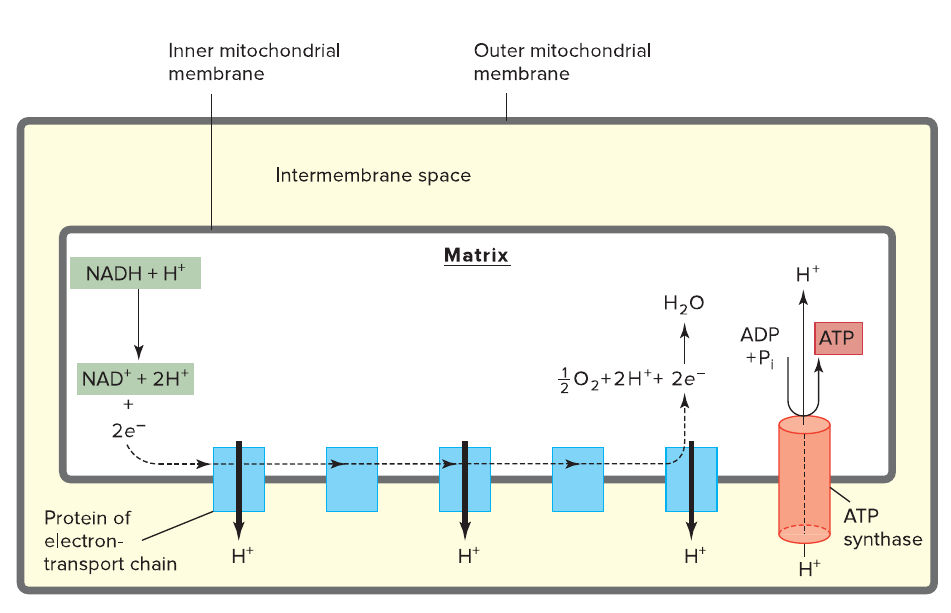
The drawing reads from left to right as pump, store, flow back and make ATP. The two nested boxes are the outer and inner membranes, with the intermembrane space between them and the matrix inside. In the matrix, NADH + H+ becomes NAD+, releasing 2 H+ and two electrons (2e). The dashed line carries the electrons along five blue proteins of the chain, and at three of them a thick arrow shows hydrogen ions pumped out. At the end, the electrons, 2 H+ and ½ O2 form H2O. The red cylinder on the right is ATP synthase, where hydrogen ions flow back in and ADP + Pi becomes ATP.
6. How much ATP each carrier gives
Each loaded carrier is worth a certain amount of ATP, and two counts are in use. The classic count gives three ATP for each NADH. In symbols this is NADH + H+ + 3 ADP + 3 Pi + ½ O2 → NAD+ + H2O + 3 ATP. In words, oxidising one NADH with one oxygen atom releases enough energy to make three ATP. The same count gives two ATP for each FADH2.
Careful measurement gives lower averages, about 2.5 ATP for each NADH and about 1.5 ATP for each FADH2. They are lower because some of the gradient’s hydrogen ions are used for other tasks in the mitochondrion instead of passing through ATP synthase. These values lie behind the modern total of 32 ATP per glucose (ATP Yield from Glucose).
FADH2 yields less because it joins the chain below the first pump. Its electrons drive only two of the three pumping points, so fewer hydrogen ions are pumped. Overall, only about a third (34 per cent) of the energy released is captured in ATP, and the rest becomes heat.
7. The role of oxygen
Everything in this chain depends on the oxygen waiting at its end. Oxygen is the major oxidising agent in the tissues, meaning the main acceptor of electrons. It also ensures that energy transfer reactions proceed at an appropriate rate. This is because the chain runs only as fast as oxygen clears electrons from its end, so the oxygen level in the mitochondria drives the chain.
This gives aerobic metabolism its precise meaning. It refers to the energy generating catabolic reactions, those that break fuel down, in which oxygen is the final electron acceptor of the respiratory chain. There oxygen combines with hydrogen to form water.
When oxygen is missing, the electrons have nowhere to go. The chain backs up like a blocked conveyor belt. NADH and FADH2 stay loaded, so the Krebs cycle stops for lack of NAD+ and FAD. Only glycolysis can carry on, by turning its end product, pyruvate, into lactate, which frees NAD+ (Lactate). That yields just 2 ATP per glucose.
Nearly all the oxygen a person breathes in is consumed at the end of this chain. That is why oxygen uptake measured at the mouth reports how hard the mitochondria are working (Oxygen Uptake – VO2, VO2max and the Lactate Threshold). The water of metabolism, made by the body’s own chemistry, also forms here, whereas the carbon dioxide we breathe out comes from the Krebs cycle.
Summary
Summary
Glycolysis and the Krebs cycle strip hydrogen from fuel and load it onto NADH and FADH2, which carry it to the inner mitochondrial membrane. There each hydrogen splits into a hydrogen ion and an electron, and the electrons fall in small steps down a chain of iron containing cytochromes. At three points the energy of this fall pumps hydrogen ions from the matrix into the intermembrane space. This builds a proton gradient, a store of energy like water behind a dam. The ions flow back only through ATP synthase, which uses the flow to join ADP and Pi into ATP, a process called chemiosmosis. At the end of the chain oxygen is the final electron acceptor and forms water, which frees NAD+ and FAD to collect more hydrogen. Each NADH yields about 2.5 ATP and each FADH2 about 1.5 ATP, and this pathway makes more than 90 per cent of the body’s ATP. Without oxygen the chain backs up, the Krebs cycle halts and only glycolysis ending in lactate remains.