Definition
Splitting glucose in two releases only a small part of the energy it holds. This note follows the leftover pieces into the cell’s power stations, where a repeating cycle takes them apart completely. The cycle makes little energy itself, but it collects the hydrogen that later pays for most of the cell’s energy.
1. Why a second stage is needed
Glycolysis splits one glucose (6 carbons) into two pyruvate molecules (3 carbons each) in the cell’s fluid, the cytoplasm (Glycolysis). When it runs fast, it releases only about 5 per cent of the energy in glucose. The rest is still locked in the two pyruvates. To release it, the cell takes them apart inside the mitochondria, the compartments of the cell that use oxygen to make ATP.
Each pyruvate is first converted to a two carbon molecule called acetyl CoA. Acetyl CoA then enters a circular series of reactions, the Krebs cycle, also called the citric acid cycle or the tricarboxylic acid (TCA) cycle. It is named after Hans Krebs, who worked out its steps. The cycle is the second stage of carbohydrate breakdown, and it produces carbon dioxide and hydrogen atoms. Because this route needs oxygen, it is also called slow glycolysis. Keep one idea in mind throughout. The cycle makes very little ATP itself. Its job is to release the carbon as carbon dioxide and load the hydrogen onto carrier molecules for the next stage.
2. The link step
Pyruvate crosses from the cytoplasm into the matrix, the inner space of the mitochondrion. This happens after glycolysis has finished, not during it. In the matrix, the enzyme pyruvate dehydrogenase does three things at once. It cuts off one carbon as carbon dioxide, the first carbon dioxide of glucose breakdown. It hands a pair of hydrogen atoms to NAD+, a carrier that becomes NADH when loaded (Hydrolysis, Condensation and Redox). And it attaches the two carbon fragment left over, an acetyl group, to coenzyme A (CoA).
A coenzyme is a small helper molecule that works alongside an enzyme (Enzymes), and coenzyme A carries acetyl groups. The whole step is pyruvate + NAD+ + CoA → acetyl CoA + CO2 + NADH + H+, where CO2 is carbon dioxide and H+ is a hydrogen ion. NAD+ releases that hydrogen ion as it takes the pair. One glucose gives two pyruvates, so the step runs twice, giving 2 acetyl CoA, 2 CO2 and 2 NADH. The step cannot run backwards, so acetyl CoA can never become pyruvate again. This limits which fuels the body can turn into glucose (Protein and the Metabolic Mill).
3. One turn of the cycle
The easiest way to follow one turn is to count carbons. The enzyme citrate synthase joins the acetyl group (2 carbons) to a molecule waiting in the matrix, oxaloacetate (4 carbons). This makes citrate (6 carbons) and sets coenzyme A free to collect another acetyl group. Citrate is then rearranged into isocitrate, which has the same atoms in a different layout.
Next, two carbons are removed. Isocitrate loses one as CO2 and becomes alpha ketoglutarate (5 carbons). Alpha ketoglutarate then loses a second as CO2 and becomes succinyl CoA (4 carbons). Each of these two steps also loads one NAD+.
The rest of the turn rebuilds oxaloacetate. Succinyl CoA becomes succinate, and the energy released makes one GTP (guanosine triphosphate). GTP is a close relative of ATP that passes its end phosphate to ADP. So the cycle makes one ATP per turn directly, by substrate level phosphorylation, meaning a phosphate is moved straight from one molecule onto ADP. Succinate then becomes fumarate and loads a second carrier, FAD, which becomes FADH2. Fumarate takes up water to become malate. Finally, malate becomes oxaloacetate and loads the third NAD+.
Oxaloacetate is back, ready for the next acetyl CoA, which is why the pathway is a cycle. Think of a roundabout. An acetyl group gets on, two carbons leave as carbon dioxide, hydrogen is picked off at four exits, and oxaloacetate comes round empty for the next passenger.
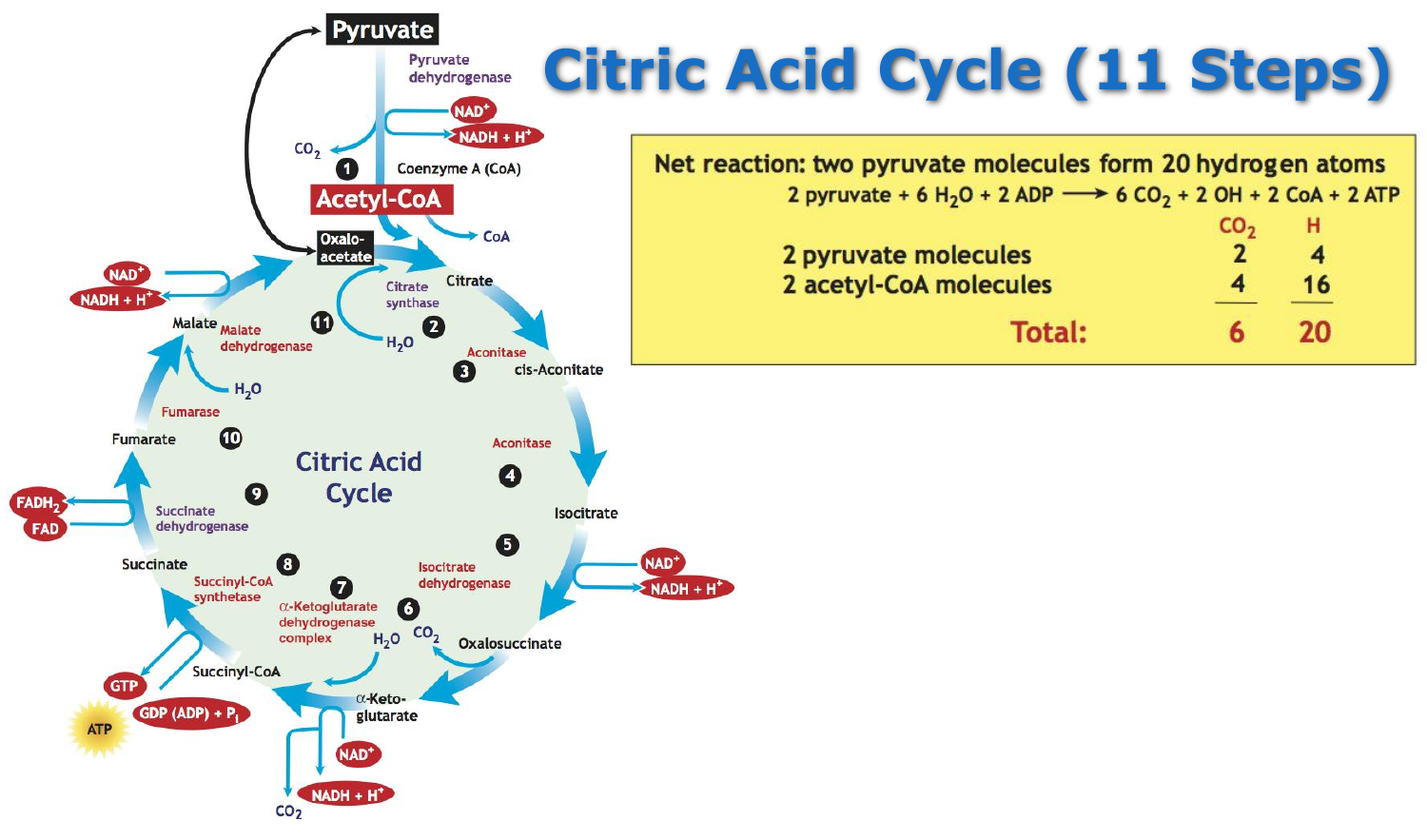
Pyruvate enters this wheel at the top. Step 1 is the link step, where pyruvate dehydrogenase releases CO2, turns NAD+ into NADH + H+ and makes acetyl CoA. Counting it as step 1 is why the wheel has 11 steps. The circles 2 to 11 then run clockwise. They are citrate synthase (2), aconitase (3 and 4), isocitrate dehydrogenase (5 and 6) and the alpha ketoglutarate dehydrogenase complex (7). Then come succinyl CoA synthetase (8), succinate dehydrogenase (9), fumarase (10) and malate dehydrogenase (11). Follow the red labels outside the wheel to see the products. NAD+ becomes NADH + H+ at three places, FAD becomes FADH2 at one, CO2 leaves at two and GTP becomes ATP at one. The yellow box counts the result for two pyruvates, 6 CO2 and 20 hydrogen atoms. Ignore the garbled equation above those counts.
4. The tally
Adding up the reactions, each turn releases 2 CO2, loads 3 NADH and 1 FADH2 and makes 1 ATP. One glucose supplies two acetyl CoA, so the cycle turns twice per glucose. The table adds the link step to the two turns.
| Stage | CO2 | NADH | FADH2 | ATP made directly |
|---|---|---|---|---|
| Link step (2 pyruvate) | 2 | 2 | 0 | 0 |
| Krebs cycle (2 turns) | 4 | 6 | 2 | 2 |
| Total per glucose | 6 | 8 | 2 | 2 |
The same result can be counted in hydrogen atoms, since each loaded carrier stands for one pair. The two pyruvates give up 4 hydrogen atoms as they become acetyl CoA. The two turns give up 16, because each turn loads four carriers. That makes 20 hydrogen atoms, or 10 pairs, carried by 8 NADH and 2 FADH2. The 6 CO2 account for all six carbons of the original glucose, so nothing of its skeleton is left.
5. What the cycle is for
Two ATP per glucose is a small direct return, so the main function of the cycle lies elsewhere. It produces reduced coenzymes, the loaded carriers NADH and FADH2. They take their hydrogen to the electron transport chain, a series of proteins in the inner membrane of the mitochondrion. There they are oxidised, meaning their hydrogen is removed, and the energy released makes most of the cell’s ATP (Oxidative Phosphorylation, ATP Yield from Glucose).
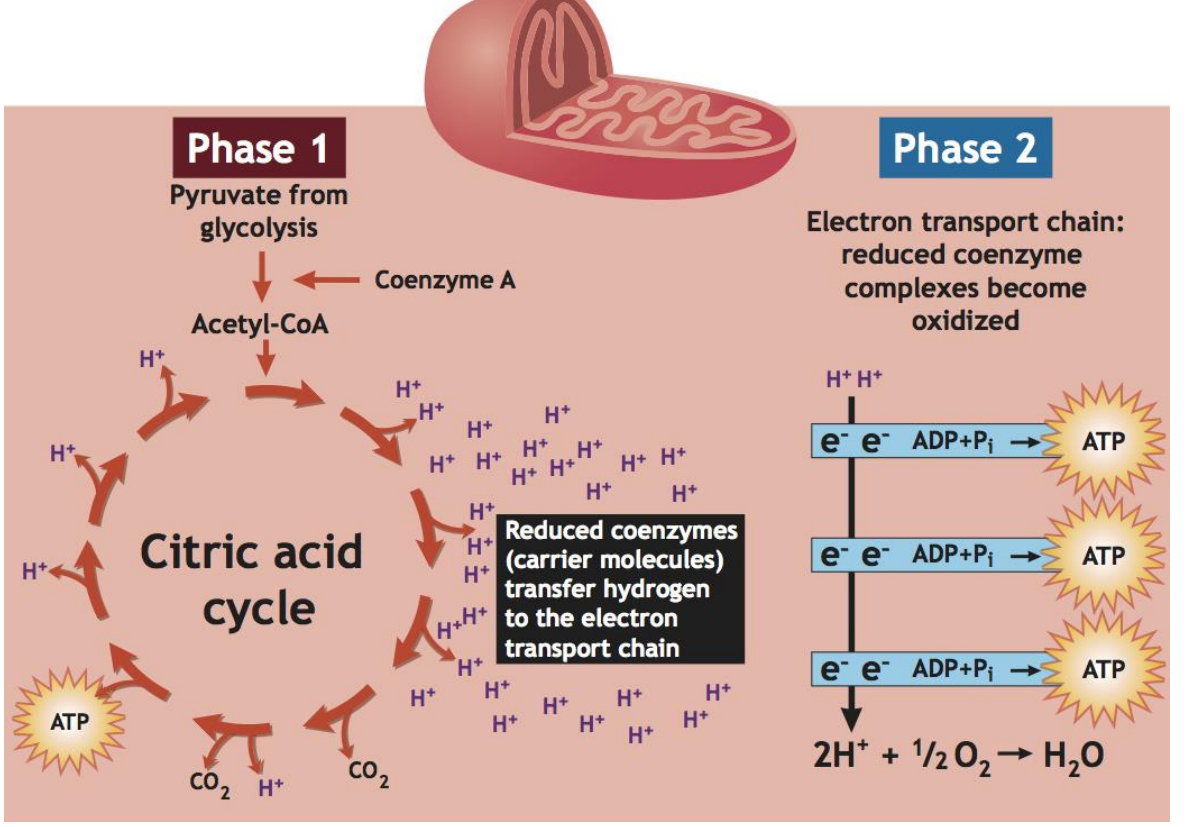
This picture splits the work of the mitochondrion into two phases. In Phase 1, on the left, pyruvate from glycolysis joins coenzyme A to become acetyl CoA, which feeds the citric acid cycle. The turning wheel throws off carbon dioxide, one ATP and a cloud of hydrogen, the many H+ around it. In Phase 2, on the right, the reduced coenzymes pass that hydrogen to the electron transport chain. Pairs of electrons (e⁻) step down three levels, and each step makes ATP from ADP and inorganic phosphate (Pi). At the bottom, 2 H+ and half a molecule of oxygen form water. Phase 1 collects the hydrogen like cheques, and Phase 2 cashes them in.
The cycle has two wider roles. It is the common final route for acetyl CoA from fat and protein as well as carbohydrate. Its intermediates can also be drawn off to build other molecules, such as some amino acids (Protein and the Metabolic Mill).
6. Why it needs oxygen
Although the cycle belongs to the oxygen using stage of metabolism, no step of it uses oxygen. The oxygen in its carbon dioxide comes from the intermediates themselves and from water, not from the oxygen we breathe. Yet the cycle runs only when oxygen is present.
The reason is the carriers. The cell has only a small stock of NAD+ and FAD, and each turn needs four empty ones. They are emptied only when NADH and FADH2 unload onto the electron transport chain, which ends at oxygen. Without oxygen the chain stops, the carriers stay loaded and the cycle stops within moments. Glycolysis has an escape route, because in the cytoplasm NADH can unload onto pyruvate to form lactate (Lactate). The mitochondrion has no equivalent reaction.
Summary
Summary
Fast glycolysis releases only about 5 per cent of the energy in glucose, so its two pyruvates are broken down further inside the mitochondria. In the matrix, pyruvate dehydrogenase turns each pyruvate into acetyl CoA, releasing one CO2 and loading one NADH, in a step that cannot be reversed. Acetyl CoA (2 carbons) joins oxaloacetate (4 carbons) to form citrate (6 carbons), which loses two carbons as CO2 to become a four carbon molecule again. The rest of the turn rebuilds oxaloacetate, so the pathway is a cycle that accepts acetyl groups from carbohydrate, fat and protein. Each turn yields 2 CO2, 3 NADH, 1 FADH2 and 1 ATP, the ATP made through GTP, and one glucose turns the cycle twice. With the link step, one glucose gives 6 CO2, 8 NADH, 2 FADH2 and 2 ATP, which is 20 hydrogen atoms and all six carbons. The real purpose of the cycle is to load NADH and FADH2, whose hydrogen drives most ATP production in the electron transport chain. No step uses oxygen, but the cycle runs only with oxygen, because only the chain that ends at oxygen frees NAD+ and FAD for the next turn.