Definition
Every pathway that releases energy in the body is a chain of chemical reactions. On their own, most of these reactions would run far too slowly to keep a cell alive. Enzymes are the proteins that speed them up, and controlling them is how the cell sets the pace of each pathway.
1. What an enzyme does
An enzyme is a protein catalyst. A catalyst speeds up a chemical reaction without being consumed or changed by it, so one enzyme molecule can be used again and again. The molecule an enzyme acts on is its substrate, and the molecule it makes is the product.
Enzymes work by lowering the activation energy, the energy barrier that molecules must get over before they can react. An enzyme is like a tunnel through a hill instead of a climb over it. Less energy is needed to get through, so the journey is quicker, but it still starts and ends in the same valleys. In the same way, an enzyme changes how fast a reaction goes, never whether it can go or how much energy it releases. That energy is set by the molecules at the start and the end, as Energy and Thermodynamics explains.
Enzyme names usually end in ase and often say what the enzyme does. Lactate dehydrogenase, for example, removes hydrogen from lactate.
2. Lock and key
To act on its substrate, an enzyme must first hold it. Each enzyme has an active site, a pocket whose shape fits its substrate. When the two meet in a perfect fit, they join into an enzyme-substrate complex, and this switches the enzyme on. Only the right shape fits, so this lock and key mechanism ensures that each enzyme acts only on its specific substrate to do one particular job. This property is called specificity.
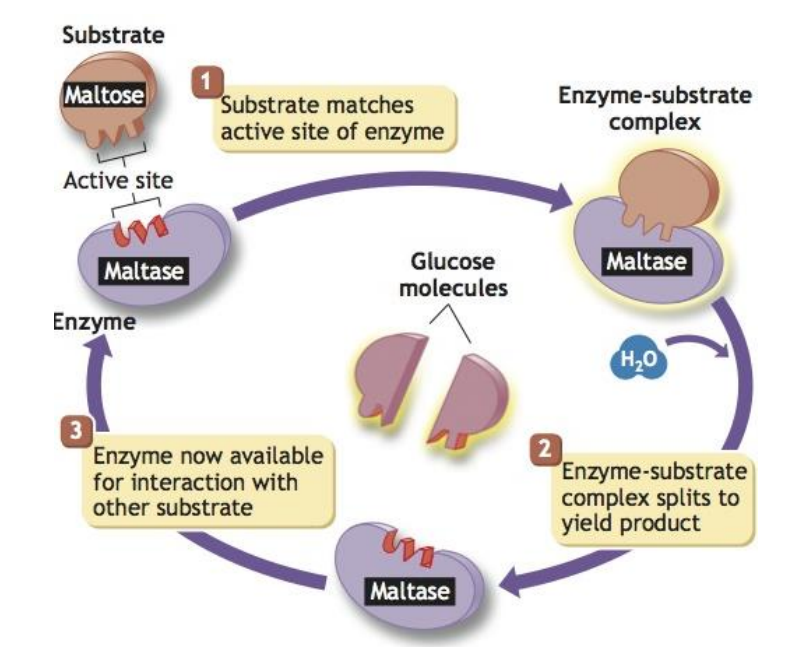
The drawing follows the enzyme maltase as it digests maltose, a sugar made of two glucose units. In step 1, maltose fits the active site of maltase and forms the enzyme substrate complex. In step 2, the complex splits with the help of a molecule of water (H2O) to release the product, two glucose molecules. In step 3, maltase comes out unchanged and is free to take another maltose. The arrows close into a circle because the same enzyme goes round this cycle again and again.
3. Coenzymes
Many enzymes also need a small helper to work. Coenzymes are organic substances that are not proteins and that help an enzyme act. A coenzyme binds to the enzyme alongside the substrate, and during the reaction it takes a small chemical group off the substrate. Lactate dehydrogenase, for example, can remove hydrogen from lactate only because a coenzyme, NAD+, is there to accept it. The coenzyme then leaves carrying that group and hands it on in a later reaction. So the job of a coenzyme is to accept and carry a small chemical group, which lets its enzyme complete the reaction. Coenzymes are reused after each reaction, so the body needs only small amounts, and many are built from B vitamins.
Three coenzymes appear in almost every pathway of energy metabolism.
- NAD+ is made from the vitamin niacin, and it carries hydrogen.
- FAD is made from the vitamin riboflavin, and it also carries hydrogen.
- Coenzyme A is made from the vitamin pantothenic acid, and it carries a two carbon unit called an acetyl group.
Hydrolysis, Condensation and Redox shows how NAD+ and FAD pick up hydrogen and hand it on.
4. Six classes of enzyme
Enzymes are sorted into six classes, and each class is named after the kind of reaction it speeds up. In the table, ATP is the cell’s energy carrier.
| Class | What it does | Example |
|---|---|---|
| Oxidoreductases | Move hydrogen or electrons from one molecule to another | Lactate dehydrogenase |
| Transferases | Move a chemical group from one molecule to another | Hexokinase, which moves a phosphate from ATP onto glucose |
| Hydrolases | Split a bond by adding water | Lipase, which splits fat |
| Lyases | Add a small molecule to a double bond, or remove one to leave a double bond, without using water to split and without moving electrons | Carbonic anhydrase, which joins water to carbon dioxide and splits them apart again |
| Isomerases | Rearrange the atoms inside one molecule | Phosphoglycerate mutase |
| Ligases | Join two molecules using energy from ATP | Pyruvate carboxylase, which joins carbon dioxide to pyruvate |
Several of these enzymes return in later pathways. Hexokinase, for example, carries out the first step in the breakdown of glucose.
5. Speed, temperature and pH
Enzymes do not all work at the same speed. Their speed is measured by the turnover number. This is simply how many substrate molecules one enzyme molecule turns into product in a given time, much like counting how many customers one cashier serves per minute. Chemists count molecules in moles, a mole being about 6 × 10^23 molecules, or roughly 600,000 billion billion. So the same idea is written formally as moles of substrate converted per mole of enzyme per unit time.
The turnover number is not fixed, because temperature and pH alter enzyme activity. As temperature rises, molecules collide more often, so the rate rises up to an optimum temperature. Beyond it the rate falls, because heat distorts the shape of the protein and its active site, so the substrate no longer fits. This loss of shape is called denaturation.
Acidity acts in a similar way. Each enzyme has an optimum pH at which it works best. Away from it, the electrical charges that hold the active site in shape change, and the rate falls. This matters in hard exercise, because working muscle becomes warmer and more acid, which changes the speed of its enzymes.
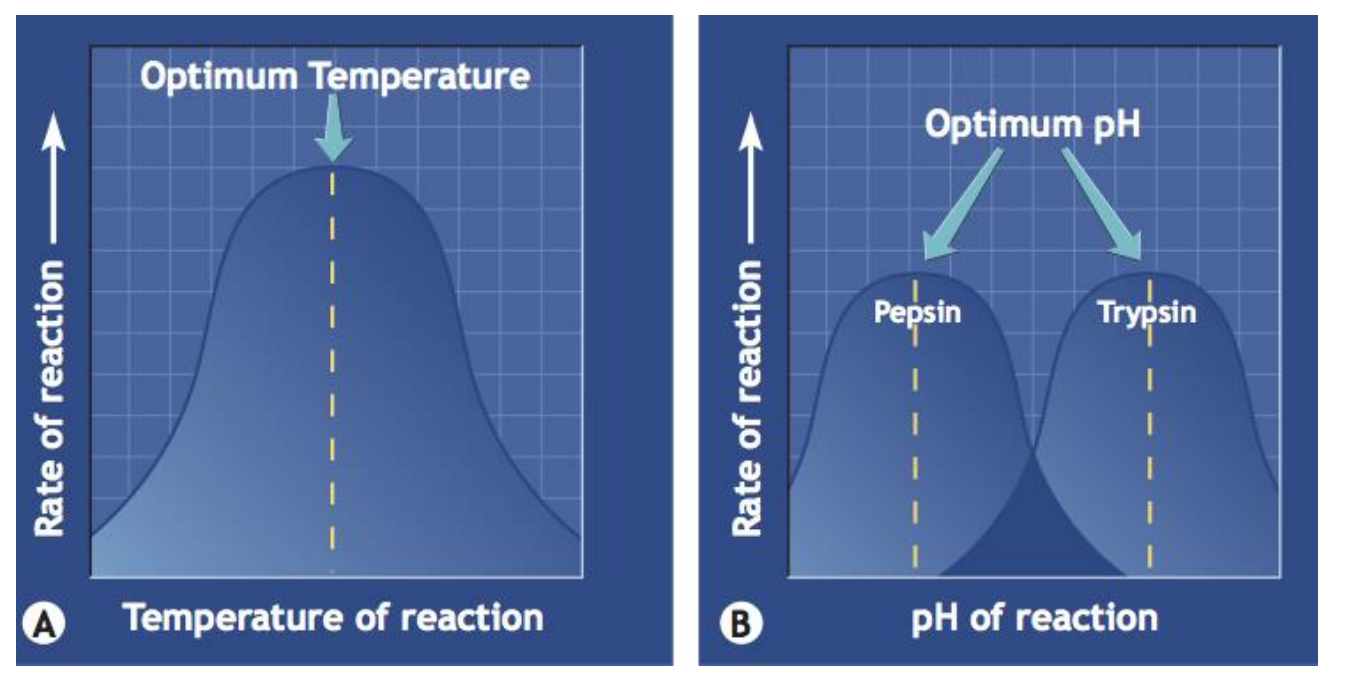
Panel A plots the rate of reaction, on the vertical axis, against the temperature of reaction. The curve is a hill whose peak is labelled optimum temperature, with faster collisions on its rising side and denaturation on its falling side. Panel B plots the rate of reaction against the pH of reaction and shows two hills. Pepsin, a digestive enzyme of the stomach, peaks in strong acid at about pH 2. Trypsin, a digestive enzyme of the small intestine, peaks in slightly alkaline conditions at about pH 8. Each enzyme is tuned to the place in the body where it works.
6. Inhibition
Other molecules can also slow an enzyme down. These inhibitors reduce enzyme activity and so slow the reaction, and their two kinds differ in where they bind.
A competitive inhibitor resembles the substrate and binds to the active site, which keeps the real substrate out. A noncompetitive inhibitor does not resemble the substrate and does not bind to the active site. It binds at another site and changes the enzyme’s structure, which reduces its ability to catalyse the reaction. A competitive inhibitor is a wrong key jammed in the lock, while a noncompetitive inhibitor bends the lock itself.
The difference matters when more substrate is added. Extra substrate wins more of the contests for the active site, so more substrate can outcompete a competitive inhibitor. More substrate cannot help against a noncompetitive inhibitor, because the lock stays bent however many keys arrive.
The cell uses inhibition to control its pathways. In a chain of reactions, the slowest step sets the pace of the whole chain, like the narrowest point of a road. The enzyme of that step is the rate limiting enzyme. The cell speeds the pathway up or slows it down by activating or inhibiting this enzyme. Often the inhibitor is the pathway’s own end product, the molecule made at its last step. When the cell has more of this product than it needs, the product builds up and binds to the rate limiting enzyme, which slows the whole pathway. When the cell uses the product up, the brake comes off and the pathway speeds up again. This is end product inhibition, and it works like a thermostat that turns the heating off once the room is warm. Glycolysis shows it at work with the enzyme phosphofructokinase.
Summary
Summary
An enzyme is a protein catalyst that speeds a reaction by lowering its activation energy. It is not used up and does not change the energy the reaction releases. Its active site fits one substrate like a lock and key. The two form an enzyme substrate complex, which splits to release the product and free the enzyme. Coenzymes are helpers built from B vitamins: NAD+ (niacin) and FAD (riboflavin) carry hydrogen, and coenzyme A (pantothenic acid) carries an acetyl group. The six classes are oxidoreductases, transferases, hydrolases, lyases, isomerases and ligases. Speed is measured by the turnover number, which peaks at an optimum temperature and optimum pH and falls when the enzyme denatures. Competitive inhibitors block the active site and can be outcompeted by more substrate, while noncompetitive inhibitors bind elsewhere and change the enzyme’s shape. The cell paces each pathway through its rate limiting enzyme, often by end product inhibition.