Definition
Every pathway that releases energy from food is built from a few simple kinds of chemical reaction. This note covers how molecules are split and joined using water, and how electrons pass between molecules, which is how the body takes energy out of food.
1. Hydrolysis: splitting with water
Two simple reactions explain how the body takes large molecules apart and builds new ones. The first is hydrolysis, which means splitting with water. Hydrolysis breaks a large molecule into smaller ones by adding water across a chemical bond. The water is split too. Its hydrogen (H+) attaches to one fragment and its hydroxyl group (OH) to the other.
Hydrolysis is the basis of digestion, which degrades complex carbohydrates, lipids and proteins into simpler forms that the body can absorb and assimilate. For example, sucrose, which is table sugar, reacts with water to give glucose and fructose. A dipeptide is two amino acids joined by a peptide bond, the link that holds amino acids together in a protein. With water, it splits into two separate amino acids. Fat is broken down in the same way, as Fat Catabolism describes, and ATP releases its energy by hydrolysis, as ATP and Phosphocreatine explains.
2. Condensation: joining and releasing water
Condensation is the reverse of hydrolysis, and it is how the body builds. In condensation, simple components bind together to form a more complex molecule. Each new bond releases one molecule of water, made from a hydrogen of one partner and a hydroxyl group of the other.
The examples mirror those of hydrolysis. Two glucose molecules join to give maltose and water. Two amino acids join to give a dipeptide and water, linked by a new peptide bond. Condensation is the basis of synthesis, because the body builds glycogen, fats and proteins this way.
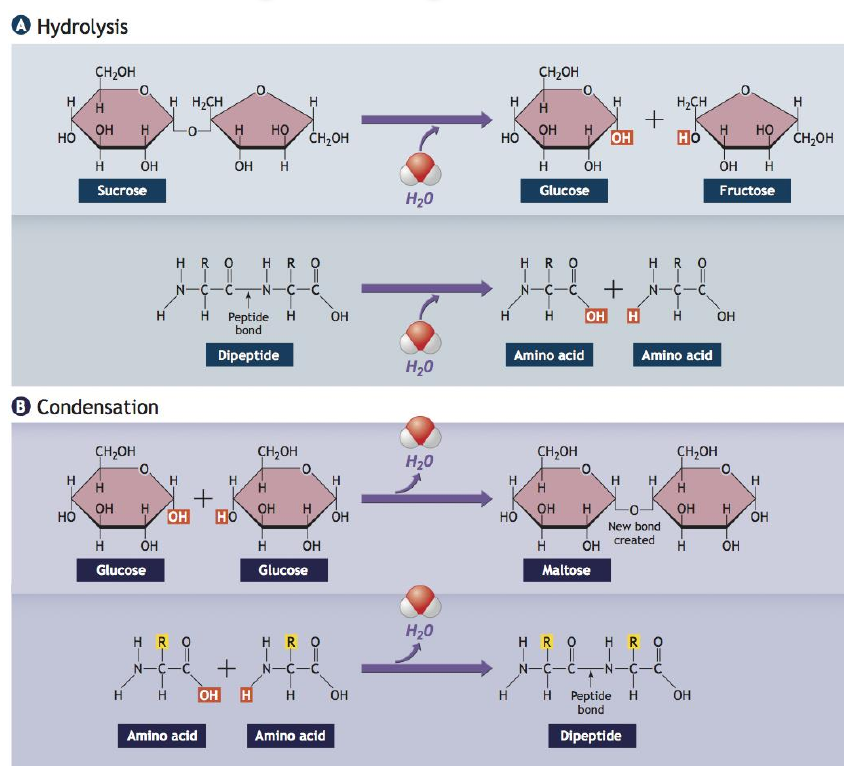
These two reactions therefore form a pair. Hydrolysis takes molecules apart and belongs to catabolism, the breaking down of molecules. Condensation builds them and belongs to anabolism, the building up of molecules.
3. Oxidation and reduction
The second kind of reaction moves electrons rather than water, and it is the one that releases energy from food. Oxidation always involves a loss of electrons. Reduction always involves a gain of electrons. A simple memory aid is that oxidation is loss and reduction is gain.
Oxidation reactions can transfer oxygen, hydrogen atoms or electrons. In the body, oxidation usually means removing hydrogen atoms. This counts because a hydrogen atom is one proton and one electron, so removing the atom also removes an electron.
Losing or gaining electrons changes an atom’s valence, which is its charge number. Electrons are negative, so losing electrons gives a net gain in valence, and gaining them gives a net decrease. For example, when iron changes from Fe2+ to Fe3+, it has lost one electron, its valence has risen from 2 to 3, and it has been oxidised.
Oxidation and reduction always happen together, because an electron given up by one substance must be taken by another. This is why they are called redox reactions. Electrons are like a hot potato. They are never dropped, only handed from one molecule to the next.
Every redox reaction therefore has two partners. The reducing agent is the substance that donates electrons, and so it is itself oxidised. The oxidising agent is the substance that gains electrons, and so it is itself reduced.
4. The hydrogen carriers
In metabolism, enzymes called dehydrogenases remove pairs of hydrogen atoms from fragments of food, which oxidises those fragments. The hydrogens are not released loose. They are handed to coenzymes.
Two coenzymes do this in every energy pathway. NAD+ takes both electrons of the pair but only one proton, and the spare proton stays free as a hydrogen ion. The reaction is NAD+ + 2H → NADH + H+, where 2H stands for the two hydrogen atoms removed from the food. FAD accepts both hydrogen atoms and becomes FADH2.
The loaded forms, NADH and FADH2, are reduced and rich in energy. The empty forms, NAD+ and FAD, must be regenerated, because without a free carrier the reactions that need it stop. The carriers are like delivery vans that load hydrogen in the energy pathways and must unload before they can load again.
They unload in the respiratory chain, the final common pathway of aerobic metabolism. There, the electrons carried by hydrogen are passed along a chain of carrier molecules to oxygen, which accepts them and forms water. Oxygen gains those electrons, so oxygen itself is reduced. In gaining them it pulls electrons away from the carriers, which is what an oxidising agent does, so oxygen is the body’s final oxidising agent. Oxidative Phosphorylation explains this chain in full.
5. Why redox carries the energy
The electrons in food molecules hold a lot of potential energy, the stored energy described in Energy and Thermodynamics. As they are passed step by step toward oxygen, they fall to a lower energy level, and the energy released by that fall is what the cell captures. Redox reactions are therefore the basis of all the body's energy transfer. Energy leaves food as electrons riding on hydrogen atoms.
Summary
Summary
Hydrolysis splits a molecule by adding water, as when sucrose gives glucose and fructose, and it is the basis of digestion and catabolism. Condensation joins molecules and releases water, as when two glucose molecules give maltose, and it is the basis of synthesis and anabolism. Oxidation is loss of electrons and reduction is gain of electrons, and the two always occur together as redox reactions. The reducing agent donates electrons and is oxidised, while the oxidising agent gains electrons and is reduced. Dehydrogenases hand hydrogen from food to the carriers NAD+ and FAD, which become NADH and FADH2 and must unload in the respiratory chain to be regenerated. There oxygen is the final oxidising agent and forms water, and the electrons falling toward it release the energy the cell captures.