Definition
Every job a cell does, from moving a muscle to building a protein, is paid for with one small molecule. This note introduces that molecule, shows how little of it the body keeps, and explains the two fastest ways the cell refills it.
1. Why the cell needs a currency
Food holds its energy in three macronutrients, carbohydrate, fat and protein. This is potential energy, stored in the chemical bonds of each nutrient. It cannot be handed directly to the work a cell does. A muscle fibre cannot contract by burning a piece of fat on the spot.
Instead, the energy released when these nutrients are broken down is funnelled into one molecule, adenosine triphosphate (ATP). The potential energy held in ATP then powers every process in the cell that needs energy.
So the cell has two great energy tasks. The first is to extract the potential energy of food and conserve it in the bonds of ATP. The second is to extract the chemical energy of ATP and transfer it to biologic work, whose mechanical, chemical and transport forms are explained in Energy and Thermodynamics.
2. What ATP is
ATP is built from adenosine, which is the base adenine joined to the sugar ribose, linked to a chain of three phosphate groups. A phosphate group is a phosphorus atom surrounded by oxygen atoms. The two bonds that join the phosphates together are called high energy bonds, because a large amount of free energy is released when one is split. Free energy is the part of a molecule’s energy that can do work.
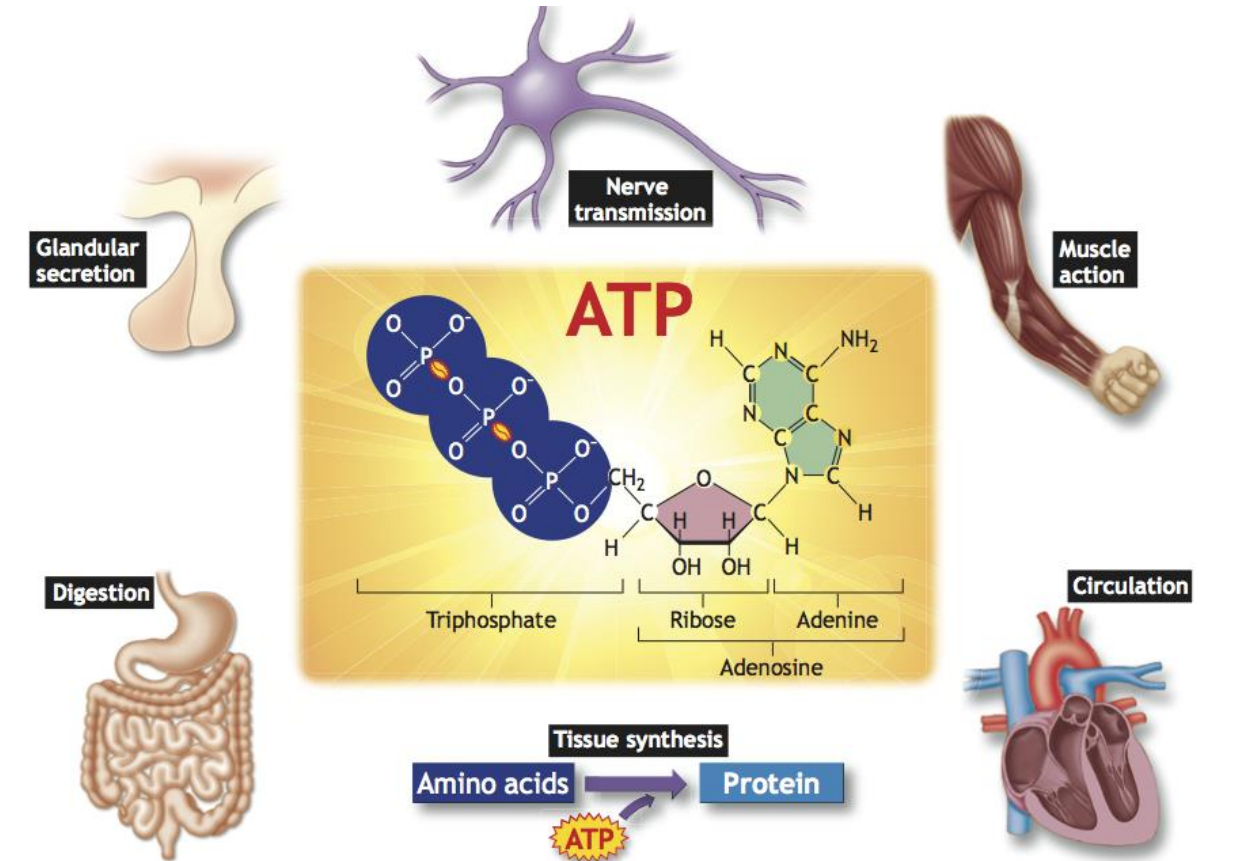
Around the molecule sit six kinds of work that ATP pays for: nerve transmission, muscle action, circulation, tissue synthesis, digestion and glandular secretion. One molecule serves every purpose, from a heartbeat to building protein from amino acids.
3. Spending ATP
The cell releases the energy in ATP by hydrolysis, splitting a bond by adding water, as explained in Hydrolysis, Condensation and Redox. The enzyme that does this is adenosine triphosphatase (ATPase). It joins ATP with water and splits off the outermost phosphate. This leaves adenosine diphosphate (ADP), which has two phosphates, and a free inorganic phosphate (Pi). The whole reaction is ATP + H2O → ADP + Pi + 7.3 kcal per mole.
A mole is simply a fixed, very large number of molecules. A mole of ATP weighs about half a kilogram, so ATP carries very little energy for its weight, far less than glucose or fat. This is why ATP works as a carrier that is used again and again, not as a store. The reaction is exergonic, meaning that it releases energy. The size of this release is measured as the free energy change (ΔG), which is the free energy of the products minus the free energy of the starting molecules. ADP and Pi hold less free energy than ATP and water, so the change is negative, and ΔG for this reaction is minus 7.3 kcal per mole. A minus sign therefore means that energy is given out. A plus sign would mean that energy must be put in, as when the cell builds new molecules.
This free energy powers all forms of biologic work, which is why ATP is called the cell's energy currency. The reaction needs no oxygen and happens at once, so energy is there the instant a muscle is told to contract.
4. Catabolism and anabolism meet at ATP
ATP links the two halves of metabolism. The first half is catabolism, the breakdown of carbohydrates, fats and proteins, with oxygen, to water and carbon dioxide. Catabolism is exergonic, and its energy is used to join ADP and Pi back into ATP.
The second half is anabolism, the building of large synthesised end products from small building block precursors. Anabolism is endergonic, meaning that it needs an input of energy. It is paid for by splitting ATP into ADP and Pi.
So ATP and ADP cycle endlessly between the two halves. ATP behaves like a rechargeable battery, charged by catabolism and drained by anabolism and every other kind of work.
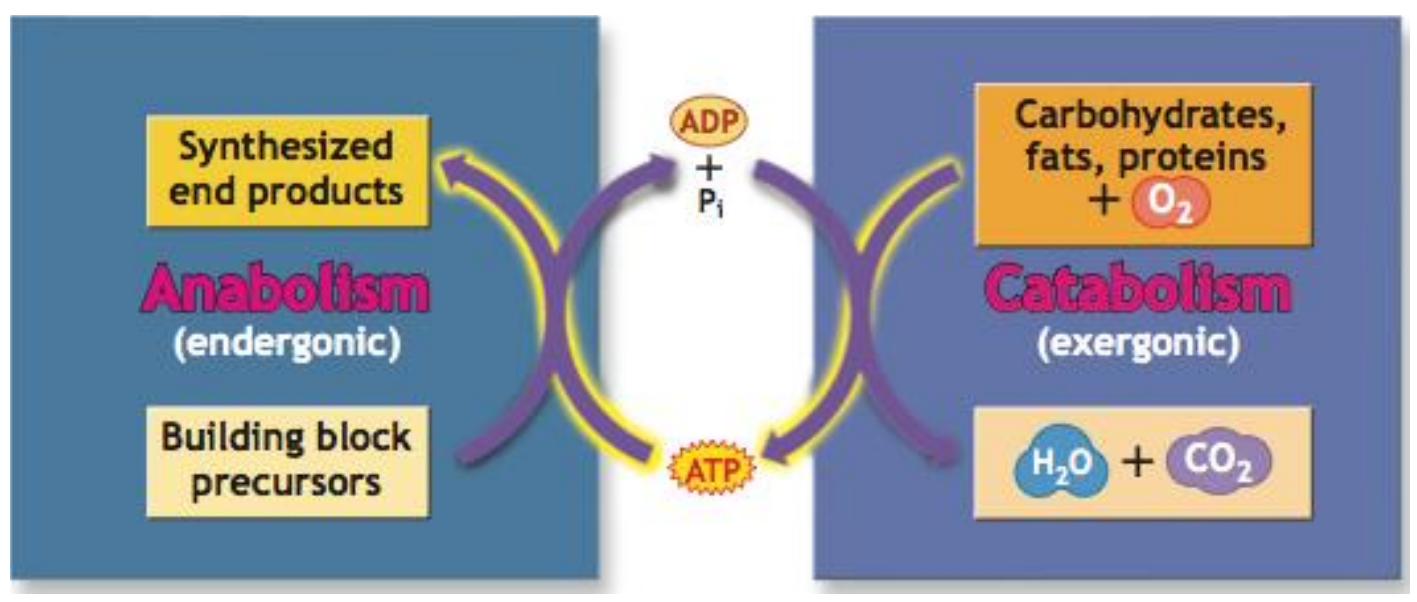
The figure draws this cycle as a wheel between two panels. The right panel, Catabolism (exergonic), turns carbohydrates, fats, proteins and oxygen into water and carbon dioxide. The left panel, Anabolism (endergonic), turns building block precursors into synthesised end products. On the catabolic side, a curved arrow carries ADP and Pi round to ATP, because the energy from food recharges the battery. On the anabolic side, the other arrow carries ATP back to ADP and Pi, because that energy is spent on building.
5. A limited currency
Despite its importance, ATP is kept in very small amounts, so it must be continually resynthesised. The whole body stores only 80 to 100 g of ATP at rest. That is enough to power 2 to 3 seconds of maximal exercise.
The store is small because ATP is a heavy molecule, as it was said before, so the cell recycles the same molecules over and over instead. Across one day, a person turns over an amount of ATP comparable to a large fraction of their body weight.
Even so, the ATP level of skeletal muscle falls only under extreme exercise conditions, because resynthesis normally keeps pace with use. The control is built in. As ATP falls and ADP rises, that change is itself the signal that speeds up the reactions that remake ATP. ATP must be remade at exactly the rate it is spent, and the rest of energy metabolism exists to do that.
6. Phosphocreatine, the energy reservoir
The fastest top up comes from phosphocreatine (PCr), also called creatine phosphate. It is a molecule of creatine that carries a high energy phosphate. The enzyme creatine kinase, also called creatine phosphokinase, passes that phosphate straight to ADP. The reaction is PCr + ADP → Cr + ATP, where Cr is creatine.
This reaction is anaerobic, meaning that it needs no oxygen. It is also a single step, which makes it the fastest way a cell can remake ATP. Cells store about 4 to 6 times more PCr than ATP. PCr reaches its maximum energy yield in about 10 seconds.
ATP and PCr together are the anaerobic sources of phosphate bound energy. They power all out efforts lasting a few seconds, such as a sprint start, a jump, a heavy lift or a throw. The reaction is reversible, so at rest ATP from the slower pathways recharges the PCr store.
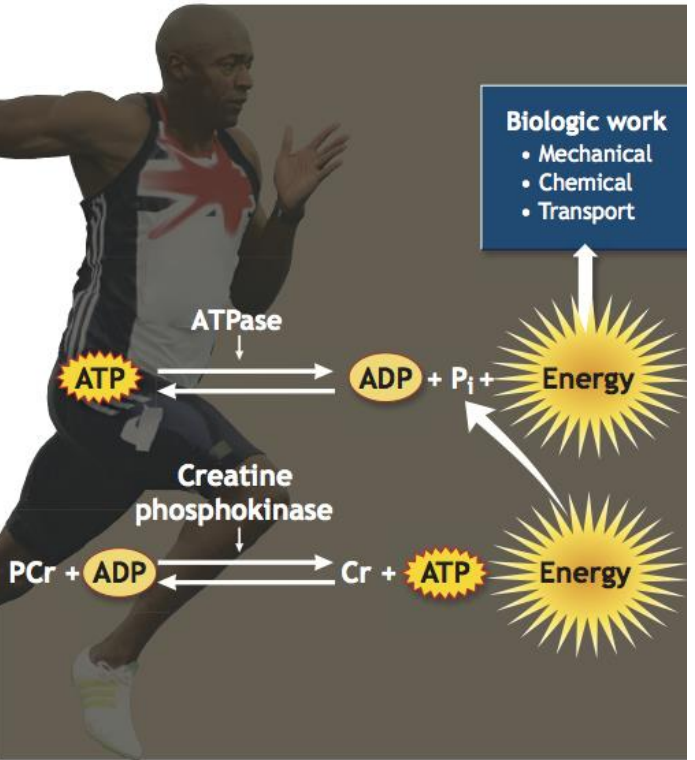
An arrow runs from this lower burst to the ADP and Pi of the upper line. It carries the key idea: PCr never powers work itself, and its energy goes into putting ADP and Pi back together as ATP, so the upper reaction can keep running. In reality this is a single step, in which creatine kinase hands the phosphate straight from PCr to ADP, and the small amount of energy left over is lost as heat.
7. Adenylate kinase, the last resort
When ADP builds up because ATP is used faster than it is remade, a second enzyme steps in. Adenylate kinase takes the phosphate from one ADP and puts it on another. The reaction is 2 ADP ⇄ ATP + AMP, where AMP is adenosine monophosphate, adenosine with a single phosphate. The enzyme needs magnesium (Mg2+) to work.
This rescues one ATP from two ADP, but it is less efficient because the AMP is metabolised and not recycled. Its nitrogen is removed as ammonia, so the muscle slowly loses part of its stock of adenine molecules. Rising AMP also acts as an alarm that energy is low, which switches on the pathways that remake ATP. This reaction runs hard in McArdle Disease Cause and Mechanism, where a missing enzyme starves muscle of fuel and ADP piles up.
8. Where the lasting supply comes from
Phosphocreatine counts as one of the six fuel sources a muscle can draw on. It works by phosphorylating ADP, which means adding a phosphate to it, under the control of creatine kinase and adenylate kinase. Yet these stores last only seconds. For anything longer, ATP must be remade from food. This happens without oxygen in the fluid of the cell, and with oxygen in the mitochondria, the cell’s power stations. Energy Pathways Overview maps those routes.
Summary
Summary
Food holds potential energy, but a cell can spend it only after it has been moved into ATP, adenosine joined to three phosphates by high energy bonds. ATPase splits ATP with water into ADP and Pi, releasing 7.3 kcal per mole that powers all biologic work without needing oxygen. Catabolism of carbohydrate, fat and protein is exergonic and recharges ADP into ATP, while anabolism is endergonic and drains it, so ATP cycles like a rechargeable battery. The body holds only 80 to 100 g of ATP, enough for 2 to 3 seconds of maximal exercise, so ATP must be remade as fast as it is spent, and rising ADP is the signal to do so. The fastest refill is phosphocreatine, whose phosphate creatine kinase passes to ADP in one anaerobic step. Muscle holds 4 to 6 times more PCr than ATP, and PCr gives its maximum yield in about 10 seconds, which makes ATP and PCr the fuel for sprints, jumps, lifts and throws. As a last resort, adenylate kinase turns two ADP into ATP and AMP, but this is less efficient because AMP is broken down and not recycled. Beyond these few seconds, ATP must be remade from food by the pathways, without oxygen in the fluid of the cell and with oxygen in the mitochondria.