Definition
Food cannot power a muscle directly. Its energy has to be released step by step and captured as ATP, the molecule that drives every contraction. This note is the map of that journey: where in the cell each step happens, which steps need oxygen, and which fuels a working muscle can call on.
1. Three stages from food to ATP
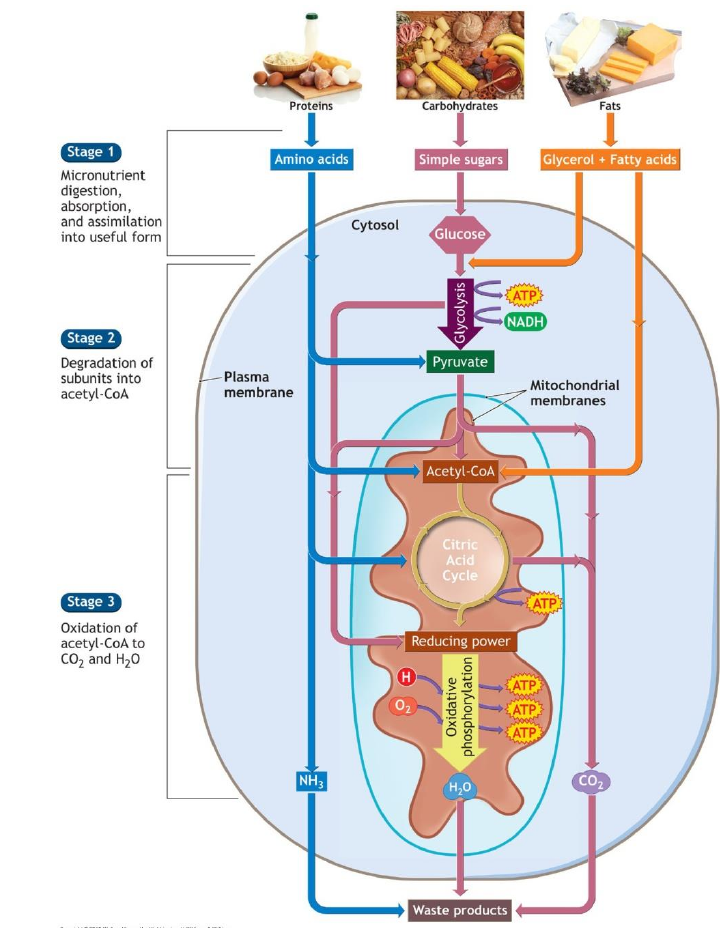
The energy in food reaches ATP in three stages, and each stage takes the fuel one step further from the plate. Stage 1 is the digestion, absorption and assimilation of the macronutrients, the nutrients we eat in large amounts: carbohydrate, fat and protein. Assimilation means taking a nutrient into the body’s own use. In this stage each large food molecule is cut into smaller subunits.
Each food gives its own subunit. Proteins become amino acids. Carbohydrates become simple sugars, mainly glucose. Fats become glycerol and fatty acids. Every one of these cuts is made by hydrolysis, a reaction in which water breaks a chemical bond (Hydrolysis, Condensation and Redox).
All of this happens inside the gut. The products are absorbed into the blood together with water, minerals and vitamins, mostly in the small intestine. That blood then passes through the liver before it reaches the rest of the body. To do this work the gut also secretes enzymes and bile salts, and its muscular contractions (motility) move the contents along. Even so, no usable energy is captured in Stage 1.
Stage 2 happens inside the cell. Part of it runs in the cytosol, the fluid of the cell, and part in the mitochondrion, a small compartment of the cell. Here amino acids, glucose, and the glycerol and fatty acid units are broken down into one common product, acetyl coenzyme A (acetyl CoA). Acetyl CoA is a two carbon fragment carried by a helper molecule called coenzyme A. Only a little ATP is made in this stage, and it comes from glucose.
In Stage 3 acetyl CoA passes through two linked routes, the Krebs cycle (also called the citric acid cycle or TCA cycle) and oxidative phosphorylation. Together they break it down completely to carbon dioxide and water, and this is where most of the ATP is made. The cell gets rid of three waste products: carbon dioxide, water and ammonia (NH3), which comes from the nitrogen of amino acids. So whatever the fuel, every route meets at acetyl CoA and then shares one final path.
2. Two compartments of the cell
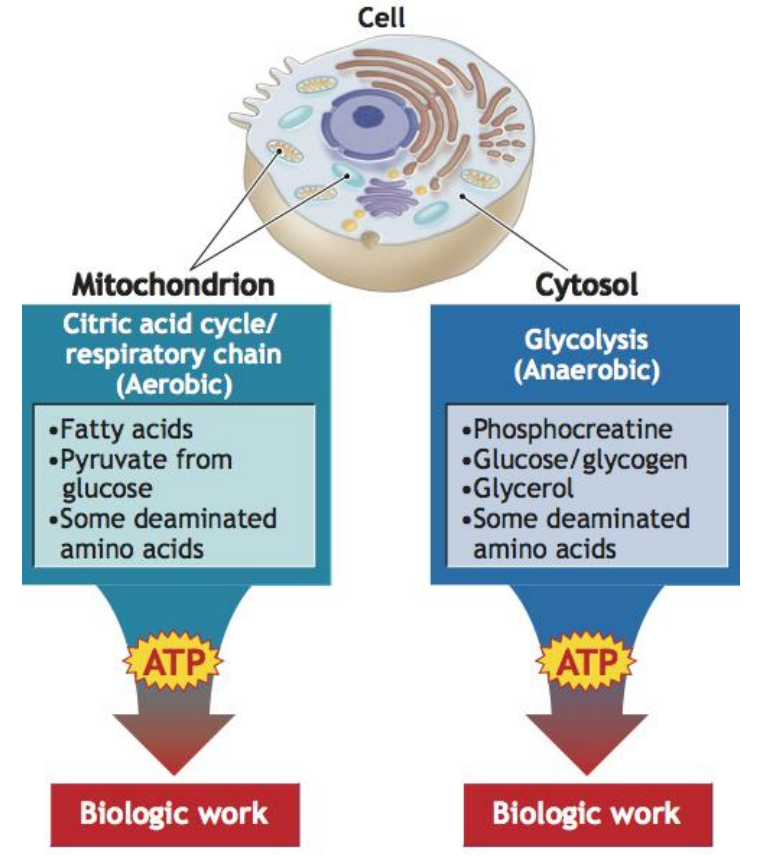
The cell makes ATP in two places, and the place decides whether oxygen is needed. The first is the cytosol, the reactions in the cytosol are anaerobic, meaning that they do not use oxygen.
Two kinds of anaerobic reaction make ATP there. One is the splitting of phosphocreatine, a high energy store that refills ATP within moments (ATP and Phosphocreatine). The other is glycolysis, which takes in glucose, glycogen, glycerol and some deaminated amino acids. A deaminated amino acid is one whose nitrogen group has been removed (Protein and the Metabolic Mill).
The second place is the mitochondrion (singular form of mitochondria), an organelle wrapped in two membranes and often called the power station of the cell. Its reactions are aerobic, meaning that they depend on oxygen. They are the Krebs cycle and the respiratory chain, another name for the electron transport chain, which passes electrons from hydrogen on to oxygen. Their fuels are fatty acids, pyruvate made from glucose, and some deaminated amino acids. Both compartments end in the same product: ATP that powers biologic work such as contraction.
3. The three pathways at a glance
Three linked pathways do the work of Stages 2 and 3, and each has its own place, its own inputs and its own products. Two carrier molecules, NADH and FADH2, link them, because they pick up hydrogen in one pathway and deliver it to another.
| Pathway | Where it runs | What goes in | Does it need oxygen | What comes out |
|---|---|---|---|---|
| Glycolysis | Cytosol | Carbohydrate: glucose from the blood or from glycogen. Glycerol from fat can join partway. | No | A little ATP, hydrogen loaded on NADH, and pyruvate, which becomes lactate or enters the mitochondrion |
| Krebs cycle | Matrix, the inner space of the mitochondrion | Acetyl CoA from carbohydrate, fat and protein | Runs only when oxygen is available, but does not use oxygen itself | Carbon dioxide, a little ATP, and much hydrogen loaded on NADH and FADH2 |
| Oxidative phosphorylation | Inner mitochondrial membrane | Hydrogen carried by NADH and FADH2, and oxygen | Yes | Most of the ATP, and water |
The Krebs cycle never touches oxygen, yet it stops without it. This is because it needs a steady return of empty carriers (NAD+ and FAD), and only oxidative phosphorylation, which does use oxygen, can empty them. Each pathway has its own note: Glycolysis, Krebs Cycle and Oxidative Phosphorylation. All three are driven by oxidation and reduction (redox) reactions, the paired loss and gain of electrons that underlie all energy metabolism (Hydrolysis, Condensation and Redox).
4. Six fuel sources of a muscle
A working muscle can draw on six sources of fuel, and three terms are needed to read the list. A triacylglycerol is a fat molecule, also called a triglyceride, made of one glycerol and three fatty acids. Glycogen is the storage form of glucose, a large branched chain of glucose units. A carbon skeleton is what is left of an amino acid once its nitrogen has been removed.
- Triacylglycerol and glycogen stored within the muscle cells themselves are the fuel closest to hand.
- Blood glucose is taken up by the muscle from the circulation.
- Free fatty acids, which are fatty acids released from fat stores and carried in the blood, are delivered to the muscle (Fat Catabolism).
- The carbon skeletons of amino acids come from the muscle’s own protein and from the liver.
- The anaerobic reactions of the first phase of glucose breakdown, glycolysis, make ATP without oxygen.
- Phosphocreatine phosphorylates ADP, meaning that it hands a phosphate to ADP to remake ATP, under the control of the enzymes creatine kinase and adenylate kinase.
Which of these the muscle leans on depends mostly on how hard and how long it works.
5. Which source when
Each source differs in how fast it delivers ATP and how long it lasts, so each suits a different kind of effort. The stores of ATP and phosphocreatine dominate all out efforts of up to about 10 seconds, such as a 100 m sprint, a jump or a heavy lift. Glycolysis ending in lactate dominates hard efforts of roughly 30 seconds to 2 minutes, such as a 400 m run or a 100 m swim, because pyruvate is made faster than the mitochondria can take it. Aerobic metabolism dominates anything longer than a few minutes, such as distance running or cycling. Within it, fat is prominent at low intensity and long duration, and carbohydrate takes over as intensity rises. These times are approximate, and the systems never switch on one after another: all run together and only their shares shift.
Summary
Summary
Food energy reaches ATP in three stages: digestion into subunits (amino acids, glucose, glycerol and fatty acids) with no energy captured, breakdown inside the cell to acetyl CoA, and complete breakdown of acetyl CoA to carbon dioxide and water with most of the ATP. The cytosol runs the anaerobic reactions, glycolysis and the splitting of phosphocreatine, while the mitochondrion runs the aerobic Krebs cycle and electron transport chain. Glycolysis needs no oxygen, the Krebs cycle needs oxygen indirectly and oxidative phosphorylation uses it and makes most of the ATP. A muscle has six fuel sources: its own triacylglycerol and glycogen, blood glucose, free fatty acids, amino acid carbon skeletons, anaerobic glycolysis, and phosphocreatine. ATP and phosphocreatine dominate efforts of up to about 10 seconds, glycolysis efforts of about 30 seconds to 2 minutes, and aerobic metabolism anything longer than a few minutes, with all systems always running together.