Definition
Fat is the body’s largest store of energy, far larger than its store of sugar. This note follows fat from storage to the working muscle. It shows how fat is taken apart and fed into the same final route that burns glucose, and why it is a slower fuel.
1. The largest fuel store
The body keeps most of its energy reserve as fat. It stores this fat as triacylglycerol (also called triglyceride), a molecule made of three long chains called fatty acids attached to a small backbone. Stored fat is the body’s most plentiful source of potential energy, that is, energy held in chemical bonds until it is released.
In a young adult male, the fat cells (adipocytes) hold 60,000 to 100,000 kcal. The triacylglycerol inside the muscles adds about 3,000 kcal. The body’s whole store of carbohydrate, by contrast, holds only about 2,000 kcal.
Fat is the better store because it packs more energy into less weight. A gram of fat holds 9 kcal, against 4 kcal for a gram of carbohydrate. Gram for gram, it also yields about two and a half times as much ATP. A reserve of carbohydrate would make the body much heavier.
How much energy comes from fat varies widely. Fat supplies 30 to 80 per cent of the energy for biologic work. The share depends on nutritional status, which means what the person has eaten and how recently. It also depends on training level and on the intensity and duration of the activity. Fat becomes the primary fuel for exercise and recovery when intense, long exercise has depleted both blood glucose and muscle glycogen.
2. Three sources of fat
A working muscle can draw on fat from three places, one inside the muscle and two in the blood.
- The first is triacylglycerol stored within the muscle fibre, as droplets lying close to the mitochondria, where fuel is burned with oxygen.
- The second is triacylglycerol in the blood inside lipoprotein complexes, parcels of fat wrapped in protein so that they can travel in watery blood.
- The third is free fatty acids in the blood, cut loose from the triacylglycerol of adipose tissue, the body’s fat tissue.
Whatever its source, the triacylglycerol must be split into its parts before the muscle can use it.
3. Lipolysis and transport
To follow how fat is split, it helps first to know its parts. The backbone of a triacylglycerol is glycerol, a small molecule of three carbons. Each fatty acid is a long chain of carbon atoms carrying hydrogen, and that hydrogen holds most of the energy. One fatty acid is attached to each carbon of glycerol.
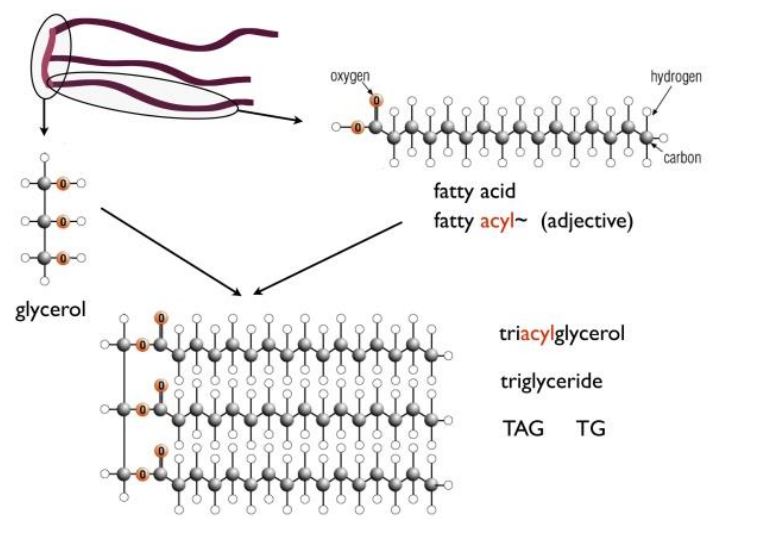
The drawing builds the molecule from its pieces. Glycerol sits on the left and a single fatty acid, a long zigzag of grey carbons and white hydrogens, on the right. At the bottom, three fatty acids hang from the glycerol like the teeth of a comb. Triacylglycerol, triglyceride, TAG and TG are all names for this one molecule.
Splitting this molecule is called lipolysis. It is a hydrolysis, a reaction that breaks a bond by adding water (Hydrolysis, Condensation and Redox), and the enzyme is a lipase. Each of the three bonds uses one water molecule, so triacylglycerol + 3 H2O → glycerol + 3 fatty acids, where H2O is water. In fat cells the enzyme is hormone sensitive lipase, so called because hormones switch it on. The hormones epinephrine (adrenaline), norepinephrine, glucagon and growth hormone activate it. So the hormones released during exercise speed up fat breakdown and the delivery of fatty acids to active muscle.
The freed fatty acids leave the fat cell and enter the blood plasma, the liquid part of the blood. They do not dissolve in water, so they travel bound to the plasma protein albumin. Triacylglycerol inside muscle fibres is split in the same way, so its fatty acids are already where they are needed.
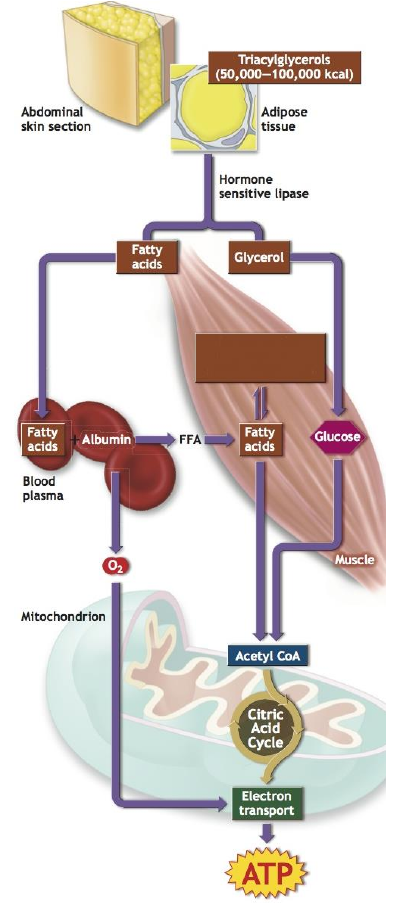
The drawing reads from top to bottom, from storage to ATP. Adipose tissue holds the triacylglycerols, and hormone sensitive lipase splits them into fatty acids and glycerol. Albumin ferries the fatty acids through the blood plasma into the muscle, where they arrive as FFA (free fatty acids). The glycerol takes its own path, toward glucose. In the mitochondrion, the fatty acids become acetyl CoA, which passes through the citric acid cycle and electron transport to give ATP. Oxygen (O2) arrives from the red blood cells to finish the process. One label in the muscle is hidden by a blank box. The store is labelled from 50,000 kcal, a slightly lower estimate than the one used here.
4. The route of glycerol
After lipolysis, glycerol and the fatty acids go separate ways, and glycerol has the shorter journey. It gains a phosphate and becomes 3-phosphoglyceraldehyde, a molecule found halfway down glycolysis, the pathway that splits glucose into pyruvate (Glycolysis). From there it follows the rest of glycolysis to pyruvate.
On the way, glycerol makes ATP by substrate level phosphorylation, in which a phosphate passes directly from a fuel molecule to ADP. It also passes hydrogen to NAD+, the carrier that takes hydrogen to the electron transport chain. The pyruvate is then oxidised in the Krebs cycle. The complete breakdown of one glycerol molecule yields 19 ATP. Alternatively, the liver can use glycerol to make new glucose (Glycogen and Blood Glucose).
5. Beta oxidation of fatty acids
The fatty acids hold most of the energy in fat, and their route to ATP has more steps. The whole sequence of fat breakdown runs as follows.
- Triacylglycerol is broken down to free fatty acids and glycerol.
- The free fatty acids are transported in the blood.
- The muscle takes up free fatty acids from the blood.
- The fatty acids are prepared for breakdown.
- The activated fatty acid enters the muscle mitochondria.
- Beta oxidation breaks the fatty acid down to acetyl CoA, generating NADH and FADH2.
- The Krebs cycle and the electron transport chain oxidise the products together.
The first three steps are lipolysis and transport, and the last four happen inside the muscle fibre. Preparation means activation, in which a carrier molecule called coenzyme A is attached to the fatty acid. This tags it for breakdown at a small cost, the equivalent of two ATP. The activated fatty acid cannot cross the inner membrane of the mitochondrion alone. So a carrier called carnitine moves it into the matrix, the fluid inside the mitochondrion.
In the matrix, beta oxidation cuts the chain two carbons at a time from its end. Each cut releases one acetyl CoA, a two carbon fragment bound to coenzyme A. Each cut also loads one FAD and one NAD+ with hydrogen, making FADH2 and NADH. The shorter chain picks up a new coenzyme A and goes round again, until it has all become acetyl CoA. It is like slicing a long loaf two slices at a time until nothing is left.
An 18 carbon fatty acid passes through 8 rounds. The last round splits a four carbon piece into two, so the result is 9 acetyl CoA, with 8 FADH2 and 8 NADH. The acetyl CoA enters the Krebs cycle (Krebs Cycle). All the hydrogen goes to the electron transport chain, where it drives ATP production and oxygen finally accepts it (Oxidative Phosphorylation).
This route means that fat can be burned only with oxygen. Glucose can make some ATP without oxygen in glycolysis, but fatty acids have no route outside the mitochondrion. Their loaded carriers can be emptied only when oxygen takes the hydrogen at the end of the chain.
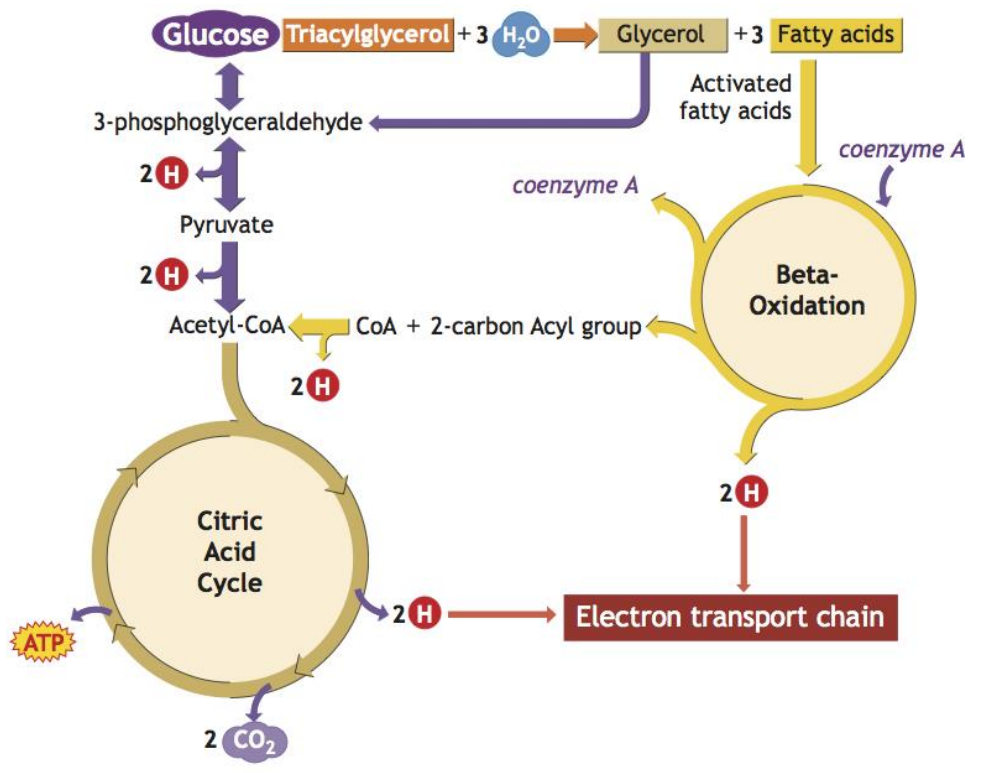
The diagram puts both routes side by side. Glycerol joins glycolysis at 3-phosphoglyceraldehyde, which also links upward to glucose. It runs down to pyruvate and acetyl CoA, releasing a pair of hydrogen atoms (2 H) at each step. The fatty acids, activated with coenzyme A, enter the yellow wheel of beta oxidation. Each turn releases a two carbon acyl group on CoA, which is acetyl CoA, and another 2 H. Both routes meet in the citric acid cycle, which gives ATP, carbon dioxide (CO2) and more hydrogen. All the hydrogen flows to the electron transport chain.
6. ATP from one fat molecule
Adding up both routes gives the yield of one whole triacylglycerol. Each 18 carbon fatty acid converts 147 ADP to ATP during beta oxidation and the Krebs cycle. This counts the ATP from its 8 NADH, 8 FADH2 and 9 acetyl CoA, minus the cost of activation.
| Source | Pathway | ATP |
|---|---|---|
| 1 glycerol | Glycolysis and Krebs cycle | 19 |
| 3 fatty acids of 18 carbons | Beta oxidation and Krebs cycle | 441 |
| Total, 1 triacylglycerol | 460 |
The three fatty acids give 3 times 147, or 441 ATP. Glycerol adds 19 ATP, bringing the total to 460 ATP for each triacylglycerol. One glucose, fully oxidised, nets 32 ATP (ATP Yield from Glucose). So a fat molecule yields over fourteen times as much, mainly because it is much larger. These fat totals use the older values of 3 ATP per NADH and 2 per FADH2. On the modern count they would be about a fifth lower, but fat stays far richer than glucose.
7. Why fat is the slower fuel
Despite its huge store, fat cannot release energy as fast as carbohydrate, for two reasons. Its route is long, because fat must be mobilised, carried, taken up, activated and moved into the mitochondria before it yields any ATP. It also needs more oxygen for each ATP than carbohydrate does, so a limited oxygen supply makes ATP from fat more slowly.
As a result, fat alone sustains about half the power achieved with carbohydrate as the main aerobic fuel. This is why pace drops when muscle glycogen runs out in a long race. Fat also burns only while the Krebs cycle keeps turning, which depends on carbohydrate, as Protein and the Metabolic Mill explains.
Summary
Summary
Fat is the body’s largest fuel store, 60,000 to 100,000 kcal in adipocytes, and it supplies 30 to 80 per cent of the energy for biologic work. Muscle draws fat from droplets in its own fibres, from lipoproteins in the blood and from free fatty acids released by adipose tissue. Hormone sensitive lipase, switched on by exercise hormones, splits each triacylglycerol into glycerol and three fatty acids, which travel to muscle bound to albumin. Glycerol enters glycolysis at 3-phosphoglyceraldehyde and yields 19 ATP, or the liver makes glucose from it. Each fatty acid is activated with coenzyme A, carried into the mitochondrion by carnitine and cut two carbons at a time by beta oxidation. Each round gives one acetyl CoA, one NADH and one FADH2, which the Krebs cycle and electron transport chain oxidise, so fat burns only with oxygen. An 18 carbon fatty acid yields 147 ATP and a whole triacylglycerol 460 ATP, against 32 ATP for one glucose. Because its route is long and costly in oxygen, fat alone sustains only about half the power of carbohydrate.