Definition
Muscles mostly burn carbohydrate and fat, but protein can be burned too. This note explains how protein is prepared as a fuel, and then shows how all three fuels meet at one central crossroads inside the cell. It also explains which fuels can be turned into which, and why fat burns fully only when some carbohydrate is present.
1. Protein as a fuel
Protein is mainly a building material for muscle fibres, enzymes and other structures, but its amino acids can also be burned. An amino acid is a carbon skeleton carrying an amino group, a small cluster of atoms that contains nitrogen. The skeleton holds the usable energy, but the nitrogen cannot be burned.
So the nitrogen must be removed first, a step called deamination. The body has two ways to do it. In oxidative deamination the amino group is pulled off as ammonia (NH3), leaving a keto acid. A keto acid is simply the bare carbon skeleton, an amino acid without its nitrogen. In transamination the amino group is instead handed to a different keto acid, which thereby becomes a new amino acid.
Ammonia is toxic, so it must not build up. The blood carries it to the liver, which combines it with carbon dioxide to make urea, a far less harmful molecule. The kidneys then excrete the urea in the urine.
Once the nitrogen is gone, the skeleton enters the pathways that burn glucose and is used to produce ATP aerobically, which means with oxygen. The first is glycolysis, which splits glucose into pyruvate, a three carbon molecule (Glycolysis). The second is the Krebs cycle, also called the citric acid cycle or TCA cycle, which is a loop of reactions inside the mitochondria that strips hydrogen from fuel to power ATP production (Krebs Cycle).
2. Glucogenic and ketogenic amino acids
Each of the 20 amino acids has its own shape, so each skeleton enters these pathways at its own point. That entry point decides what the skeleton can become, because only some points lead back towards glucose.
Glucogenic amino acids, when deaminated, yield pyruvate or intermediates of the Krebs cycle, which are the molecules made partway round the cycle. From these the liver can build new glucose, a process called gluconeogenesis (Glycogen and Blood Glucose). For example, alanine becomes pyruvate, and glutamate enters the Krebs cycle directly.
Ketogenic amino acids, when deaminated, yield acetyl CoA or acetoacetate. Acetyl CoA is a two carbon fragment carried by a helper molecule called coenzyme A, and it is the form in which most fuel enters the Krebs cycle. Acetoacetate is a small fuel molecule built from two acetyl CoA units. These products cannot become glucose, but they can be burned or built into triacylglycerol (triglyceride), the storage form of fat.
3. The metabolic mill
All three fuels end up at the same place. The Krebs cycle is the vital link between the energy in the macronutrients and the chemical energy of ATP, where the macronutrients are carbohydrate, fat and protein.
Carbohydrate arrives through glycolysis as pyruvate, which is then turned into acetyl CoA. Fat arrives mostly as acetyl CoA, made by beta oxidation, which chops fatty acids into two carbon pieces (Fat Catabolism). Its small glycerol part joins glycolysis and arrives through pyruvate. Protein arrives after deamination, at pyruvate, at acetyl CoA or straight into the cycle.
The cycle also works in reverse. Its intermediates can leave the mitochondrion, cross into the cytosol (the cell fluid) and be used to build new molecules for maintenance and growth. So the Krebs cycle is also a metabolic hub, like a station where traffic both arrives and departs.
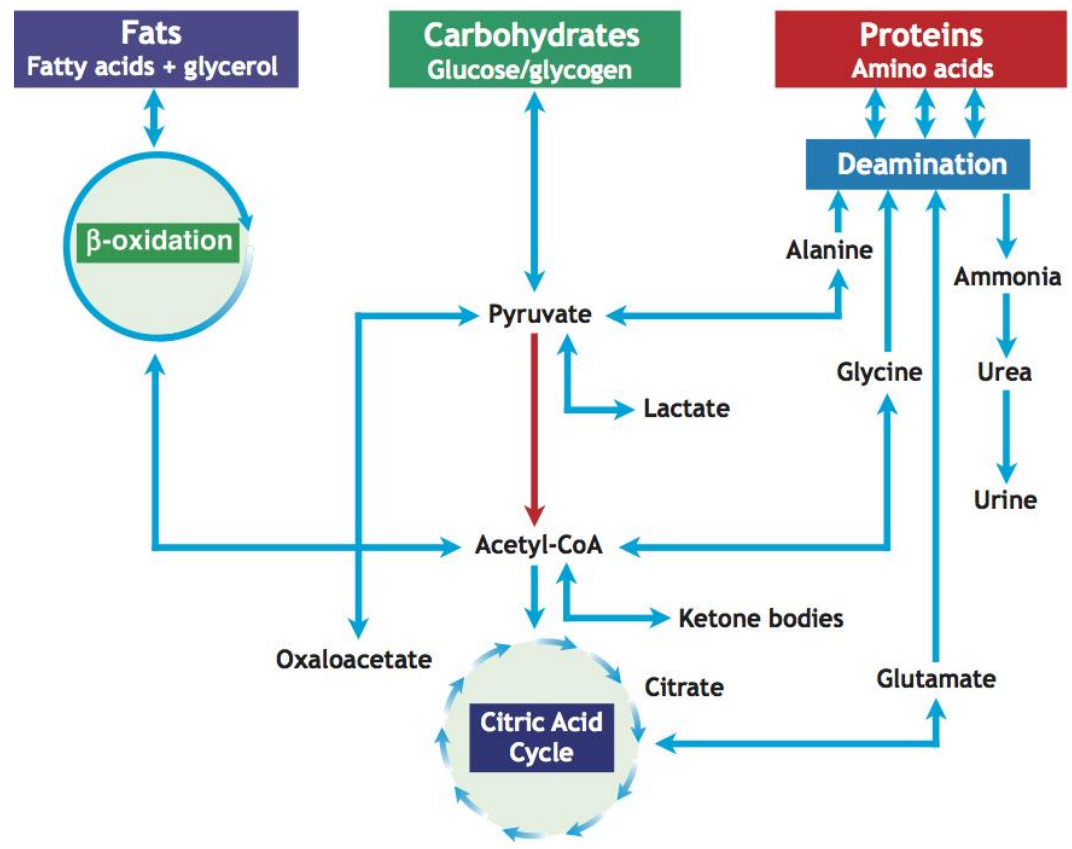
This drawing is the metabolic mill. Like a mill that grinds whatever grain is brought to it, the cycle burns whichever fuel arrives. The three fuel boxes stand across the top, and the cycle sits at the bottom. Protein’s nitrogen leaves on the right as ammonia, then urea, then urine. Its skeletons join the main line at different heights: alanine at pyruvate, glycine lower down and glutamate at the cycle. Acetyl CoA joins oxaloacetate to make citrate, the first molecule of the cycle, and it also has an arrow to ketone bodies.
Most of the blue arrows have two heads, which means those steps run both ways. This is the hub sending traffic out as well as taking it in. The single red arrow, from pyruvate down to acetyl CoA, has only one head.
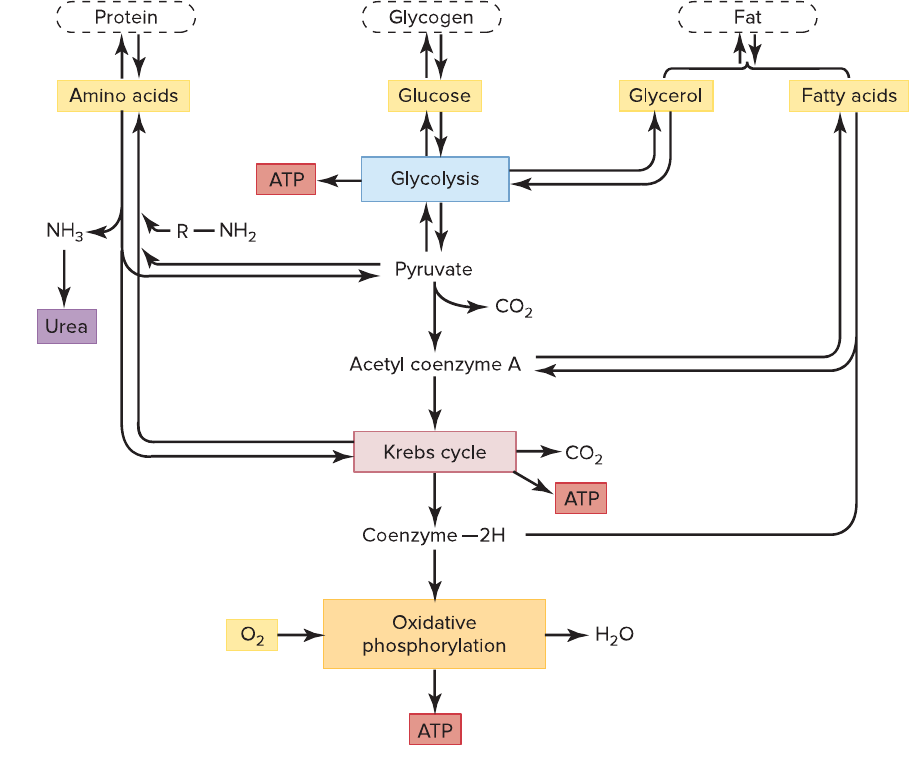
This second drawing tells the same story but adds the stores and the final stage. At the top, protein, glycogen and fat each exchange with their building blocks: amino acids, glucose, and glycerol with fatty acids. Below the Krebs cycle, hydrogen loaded onto carriers (labelled coenzyme 2H) goes to oxidative phosphorylation, the final stage in the mitochondria. There oxygen (O2) is used, water (H2O) is formed and most of the ATP is made. Every pathway in this series of notes lies on this one drawing.
4. What can become what
Because the routes meet and many steps run both ways, one fuel can often be rebuilt into another. Three predominant interconversions stand out.
- Carbohydrates can be converted to fats, a process called lipogenesis, or to nonessential amino acids.
- Fats can be converted to nonessential amino acids.
- Proteins can be converted to carbohydrates or fats.
Each has a simple route. Surplus glucose becomes pyruvate, then acetyl CoA, and acetyl CoA units are joined two carbons at a time into fatty acids. That is why excess carbohydrate is stored as fat. Carbohydrate and fat can both supply keto acids, and a keto acid becomes an amino acid when it receives an amino group by transamination. Proteins split by their amino acids: glucogenic ones can give glucose and ketogenic ones can give fat.
Only some amino acids can be made in this way. The body can make 11 of the 20 amino acids itself, and these are called nonessential. The other 9 are essential, because the body cannot make their keto acids, so they must come from food.
5. The one way door
The red arrow on the mill drawing breaks the pattern of two way traffic. The step from pyruvate to acetyl CoA cannot be reversed, because pyruvate loses a carbon as CO2 and no enzyme can undo that step. This single fact decides what fat can become.
A fatty acid yields nothing but acetyl CoA. Since acetyl CoA can never go back to pyruvate, it cannot travel back up to glucose. A second road to glucose starts from oxaloacetate, the four carbon molecule of the Krebs cycle, but that road is closed too. Each acetyl CoA brings two carbons into the cycle, and two carbons leave as CO2 in the same turn. So no extra oxaloacetate is made that could be spared for glucose.
Only the small glycerol part of a fat can become glucose, because glycerol joins glycolysis above the one way step. In short, glucose can be turned into fat, but fat cannot be turned back into glucose.
6. Fats burn in a carbohydrate flame
Fatty acids also depend on carbohydrate in a second way, because they need it to keep burning. Acetyl CoA can enter the Krebs cycle only by joining oxaloacetate. Oxaloacetate is remade at the end of each turn, but some is steadily lost as intermediates leave the cycle. Its stock is topped up mainly from pyruvate, which means from carbohydrate. The enzyme is pyruvate carboxylase, a ligase, which is an enzyme that joins two molecules using energy from ATP (Enzymes).
When carbohydrate runs short, as in glycogen depletion, starvation or a diet very low in carbohydrate, oxaloacetate runs low. The cycle then slows, and the acetyl CoA arriving from fat cannot all be burned. The liver turns the surplus into ketone bodies, small fuel molecules such as acetoacetate that other tissues can use. So fat needs a steady trickle of carbohydrate to burn completely, which is what the saying fats burn in a carbohydrate flame means.
Two consequences for performance follow. Fat alone generates about one half of the power achieved with carbohydrate as the main aerobic fuel (Fat Catabolism). So depleting muscle glycogen considerably lowers a muscle's maximum aerobic power, because the muscle must then rely mainly on fat. The same principle reappears in McArdle disease, an inherited condition in which muscle cannot use its own glycogen and so also burns fat poorly (McArdle Disease Cause and Mechanism).
7. Alcohol and the full map
Alcohol also carries energy, about 7 kcal per gram, but it is not drawn beside the macronutrients. This is because the body neither needs it nor can store it. The liver oxidises it in two steps to acetate, and each step loads NAD+ with hydrogen to form NADH. The acetate becomes acetyl CoA, so alcohol enters the mill where a fatty acid does. It can be burned or turned into fat, but never into glucose.
The real map of human metabolism is far larger than these drawings. It holds thousands of reactions, with the Krebs cycle near its centre, and the pathways in this series are a deliberately simple sketch of it.
Summary
Summary
Protein is mainly a building material, but its amino acids can be burned once deamination removes their nitrogen, either as ammonia or by handing it to another keto acid. The liver turns the toxic ammonia into urea, which leaves in the urine. Glucogenic skeletons yield pyruvate or Krebs cycle intermediates and can make glucose, but ketogenic ones yield acetyl CoA or acetoacetate and cannot. All three fuels meet at the Krebs cycle, the metabolic mill that turns their energy into ATP and a hub that sends intermediates out to build new molecules. So carbohydrate can become fat or nonessential amino acids, fat can become nonessential amino acids, and protein can become carbohydrate or fat. Because the step from pyruvate to acetyl CoA is one way, fatty acids can never become glucose, and only glycerol can. Acetyl CoA must also join oxaloacetate, which is kept up mainly from carbohydrate, so fats burn in a carbohydrate flame. When glycogen runs out, fat burns incompletely, ketone bodies form and maximum aerobic power falls.