Definition
Every movement you make runs on energy taken from food, and sugar is the fuel the body can reach most quickly. This note follows the first pathway that breaks sugar down, how it earns a small but very fast profit of energy, and how the cell decides how hard to run it.
1. The energy in glucose
Carbohydrate’s main job in the body is to supply energy for cellular work, mostly in the form of glucose, a simple sugar. When glucose is broken down completely, it reacts with oxygen to give carbon dioxide, water and energy, C6H12O6 + 6 O2 → 6 CO2 + 6 H2O + 686 kcal per mole, where C6H12O6 is glucose. Only part of these 686 kcal is captured in ATP, the cell’s energy currency, and the rest escapes as heat (ATP Yield from Glucose).
The equation above describes the complete breakdown of glucose, and oxygen is needed only at its very end, where it collects the hydrogen removed from the fuel. Before that, glucose is broken down in stages (Energy Pathways Overview), and the first stage, glycolysis, frees a small part of the energy with no oxygen at all. That makes carbohydrate the only fuel that can yield ATP without oxygen, because fat releases all of its energy in the later stages that need oxygen. Carbohydrate also helps fat to burn. Its breakdown products keep the Krebs Cycle turning, and fat can only be burned while that cycle runs (Protein and the Metabolic Mill).
2. Three phases, key steps only
Glycolysis means sugar splitting. It is a chain of ten reactions, each run by its own enzyme, and all of them take place in the cytosol, the fluid that fills the cell outside the mitochondria. Together they turn one glucose, with six carbons, into two molecules of pyruvate with three carbons each. The ten steps are easiest to follow as three phases: investment, split and payoff. The pathway works like a small business that invests 2 ATP, earns 4 ATP and keeps a profit of 2 ATP.
In the investment phase the cell spends two ATP to prime the sugar, which makes it more reactive and ready to split. In step 1 the enzyme hexokinase moves a phosphate from ATP onto glucose, making glucose 6-phosphate. The phosphate gives the molecule an electric charge, and the cell membrane does not let charged molecules through. So glucose is now trapped inside the cell. Step 2 only reshapes this molecule. In step 3 the enzyme phosphofructokinase (PFK) adds a second phosphate from another ATP, making fructose 1,6-diphosphate.
In the split phase, step 4 cuts this six carbon sugar into two three carbon molecules. The two halves are not quite the same at first, so step 5 converts one into the other. After step 5 both are 3-phosphoglyceraldehyde. From here on every reaction happens twice for each glucose.
The payoff phase begins at step 6, where each three carbon molecule is oxidised, which means it loses hydrogen. A pair of hydrogens is removed and handed to NAD+, a carrier that picks up hydrogen and so becomes NADH (Hydrolysis, Condensation and Redox). Because step 6 happens twice, glycolysis makes 2 NADH per glucose.
In steps 7 and 10 a phosphate is passed straight from the intermediate molecule to ADP, which makes ATP. This is called substrate level phosphorylation, which means ATP made by passing a phosphate directly from a substrate, the molecule an enzyme works on, to ADP. No oxygen and no electron transport chain are involved. Each of the two steps runs twice and makes 2 ATP, so the payoff is 4 ATP per glucose. The pathway ends with two molecules of pyruvate.
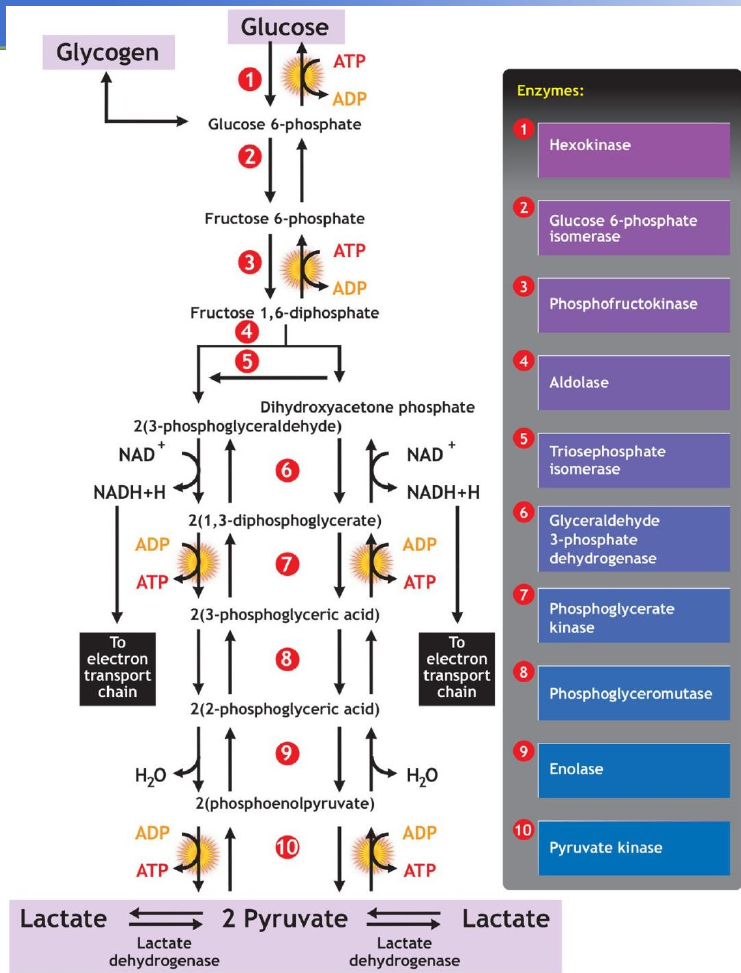
This map is for looking steps up, not for learning by heart. It runs from glucose at the top to 2 pyruvate at the bottom, through ten numbered red circles for the ten reactions. The coloured column on the right lists their enzymes in the same order, from hexokinase (1) to pyruvate kinase (10).
ATP turns into ADP at steps 1 and 3, and ADP turns into ATP at steps 7 and 10, on both sides. Below step 4 the map splits into two parallel columns, one for each half of the sugar. At step 6 NAD+ becomes NADH + H, and black boxes send it to the electron transport chain. Glycogen joins at glucose 6-phosphate, and at the very bottom the enzyme lactate dehydrogenase links pyruvate and lactate in both directions.
3. The balance sheet
Glycolysis makes 4 ATP and spends 2, so it leaves a net gain of 2 ATP per glucose. Splitting ATP releases about 7.3 kcal per mole, so this is 2 times 7.3, or 14.6 kcal per mole of glucose. The other products are 2 NADH and 2 pyruvate. The whole pathway can be written as glucose + 2 ADP + 2 Pi + 2 NAD+ → 2 pyruvate + 2 ATP + 2 NADH + 2 H+ + 2 H2O, where Pi is inorganic phosphate and H+ stands for hydrogen ions.
This is a small return, only about 5 per cent of the energy in the glucose molecule, and about 5 per cent of the ATP that complete breakdown would give. Most of the energy is still locked inside the two pyruvates and the NADH. The value of glycolysis lies in its speed and in not needing oxygen, which is why it is called rapid glycolysis.
Glycogen, the stored form of glucose, can also feed glycolysis. It is broken down to glucose 6-phosphate, a process called glycogenolysis that Glycogen and Blood Glucose explains. A glucose unit from glycogen enters already carrying a phosphate, so it skips the hexokinase step and saves one ATP. So glycolysis from glycogen nets 3 ATP instead of 2.
4. Two fates of pyruvate
Strictly speaking, glycolysis ends at pyruvate, but pyruvate then goes one of two ways. In anaerobic (rapid) glycolysis pyruvate is converted to lactate (Lactate). Step 6 needs NAD+ to collect hydrogen, and without enough oxygen the mitochondria cannot take that hydrogen back off NADH. So pyruvate takes it instead, becoming lactate and freeing NAD+, which lets glycolysis keep running without oxygen.
Lactate is not wasted either. Tissues such as the heart burn it for ATP. A recent study in mice suggests that the heart can even carry lactate straight into its mitochondria, as a commentary shared by Dr Shafat explains (Thome and Arany, 2026). These findings are new and preliminary, and they are still debated.
In aerobic (slow) glycolysis pyruvate enters the mitochondria and is converted to acetyl CoA, a two carbon fuel molecule. Acetyl CoA then passes through the Krebs cycle (Krebs Cycle) and electron transport, which release the remaining energy. The name slow glycolysis therefore covers the whole aerobic route after pyruvate, because the ten steps themselves are the same in both cases.
What decides between the two fates is whether the mitochondria can take up pyruvate and the hydrogen on NADH as fast as glycolysis makes them. When they keep up, pyruvate takes the aerobic route. When glycolysis runs faster, as in an all out sprint, the surplus is turned into lactate.
5. How glycolysis is regulated
Three factors set how fast glycolysis runs. The first is its key enzymes, hexokinase, phosphofructokinase and pyruvate kinase, which run steps 1, 3 and 10. These steps cannot run backwards, so they act like one way valves and are natural control points. A fourth, phosphorylase, releases glucose units from glycogen and so controls how much fuel enters (Glycogen and Blood Glucose). It is the enzyme missing in McArdle disease (McArdle Disease Cause and Mechanism). Of these, phosphofructokinase is the main rate limiting enzyme, the slowest step that sets the pace of the whole pathway (Enzymes). It senses the cell’s energy state. When muscle uses ATP fast, ADP, AMP and Pi build up, and they switch phosphofructokinase on. When ATP is plentiful, ATP itself slows the enzyme down.
The second factor is the level of fructose 1,6-diphosphate, the molecule that phosphofructokinase makes at step 3. When phosphofructokinase speeds up, this molecule builds up and switches on pyruvate kinase at step 10. In this way the end of the pathway speeds up to match the start, so the molecules in between do not pile up.
The third factor is oxygen, because oxygen in abundance inhibits glycolysis. Mitochondria with plenty of oxygen make ATP in large amounts, and that high ATP level holds phosphofructokinase back. So glycolysis speeds up when energy demand outruns the oxygen supply, and slows down when the mitochondria can keep up.
Summary
Summary
Complete breakdown of one mole of glucose releases 686 kcal, and glycolysis is its first stage, ten enzyme steps in the cytosol that need no oxygen. Its first phosphate traps glucose in the cell, and the cell then invests 2 ATP at steps 1 and 3, run by hexokinase and phosphofructokinase, to prime the sugar. Step 4 splits the six carbon sugar into two three carbon halves, and at step 6 each half is oxidised, giving 2 NADH in all. At steps 7 and 10 substrate level phosphorylation passes phosphates directly to ADP, making 4 ATP. The balance is a net 2 ATP, or 14.6 kcal per mole, plus 2 pyruvate, which is about 5 per cent of glucose’s energy, or 3 ATP when the glucose comes from glycogen. Without enough oxygen pyruvate becomes lactate in rapid glycolysis, while with oxygen it becomes acetyl CoA and releases the rest of its energy through the Krebs cycle in slow glycolysis. The pace is set by the key enzymes, above all the rate limiting phosphofructokinase that speeds up as ADP, AMP and Pi rise, and also by fructose 1,6-diphosphate and by oxygen, which slows it. Glycolysis matters because it is the fastest way, and the only way without oxygen, to make ATP from fuel.
References
Thome, T. and Arany, Z. (2026) ‘Lactate takes a shortcut into mitochondria’, Nature. https://doi.org/10.1038/d41586-026-03261-2